MICE-1
 Prisma Electronics
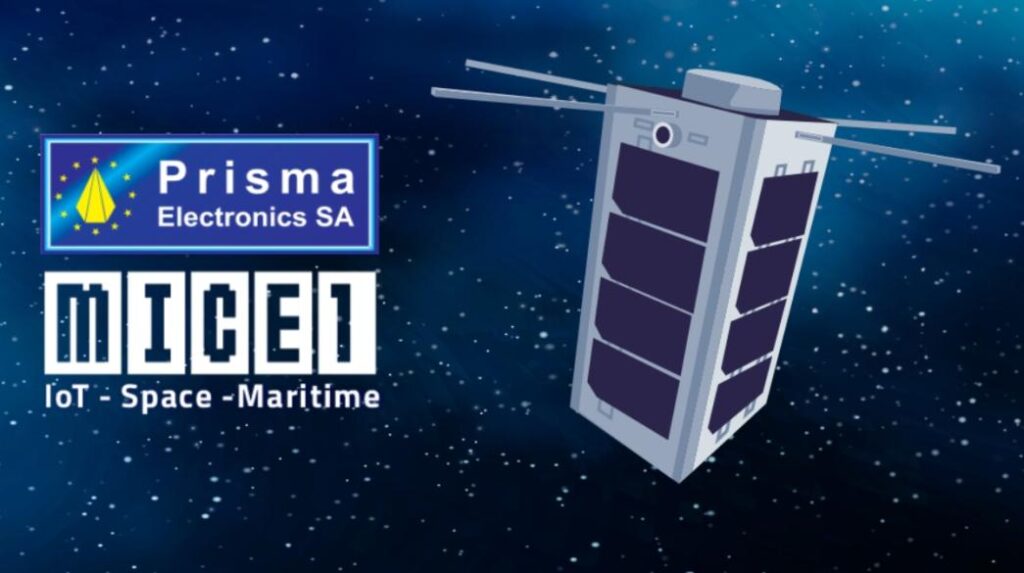
3U CubeSat for maritime AIS tracking and S-band IoT communications, Greece's first nanosatellite dedicated to maritime IoT, launched November 2025.
Technical specifications
- Form factor
- 3U CubeSat
- Mass
- 6 kg
- Orbit
- Sun-synchronous LEO
- Launch date
- 28 November 2025, 18:44 UTC
- Launch vehicle
- SpaceX Falcon 9 (Transporter-15)
- COSPAR ID
- 2025-276DP
- SATCAT No.
- 66775
- Primary payload
- AIS receiver for maritime vessel tracking
- Secondary payload
- S-band IoT transceiver (LAROS platform)
- Program
- ESA Greek CubeSat In-Orbit Validation programme / Greece 2.0 National Microsatellite Program
About
MICE-1 (Maritime Identification and Communication systEm – 1) is a 3U CubeSat designed, built and operated by Prisma Electronics S.A. in Alexandroupolis, Greece, developed with the Democritus University of Thrace, the European Space Agency and the EU Recovery and Resilience Facility under Greece’s National Microsatellite Program (Greece 2.0). It carries two primary payloads: an Automated Identification System (AIS) receiver for space-based vessel tracking in the Mediterranean, and an S-band IoT transceiver that interfaces with Prisma’s proprietary LAROS platform to collect, process and securely relay maritime and remote-infrastructure sensor data beyond terrestrial coverage. MICE-1 launched on 28 November 2025 (18:44 UTC) aboard SpaceX’s Falcon 9 Transporter-15 rideshare mission from Vandenberg Space Force Base into sun-synchronous low Earth orbit, and serves as an in-orbit demonstrator under ESA’s Greek CubeSat In-Orbit Validation programme.
Documentation
No public datasheet yet — request the datasheet / ICD from the supplier.