Promin 1 (Zaarbird)
 Promin Aerospace
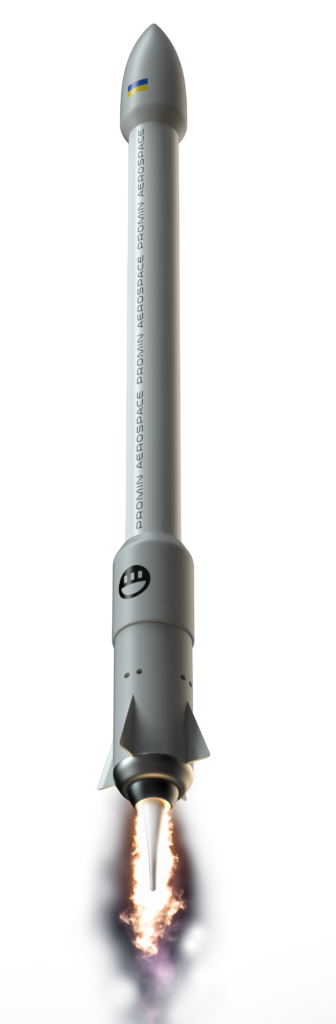
Ultra-light autophagic small-satellite launch vehicle carrying pico/nanosatellite payloads to orbit.
Key figurescomparable across the catalogue
- Mass
- 100 kg
Normalised to common units so this product can be compared with others in its category. The supplier's own wording is below.
As published by the supplier
- Vehicle mass (approx.)
- ~100 kg
- Payload class
- Pico/nanosatellites, target ~0.1-3 kg to LEO (launcher family spans 100-500 kg mass class)
- Propulsion technology
- Autophagic (self-devouring) solid-fuel engine; fuel tank doubles as airframe, gasified and burned in flight with pulsation combustion
- Orbital debris
- Designed to leave no spent stage/tank structure in orbit
- Turnaround time
- As little as ~1 month from order to launch (company target)
- Target launch price
- ~$150,000-$200,000 per launch (early public estimate)
- Development status
- Ground engine/fuel testing since 2021; suborbital test campaign planned from Brunswick, Maine, US
About
Promin 1 (also referred to by the internal name Zaarbird) is Promin Aerospace’s ultra-light orbital launch vehicle built around the company’s proprietary autophagic propulsion technology. Instead of carrying a separate metal or composite fuel tank, the rocket’s solid-fuel propellant grain doubles as the vehicle’s own structural airframe: as the engine burns, it progressively gasifies and consumes the fuel-tank material itself in a pulsation-combustion process, shedding structural mass in flight the way a candle burns down. This ‘self-devouring’ design sharply reduces passive (dead) mass and mitigates the scale-factor penalty that normally makes very small launch vehicles inefficient, allowing Promin 1 to be one of the lightest orbital-class rockets in the world at roughly 100 kg gross liftoff mass.
The vehicle is sized for the pico- and nanosatellite segment, targeting delivery of payloads on the order of a few kilograms to orbit (early public figures cite roughly 0.1-3 kg to LEO, with the company’s broader launcher family spanning a 100-500 kg mass class). Because most of the airframe is consumed during ascent, the design is intended to leave little to no spent-stage debris in orbit, addressing a longstanding sustainability concern for the smallsat launch market. Promin Aerospace states that turnaround from order to launch can be as short as about one month, aimed at underserved customers — research groups, universities, and organizations in countries without national launch capability — who need dedicated, responsive access to orbit rather than waiting for rideshare slots.
Development has proceeded through autophagic engine and solid-fuel combustion ground testing conducted in Ukraine beginning in 2021, including a notable large-scale fuel-combustion test in December 2021 and continued engine test campaigns through 2022 despite the full-scale Russian invasion. The programme has publicly targeted a progression from short-hop/suborbital test flights toward an orbital demonstration, with the company also pursuing launch-site agreements (memoranda of understanding with the Atlantic Spaceport Consortium in the Azores and Spaceport 1 in Scotland) and, more recently, a US-based flight-test campaign from Brunswick, Maine, supported by Promin Aerospace’s US office opened in December 2024.
Documentation
No public datasheet yet — request the datasheet / ICD from the supplier.