Reaction Wheels
 Sinclair Interplanetary (Rocket Lab)
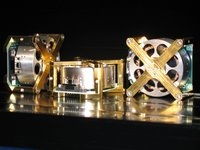
Sinclair Interplanetary offers a range of high-reliability, vacuum-lubricated reaction wheels for picosatellites, nanosatellites, and microsatellites, featuring built-in digital processors for precise control and telemetry.
Typed specifications41 values
Discloses 7 of 10 fields engineers filter by in this category (category median 5).
- Mass
- 120 g datasheet p.1
- Envelope (L×W×H)
- 50 mm x 50 mm x 30 mm datasheet p.1
- Angular momentum storage
- 0.01 N·m·s Nominal · datasheet p.1 0.018 N·m·s peak, at 5 V supply | 0.018 N·m·s max · peak (at 5 V supply) | 0.01 N·m·s nom. · nominal
- Max torque
- 1 mN·m ±1 mNm at 0.01 Nms (at 5 V supply) · datasheet p.1 1 mN·m at 0.01 Nms (at 5 V supply)
- Supply voltage
- 3.4 V min · Nominal · datasheet p.1 8 V max · Maximum | 6 V max · Nominal | 3.4–6 V nominal | 3.4–6 V nom. · Nominal
- Power consumption
- 0.11 W @ 0.005 Nms, steady state · datasheet p.1 1.05 W @ 0.01 Nms, + 1 mNm | 0.25 W @ 0.018 Nms, steady state | 0.11 W 0.005 Nms, steady state (in vacuum) | 1.05 W 0.01 Nms, + 1 mNm (in vacuum) +1
- Data interface
- UART datasheet p.1 I2C I2C/SMBus | other SMBus | I2C
- Operating temperature
- -40 °C min · datasheet p.1 70 °C max | -40–70 °C operating
- Radiation tolerance (TID)
- 20 krad datasheet p.1 20 krad min · >20 krad dose
- Design lifetime
- 10 years on-orbit · datasheet p.1
- Wheels in the unit
- 1 datasheet p.0
- Bearing type
- ball Diamond coated hybrid ball bearings · datasheet p.1
- Random vibration
- 12 g RMS min · >12 gRMS · datasheet p.1
- Flight heritage
- 10 Units total on-orbit on 4 satellites, first launched June 2014 datasheet p.1
- Satellite class
- CubeSat datasheet p.0
- Missions flown
- 10 units total on-orbit on 4 satellites · datasheet p.1
- Drive electronics
- integrated built-in control CPU · datasheet p.1
- Volume
- 0.25 U datasheet p.1
- Control modes
- speed datasheet p.1 torque
- Indicative price
- 20 000 EUR each; +US$2000 for radiation lot-screened parts · datasheet p.1 18 400 EUR each; converted from USD at 0.92
Each value is typed with its unit and measurement condition and cites the datasheet page it was taken from. Nothing is guessed: a field that is absent here has not been published by the manufacturer. machine-extracted ✓ checked by NewSpace Market ✓ manufacturer confirmed by the manufacturer.
As published by the supplier19 lines, in the manufacturer's own wording
- 1 nms microsatellite wheel suitability
- 100 kg Earth-observation missions
- 1 nms microsatellite wheel units on-orbit
- 76 units on 19 spacecraft
- 1 nms microsatellite wheel first launch
- June 2016
- 1 nms GEO wheel features
- Hardened version of heritage 1 Nms wheel, rad-hard parts, shielded enclosure, active mechanism to mitigate deep charging, greatly reduced power consumption
- 1 nms GEO wheel suitability
- High orbits
- 1 nms GEO wheel first flight deliveries
- Q1 2020
- 400 mnms microsatellite wheel optimization
- Torque and radiation hardness
- 400 mnms microsatellite wheel performance equivalent
- 0.4 Nms CMG with 22.5 deg/sec gimbal rate
- 400 mnms microsatellite wheel design for
- High-agility remote sensing or science microsatellites
- 60 mnms microsatellite wheel features
- High-torque motor phase current control electronics in a small package
- 60 mnms microsatellite wheel units on-orbit
- 68 units on 20 spacecraft
- 60 mnms microsatellite wheel first launch
- June 2014
- 30 mnms nanosatellite wheel first launch
- April 2008
- 30 mnms nanosatellite wheel units on-orbit
- 61 units
- 30 mnms nanosatellite wheel fit
- 6U to 12U cubesat
- 10 mnms picosatellite wheel suitability
- Smaller cubesats
- 10 mnms picosatellite wheel units on-orbit
- 10 units on 4 spacecraft
- 10 mnms picosatellite wheel first launch
- June 2014
- 3 mnms picosatellite wheel capacity
- 3 wheels in a 1U Cubesat, 4-wheel pyramid configuration possible
About
Sinclair Interplanetary pioneered high-reliability vacuum-lubricated reaction wheels for picosatellites, nanosatellites, and microsats. There are currently 76 wheels on-orbit, all working well. All of these reaction wheels incorporate a built-in digital processor. They can be commanded over a serial bus to produce a desired speed, momentum, or torque. They report digital telemetry concerning speed, temperature, voltage, current, and other health parameters. The product line includes several models:
1 Nms Microsatellite Wheel: This is the largest wheel, suitable for 100 kg Earth-observation missions. There are currently 76 units on-orbit on 19 spacecraft, with the first launch in June 2016.
1 Nms GEO Wheel: This is a hardened version of the heritage 1 Nms wheel, suitable for high orbits. It uses rad-hard parts, has a shielded enclosure, and employs an active mechanism to mitigate deep charging of the rotor assembly. Power consumption is greatly reduced. First flight deliveries are scheduled for Q1 2020.
400 mNms Microsatellite Wheel: This wheel is optimized for torque and for radiation hardness. It can give performance equivalent to a 0.4 Nms CMG with 22.5 deg/sec gimbal rate at much reduced mass and complexity. Designed for high-agility remote sensing or science microsatellites.
60 mNms Microsatellite Wheel: This wheel packs high-torque motor phase current control electronics into a small package. There are 68 units on-orbit on 20 spacecraft, with the first launch in June 2014.
30 mNms Nanosatellite Wheel: This was the first wheel design and remains the most popular. First launched in April 2008, there are now 61 units on-orbit. Many of these are onboard the University of Toronto SpaceFlight Lab’s GNB series of spacecraft. They fit comfortably into a 6U to 12U cubesat.
10 mNms Picosatellite Wheel: This wheel is ideally suited for smaller cubesats. There are 10 units on-orbit on 4 spacecraft, with the first launch in June 2014.
3 mNms Picosatellite Wheel: This wheel is so tiny that 3 wheels can be carried in a 1U Cubesat. A 4-wheel pyramid configuration is also possible.
Documentation
- 10 mNm-sec wheel 2018b.pdf PDF source: web.archive.org ↗
- 1 Nm-sec wheel 2019a.pdf web.archive.org ↗
- 1 Nm-sec GEO wheel 2020a.pdf web.archive.org ↗
- 400 mNm-sec rad-hard wheel 2019a.pdf web.archive.org ↗
- 60 mNm-sec wheel 2019a.pdf web.archive.org ↗
- 30 mNm-sec wheel 2019a.pdf web.archive.org ↗
Need the full ICD, test reports or a specific revision? Ask the supplier directly.