Sterna
 EDGX
EDGX
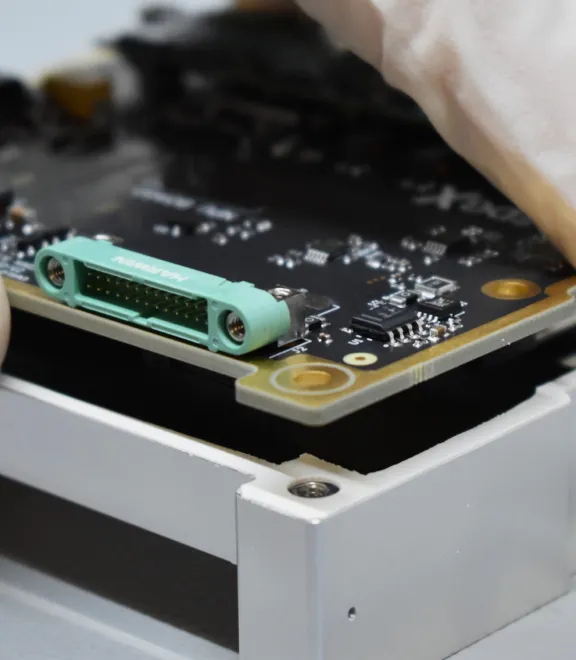
Sterna is a flight-proven, space-hardened edge computing platform designed to provide supercomputing capabilities in orbit for ambitious satellite payloads.
Typed specifications65 values
Discloses 10 of 13 fields engineers filter by in this category (category median 5).
- Processor
- 8-Core ARM Cortex-A78AE datasheet p.2
- Mass
- 350 g datasheet p.2 350 g w/o harness
- CPU clock
- 2 000 MHz datasheet p.2 1 000 MHz 1024 CUDA Core Ampere GPU | 600 MHz 2x NVDLA 2.0 NPU | 2 000 MHz ARM Cortex-A78AE CPU
- Envelope (L×W×H)
- 96 x 90 x 30 mm datasheet p.2
- RAM
- 16 384 MB datasheet p.2 16 384 MB NVIDIA Jetson Orin NX 16GB
- Operating system
- A custom, space-hardened Linux operating system. datasheet p.2 Linux custom, space-hardened Linux operating system; Optimized Linu… | FreeRTOS health monitoring and logging | Optimized Linux OS ( Yocto / JetPack 6) | FreeRTOS
- Supply voltage
- 15–30 V datasheet p.2 15–30 V normal | 23–30 V Super
- Power consumption
- 15 W nom. · avg · datasheet p.2 15 W avg | 30 W peak | 45 W super | 30 W max · peak +1
- Data interface
- CAN datasheet p.2 Ethernet 1x 10/100 Mbps ETH for redundant C&C (Opt. B); 1x Gigabit Eth… | other 1x 2-Lane MIPI CSI-2 (Opt. B) | CAN 1x CAN for C&C of Sterna (+1x CAN redundant, Opt. A) | PCIe 1x PCIe Gen4 x4 with SRIS clocking (Opt. A) +13
- Operating temperature
- -20–65 °C datasheet p.2 -20–65 °C operational range | -25–70 °C qualified in a Thermal Vacuum Chamber (TVAC) for an operation… | -25–70 °C
- Radiation tolerance (TID)
- 30 krad datasheet p.2 30 krad min · components selected for a minimum TID resilience of 30 kRad
- Processor architecture
- GPU / NPU 1024 CUDA Core Ampere GPU; 2x NVDLA 2.0 NPU · datasheet p.2 ARM Cortex-A 8-Core ARM Cortex-A78AE
- Board format
- PC/104 form-factor PC/104 (mounting) · datasheet p.2
- Flight software support
- SpaceFeather software ecosystem: Real-Time Supervisor, Application Framework for containerised applications (Docker), Optimized Linux OS (Yocto / JetPack 6) datasheet p.2
- Radiation and fault mitigation
- other Radiation Shielding actively mitigates radiation-induced func… · datasheet p.2 other Actively mitigates radiation-induced functional interrupts
- Connector
- Harwin Gecko-SL datasheet p.2 Harwin Gecko-SL | Samtec ERF8
- Survival temperature
- -40–80 °C datasheet p.2 -40–80 °C non-operational range
- Random vibration
- 14.14 g RMS product page
- Satellite class
- CubeSat engineered to provide compute power to CubeSats and SmallSats… · datasheet p.2 SmallSat
- Cores
- 8 ARM Cortex-A78AE · datasheet p.2
- AI performance
- 157 TOPS max · deliver up to 157 TOPS of in-orbit compute · datasheet p.2
- Data interface speed
- 100 Mbps 10/100 Mbps ETH for redundant C&C · datasheet p.2
Each value is typed with its unit and measurement condition and cites the datasheet page it was taken from. Nothing is guessed: a field that is absent here has not been published by the manufacturer. machine-extracted ✓ checked by NewSpace Market ✓ manufacturer confirmed by the manufacturer.
As published by the supplier13 lines, in the manufacturer's own wording
- Computational power
- Up to 157 TOPS (NVIDIA Jetson Orin NX 16 GB)
- Baseline computational power
- 100 TOPS (NVIDIA Jetson Orin NX 16 GB)
- Scalable power
- 10 W–40 W (Jetson Orin Nano or NX)
- Power presets
- 10 W, 15 W, 25 W, 40 W
- Launch compatibility
- Falcon 9, Ariane 6, Vega-C
- Random vibration test
- 14.14 g RMS
- Quasi-static sine burst test
- 21.25 g
- Operational temperature range (in vacuum)
- -20°C to +65°C
- Non-operational tvac cycles
- -40°C to +80°C
- Operational tvac cycles
- -25°C to +70°C
- Radiation system-wide qualification
- 200 MeV protons
- TID tolerance
- Beyond 30 krad(Si)
- SEE performance destructive LET threshold
- 38 MeV·cm2/mg
About
Sterna is an edge computing platform built to power ambitious satellite payloads by shifting intelligence from Earth to orbit. It offers raw computational power, allowing for immediate action on critical intelligence. The platform can achieve up to 157 TOPS by deploying the NVIDIA Jetson Orin NX 16GB, with a baseline of 100 TOPS in orbit, and a software unlock for power-rich systems to reach 157 TOPS. It features scalable power from 10W to 40W, allowing users to tailor the power-to-performance ratio by equipping either a Jetson Orin Nano or NX. Granular software control is available through stable, enforced presets (10W, 15W, 25W, 40W) or custom profiles. Sterna supports the full NVIDIA Ecosystem, including CUDA, TensorRT, and cuDNN, enabling a seamless “lab-to-launch” workflow for deploying AI models developed on Earth directly onto satellites. The system is engineered for mission certainty and has been validated against extreme conditions. It is launch-ready and compatible with Falcon 9, Ariane 6, and Vega-C. It has survived a 14.14 g RMS random vibration test and 21.25 g quasi-static sine burst, with 100% operational health post-test. Thermal resilience includes an operational range of -20°C to +65°C in the vacuum of space, and it is TVAC qualified for non-operational cycles from -40°C to +80°C and operational cycles from -25°C to +70°C. Radiation tolerance is ensured through system-wide qualification with 200 MeV protons, component reliability with TID tolerance beyond 30 krad(Si) and robust SEE performance (destructive LET threshold of 38 MeV·cm2/mg), and data protection through targeted irradiation testing on critical components like the SSD. Sterna operates with the SpaceFeather™ Software ecosystem, which includes an autonomous supervisor on a dedicated chip for hardware and software monitoring, ensuring system integrity and reliable command and control. The containerised application framework allows for in-orbit application management and updates, with a custom SDK optimizing and compressing Docker image updates to minimize uplink costs. Radiation Shielding Software provides hierarchical fault detection, isolation, and recovery (FDIR) across the software stack to counter radiation-induced events, reducing system downtime and ensuring high availability.
Documentation
Need the full ICD, test reports or a specific revision? Ask the supplier directly.