XI-IV
 University of Tokyo
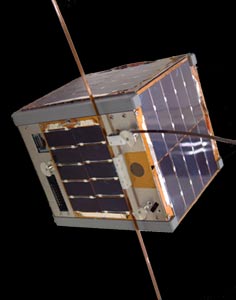
The world's first CubeSat to achieve successful on-orbit operation, and the longest-operating CubeSat in history.
Technical specifications
- Form factor
- 1U CubeSat, 10x10x10 cm
- Mass
- 1.0 kg
- Payload
- Onboard camera for Earth imaging; COTS-based bus with cross-check fault redundancy
- Communications
- 80 mW beacon at 436.8475 MHz, AX.25 store-and-forward
- Launch
- Rockot, 30 June 2003, Plesetsk Cosmodrome
- Significance
- World's first CubeSat to achieve successful on-orbit operation; longest-operating CubeSat on record
About
XI-IV (CubeSat-OSCAR 57 / CO-57) was developed by the University of Tokyo’s Intelligent Space Systems Laboratory (ISSL) and launched June 30, 2003 on a Russian Rockot from Plesetsk Cosmodrome, alongside Stanford University’s QuakeSat and several other picosatellites. It became the world’s first CubeSat to achieve successful on-orbit operation, proving that a functional satellite bus could be built almost entirely from low-cost commercial off-the-shelf (COTS) components rather than expensive space-qualified parts — a demonstration that helped catalyze the modern smallsat/CubeSat industry. The 1U spacecraft carried an onboard camera for Earth imaging and used a “cross-check” fault-redundancy system to mitigate radiation effects. XI-IV remained operational for more than two decades, making it recognized as the longest-lived CubeSat on record.
Documentation
No public datasheet yet — request the datasheet / ICD from the supplier.