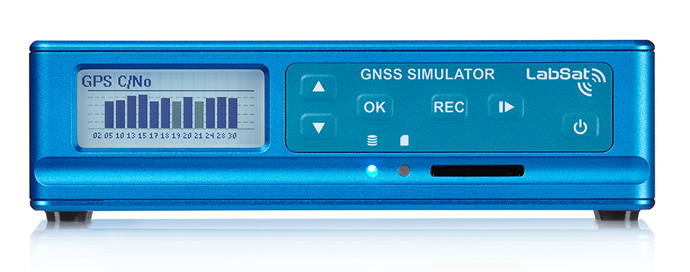

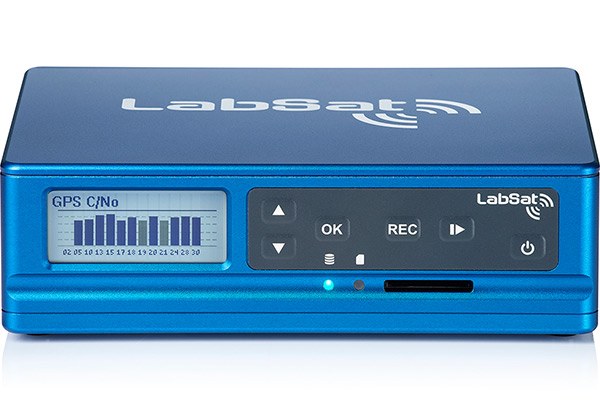
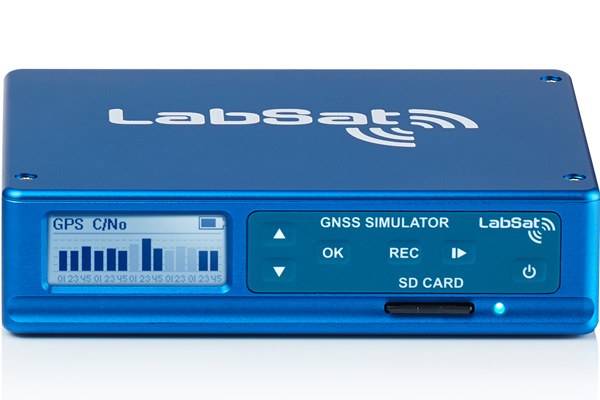
Compact, portable multi-constellation GNSS record-and-replay simulator for testing and developing products with satellite navigation chipsets.
LabSat 3
Compact, portable multi-constellation GNSS record-and-replay simulator for testing and developing products with satellite navigation chipsets.
Description
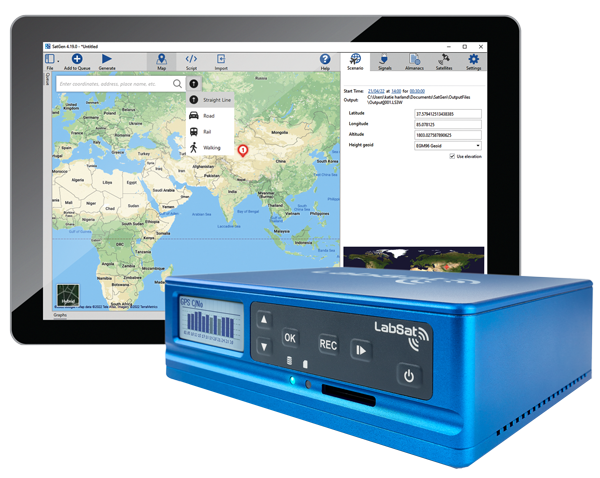
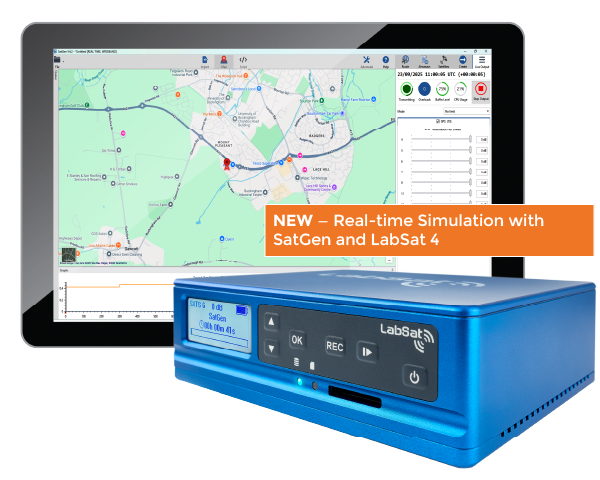
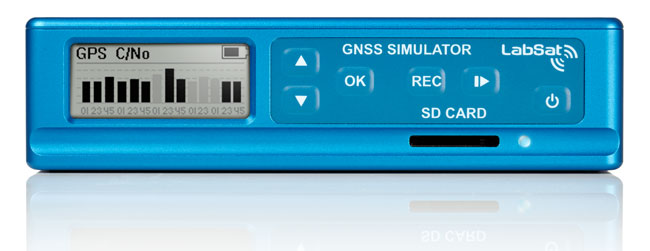
LabSat 3 is Racelogic's compact, battery-powered multi-constellation GNSS signal record-and-replay system for testing and developing devices incorporating satellite navigation chipsets. It receives RF signals from a standard satellite antenna and, instead of computing a position fix, digitises and stores the raw satellite signals at high bandwidth onto a removable SD card or USB hard drive. The recorded data can then be replayed as an RF output connected to the antenna input of a device under test, which will track satellites as though travelling the original recorded path, enabling repeatable, real-world bench testing without costly field trials. It supports GPS L1, GLONASS G1, BeiDou B1, QZSS L1, Galileo E1 and SBAS (WAAS, EGNOS, GAGAN, MSAS, SDCM) signals, with up to 3 constellations and 8 simultaneous signals across a 9.66 MHz bandwidth, using 1 or 2 bit (I&Q) quantisation. It is fully standalone, requiring no PC or specialist training, and ships with a free library of pre-recorded and simulated files. A developer API allows custom software controllers to be built. LabSat 3 can be mains powered or run on an internal battery for up to 2 hours, and can log external CAN, RS232 or digital data alongside GNSS signals, synchronised to within 60 nS, with an embeddable 1 PPS signal from an internal GPS receiver. When paired with SatGen simulation software, users can draw custom routes on Google Maps to generate RF scenario files with user-defined velocity, heading, height, time, date and dynamics, and can import KML/NMEA files and automatically or manually defined almanacs. LabSat 3 is available in six versions from single-constellation replay-only to triple-constellation record & replay, factory-upgradeable between versions, with an optional OCXO oscillator upgrade over the standard TCXO. Accessories include a GNSS test enclosure, scenario hard drive, locking expansion connector, expansion connector adapter, active/passive GPS antennas, USB 3.0 card reader, SD cards, battery charger and internal battery.
Specifications
| Constellations | GPS/Galileo/SBAS/QZSS, GLONASS, or BeiDou |
|---|---|
| Output signal level | Adjustable -73 dBm to -103 dBm |
| RF channels | 1, 2 or 3 (model dependent*) |
| RF constellation centre frequencies | 1575.420 MHz (GPS L1, Galileo E1, SBAS and QZSS); 1602.00 MHz (GLONASS L1); 1561.098 MHz (BeiDou B1) |
| Number of satellites observed | All in view |
| Sampling frequency | 16.368 MHz |
| Bandwidth | 9.66 MHz |
| Quantisation | 1 and 2 bit |
| Data format | I & Q |
| Additional logging | 2x CAN, RS232 or Digital (1x CAN, RS232 or Digital for single constellation model with upgrade) |
| Removable battery pack | Yes |
| Media storage included | 1 TB USB HDD, 32 GB SD Card |
| Active antenna voltage supply | 2.8 to 3.3 V |
| Reference oscillator accuracy | TCXO ± 2.5; OCXO ± 0.3 ppm** |
| Reference oscillator aging | TCXO ±1; OCXO ± 0.3 ppm/year** |
| Reference oscillator stability | TCXO ±0.05; OCXO ± 0.05 ppm/ °C** |
| Operating voltage | 8 V to 30 V DC |
| Dimensions | 167 mm x 128 mm x 43 mm |
| Mass | 960 g (910 g without battery) |