LabSat 4
 LabSat
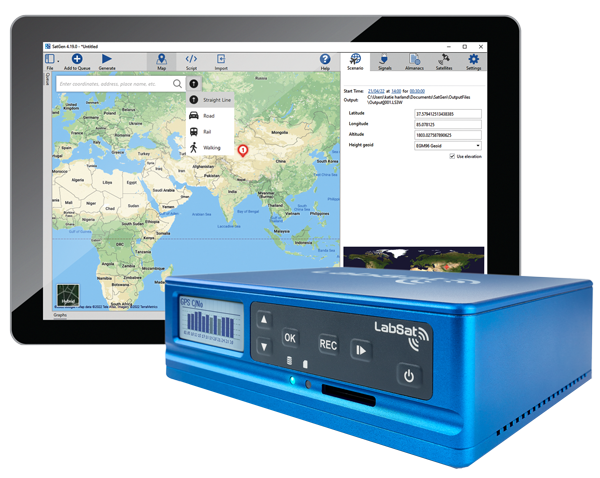
The LabSat 4 is a compact, portable, and cost-efficient GNSS Record & Replay simulator offering multi-constellation and multi-frequency capabilities with up to 12-bit quantisation and three individually configurable RF channels.
Key figurescomparable across the catalogue
- Mass
- 1.45 kg
- Power
- 8 W
- Largest dimension
- 167 mm
Normalised to common units so this product can be compared with others in its category. The supplier's own wording is below.
As published by the supplier
- Constellations
- GPS L1, L2, L5; Galileo E1, E5a/b, E6; GLONASS G1, G2, G3; BeiDou B1, B2a/b, B3; QZSS L1, L2, L5, L6; NavIC L1, L5, S-Band; SBAS L1, L5; Pulsar X1, X5. Further signals in the upper and lower L band as well as the S band can be configured with the web interface. Bespoke requirements like Iridium & Sirius XM radio frequencies are available on request.
- Nominal output signal level
- -73 dBm/MHz @ 0 dB Variable attenuator provides between +20 dB and –69 dB of adjustment during replay
- RF channels
- 3
- RF channel centre frequencies
- Selectable
- Number of satellites observed
- All in view
- Bandwidth
- Variable 10 - 60 MHz per channel
- Sampling frequency
- Automatically adjusted to suit Bandwidth 10 – 61 MHz
- Quantisation
- 1, 2 bits I&Q (LabSat 4 Lite) 1, 2, 4 bits I&Q (LabSat 4 Core) 1, 2, 4, 8, 12 bits I&Q (LabSat 4)
- Data format
- I & Q
- Additional logging
- 2x CAN channels, 4x Digital channels, 1x RS232 channel, 1x CAN-FD (Not available for LabSat 4 Lite)
- User defined simulation capability
- Yes, through optional Simulation Software license.
- Storage
- 4 TB SSD (LabSat 4 Lite & LabSat 4 Core), 7 TB SSD (LabSat 4) All versions come with a 8 GB SD Card (SD card for firmware upgrades only) and removable battery pack
- Data transfer
- High-speed data transfer to and from SSD via Gigabit Ethernet
- Active antenna voltage supply
- 4 - 4.5 V
- Reference oscillator
- OCXO, Temperature Stability ± 0.05 ppm, Frequency Stability ± 0.3 ppm over first year TCXO, Temperature Stability ± 0.05 ppm, Frequency Stability ± 1 ppm over first year
- Operating voltage
- 8 V to 30 V DC
- Operating temperature
- 50°C ambient
- Dimensions
- 137 mm x 167 mm x 52 mm
- Mass
- 1.45 kg with battery and SSD
About
The LabSat 4 is an advanced GNSS Record & Replay simulator designed for comprehensive testing of GNSS devices. It provides exceptional performance while maintaining portability and cost-efficiency. The system supports multi-constellation and multi-frequency recording and replaying of GNSS signals, including those in the Upper and Lower L-Band, SBAS, and Commercial differential services. It features up to 12-bit quantisation, a variable bandwidth of 10–60 MHz, and three individually configurable RF channels. Users can create custom scenarios for simulated testing using the SatGen Simulation Software, which can also be streamed in real-time with live time/date via LabSat 4. The device offers multi-system synchronisation for dual antenna testing and an API for automating test programmes and integrating with wider test setups. It can record additional signals synchronised to the GNSS input, such as dual-CAN, CAN-FD, RS232, and digital signals. Testing can be conducted (direct RF connection) or radiated (wireless transmission via an antenna). Efficient file management is achieved through high-speed data transfer via Gigabit Ethernet and USB 3. The LabSat 4 is available in three models: LabSat 4 Lite, LabSat 4 Core, and LabSat 4, with upgrade paths between them. All models can replay legacy LabSat 3 Wideband scenarios. It supports both Record & Replay and Replay Only functionalities. The system is designed for realistic, reliable, and repeatable testing, capturing challenging conditions like low signal strength, multipath effects, interference, and spoofing attacks. It is user-friendly, compact, battery-powered, and offers plug-and-play operation with sample scenarios. Applications include Aerospace & Drone GNSS testing, Automotive & AV GNSS testing, Agriculture, IoT, and End-of-Line (EOL) testing. The LabSat 4 supports GPS L1, L2, L5; Galileo E1, E5a/b, E6; GLONASS G1, G2, G3; BeiDou B1, B2a/b, B3; QZSS L1, L2, L5, L6; NavIC L1, L5, S-Band; SBAS L1, L5; and Pulsar X1, X5, with further signals configurable via the web interface and bespoke requirements like Iridium & Sirius XM radio frequencies available on request. It also features Manual Gain Control for precise signal fidelity and a web-based user interface for full control and customisation.
Documentation
Need the full ICD, test reports or a specific revision? Ask the supplier directly.