ANT61 Beacon S
 ANT61
ANT61
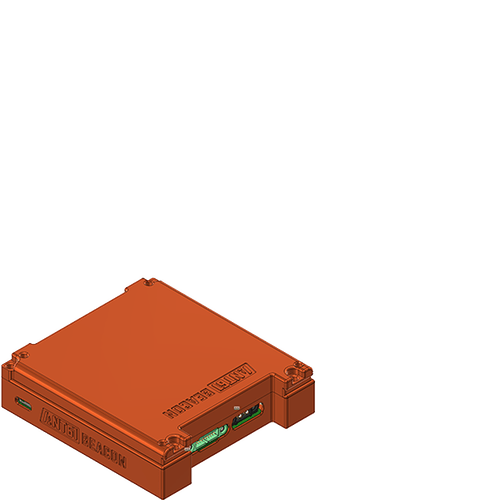
0.25U independent satellite recovery and telemetry module, 375 g, with its own battery, GNSS and two-way Iridium link; TRL-9 since February 2024.
Typed specifications28 values
Discloses 2 of 12 fields engineers filter by in this category (category median 5).
- Mass
- 375 g datasheet p.5 375 g Without cables
- Envelope (L×W×H)
- 25 mm max · height · datasheet p.5 95.9 mm max · length | 90.2 mm max · width
- Supply voltage
- 3.5 V min · datasheet p.5 36 V max
- Power consumption
- 4.2 W min · Charging power consumption · datasheet p.9 5 W max · Charging power consumption
- Data interface
- SPI datasheet p.2 CAN CAN-FD | RS-422 USART | I2C | RS-485 USART +1
- Operating temperature
- -40 °C min · datasheet p.5 70 °C max
- Design lifetime
- 6 years datasheet p.5 6 years LEO
- Lead time
- 12 months product page
- Export status
- ITAR-free made in Australia, non-ITAR · datasheet p.2
- Connector
- USB-C datasheet p.11 SAMTEC-ESQ-126-39-G-D 104-pin connector (PC/104 compatible) | G125-2242096F1 20-pin cable connector | Harwin Datamate 2-coax contact Antenna connection | Harwin M80-FC305F1-02 Antennas +1
- Board format
- PC/104 datasheet p.5
Each value is typed with its unit and measurement condition and cites the datasheet page it was taken from. Nothing is guessed: a field that is absent here has not been published by the manufacturer. machine-extracted ✓ checked by NewSpace Market ✓ manufacturer confirmed by the manufacturer.
As published by the supplier22 lines, in the manufacturer's own wording
- Data volume
- 2.2 MB
- Size class
- 0.25U
- Mass
- 375 g (without cables)
- Dimensions
- 25.0 x 90.2 x 95.9 mm (+/- 0.2 mm)
- Lead time
- 12 weeks
- Operating temperature
- -40 to +70 C
- Shock
- 10 g
- Voltage on power line
- 3.5 to 36 V
- Highest supported orbit
- 700 km
- Design life in LEO
- 6 years
- Operating power consumption
- 0 W (runs from internal battery under normal operation)
- Charging power consumption
- 4.20 to 5.0 W
- Transmit frequency
- 1,616.0 to 1,626.5 MHz
- Receive frequency
- 1,525.0 to 1,626.5 MHz
- RF power output
- 0.5 W average, 1.5 W peak
- Max antenna gain
- 3 dBi
- Interfaces
- USART (RS-232/RS-422/RS-485), CAN-FD, SPI, I2C
- Encryption
- AES 256-bit hardware encryption
- Compatibility
- CubeSat, PC/104 corner hole pattern and connector placement, Pumpkin stack
- Maturity
- TRL-9 since February 2024
- Export status
- Made in Australia, non-ITAR
- Availability
- Available
About
The Beacon is designed to provide a way to restore the normal operations of a satellite in the event of partial failure or anomaly. It independently collects and transmits satellite health data (telemetry), primarily for anomaly root cause analysis. The device has an independent power supply (batteries), an attitude determination system and a GNSS module for precise orbital parameter estimation, and provides a two-way continuous connection to mission control.
The Beacon lets the satellite operations team receive a constant stream of telemetry. It has been specifically designed to function during operational anomalies and outside the normal operating conditions for LEO satellites, providing a backup communication system that can be used for critical satellite firmware updates and for regaining control of the satellite.
Features include real-time 24/7 telemetry independent of orbital position or attitude control, operation for up to one week after main satellite bus failure, tolerance of micro-debris collision, support for all common satellite internal networks (USART with RS-232/RS-422/RS-485, CAN-FD, SPI, I2C), direct connection to satellite components, command relay to the onboard computer, and firmware updates for microcontrollers and OS-based OBCs. All communication packets to and from the satellite bus are hardware-encrypted with AES 256-bit, and commands remain cryptographically opaque to ANT61 and intermediaries.
Beacon is made in Australia, which means light-weight export controls (non-ITAR) and no separate spectrum licence for data exchange, as it uses inter-satellite links with the RF licence held by the constellation operator (Iridium).
Documentation
- 6981ef31a138f8484b962dd8_ANT61 Beacon S Rev I Datasheet (1).pdf PDF source: cdn.prod.website-files.com ↗
Need the full ICD, test reports or a specific revision? Ask the supplier directly.