DRO – Direct Resonance Oscillator
 SpaceForest
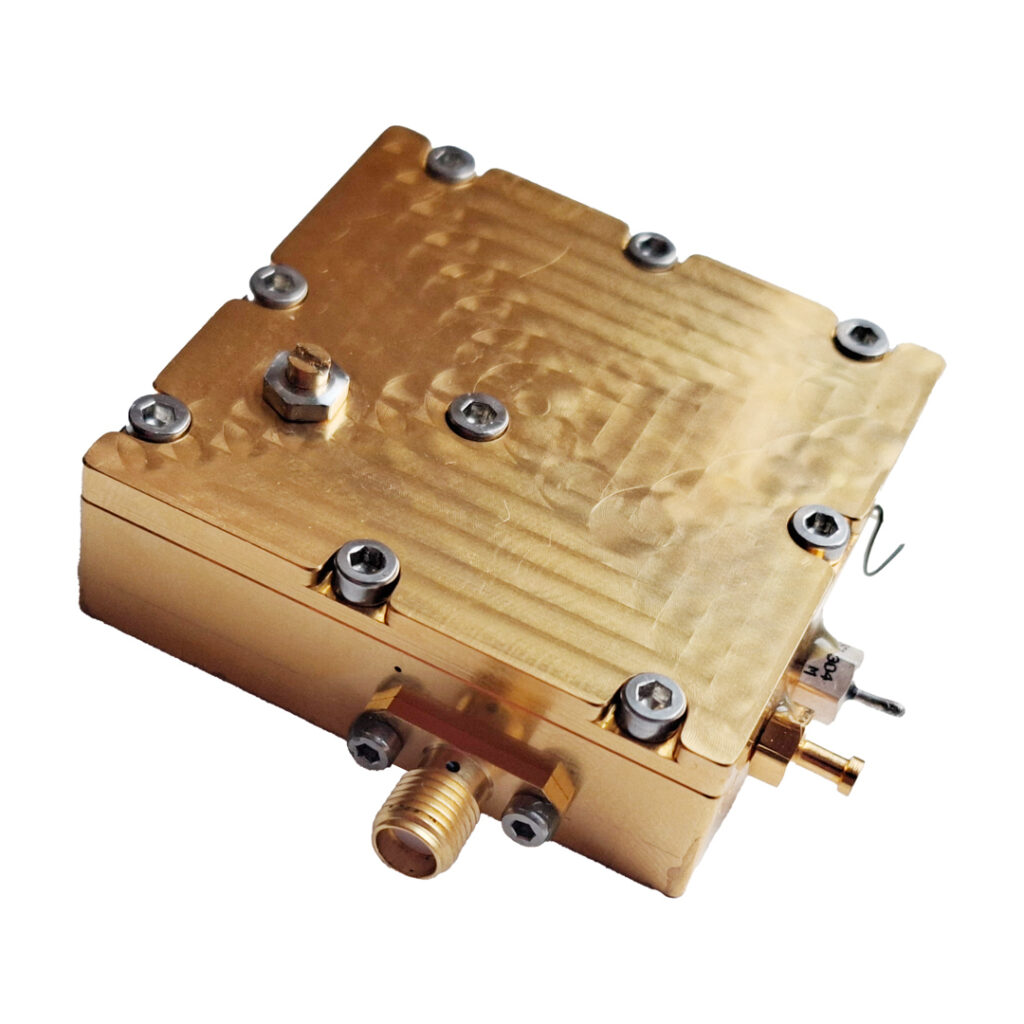
The Direct Resonance Oscillator (DRO) is a microwave oscillator designed to generate stable high-frequency signals with excellent frequency stability, high output signal power stability, and low phase noise.
Key figurescomparable across the catalogue
- Mass
- 0.07 kg
- Power
- 1.2 W
- Largest dimension
- 58 mm
Normalised to common units so this product can be compared with others in its category. The supplier's own wording is below.
As published by the supplier
- Frequency range
- 2.8 GHz – 18 GHz (other ranges available upon request)
- Initial frequency accuracy
- ±10 ppm (typical value; lower values possible after individual analysis)
- Phase noise @ 10 khz offset
- -90 dBc/Hz @ 15.3 GHz (guaranteed value)
- Phase noise @ 100 khz offset
- -110 dBc/Hz @ 15.3 GHz (guaranteed value)
- Supply voltage
- 8.7 V – 15 V DC
- Current consumption
- max. 80 mA
- Operating temperature
- -15°C to +45°C (extendable to -40°C to +80°C)
- Storage temperature
- -55°C to +125°C
- Stability over the full temperature range
- ±50 ppm (lower values possible after individual analysis)
- Dimensions
- 58 mm x 58 mm x 24 mm
- Mass
- 70 g
- RF connector
- SMA
About
The Dielectric Resonator Oscillator (DRO) is a microwave oscillator designed to generate stable high-frequency signals for industrial, communication, and laboratory applications. Its key advantages include excellent frequency stability, high output signal power stability, and low phase noise, making it ideal for systems requiring precise and reliable signals. Unlike traditional oscillators, the DRO does not require an external reference signal generator to maintain output frequency stability, which simplifies system design and enhances reliability. With its low phase noise, the DRO is perfect for applications such as telecommunications, radar, and research, where signal clarity is critical. The DRO offers a compact, high-performance solution for stable high-frequency signal generation across a wide range of demanding applications. Key features include high stability, minimizing frequency variation over the full temperature range without a reference signal; low phase noise, optimized for demanding applications like telecommunications; environmental resistance, with a robust design allowing operation across a wide temperature range and resistance to significant radiation and mechanical stress, making it suitable for space conditions; output power greater than +10 dBm over its entire operating range; and a compact design with small size and weight suitable for airborne and space systems. Applications include telecommunications for stable signal generation in transceiver systems, industrial control and measurement systems, research laboratories requiring precise frequencies, and radar systems as a reference signal source.
Documentation
No public datasheet yet — request the datasheet / ICD from the supplier.