Gyroscope Sensor for Measuring Angular Velocity Vector Projections 1
 Glavkosmos
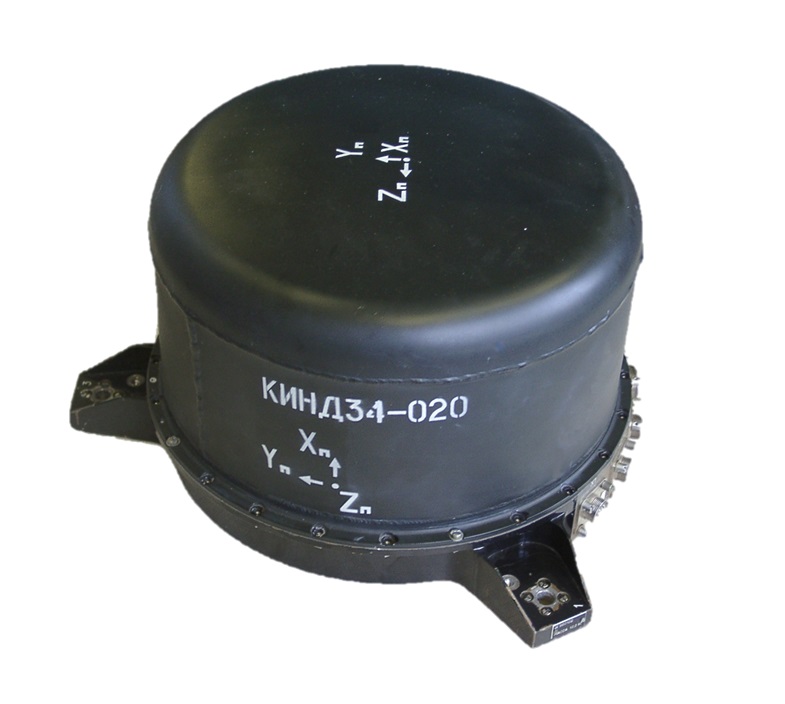
A redundant, free-form gyroscopic angular velocity vector meter designed for spacecraft orientation and stabilization control systems, measuring angular increments on four sensitive axes.
Key figurescomparable across the catalogue
- Mass
- 12.9 kg
- Power
- 69 W
- Design life
- 15 years
- Lead time
- 18 months
Normalised to common units so this product can be compared with others in its category. The supplier's own wording is below.
As published by the supplier
- Purpose
- Measurement of angular increments (rate integral) on sensitive axes of four measurement channels and transmission of that information to the object’s control system.
- Year of release
- 1996
- Design life
- 15 years
- Lead time
- 18 months
- Flight qualification of the product
- Yes
- Brief history of flight qualification
- First launch in 1999. Further operation as a part of several SC.
- Possibility to adapt the product to customer requirements
- Yes
- Measured angular velocity range
- 0.4◦/s
- Nominal certified value of scale factor (information impulse value)
- (0.30-0.45) arc second
- Random component of the deviation of the ir zero signal, independent of overload, in continuous start-up up to 24 hours
- 0.003 ◦/h
- Mass
- 12.9 kg
- Maximum value of the ir zero signal, independent of overload, per module
- 3.0 ◦/h
- Noise component (1 rms) of the ir output signal of the device on a stationary ground at the averaging time from 0.1 to 10 s
- 0.15 arc second
- Energy consumption of the device in the steady-state thermal state of 4 ir at a temperature of heat-absorbing surface of the satellite from 5 to 30˚c
- 69 W
- Power supply voltage
- 27 V
- Precision readiness (from the thermal readiness state, from the moment of switching on the IR)
- 180 min
About
The Gyroscope Sensor for Measuring Angular Velocity Vector Projections 1 is a redundant, free-form gyroscopic angular velocity vector meter intended for spacecraft orientation and stabilization control systems. Its primary purpose is to measure angular increments (rate integral) on the sensitive axes of four measurement channels and transmit this information to the object’s control system. The device is a sealed monoblock, incorporating electronic and optoelectronic modules, a block of four sensitive elements of a fiber-optic gyroscope, and four sensitive elements of a pendulum quartz accelerometer. It also includes a thermal control system and a vibration protection system. The product was released in 1996 and has a guaranteed service life of 15 years. It is flight-qualified, with its first launch in 1999 and subsequent operation as part of several spacecraft. The product can be adapted to customer requirements.
Documentation
No public datasheet yet — request the datasheet / ICD from the supplier.