Gyroscope Sensor for Measuring Angular Velocity Vector Projections-4
 Glavkosmos
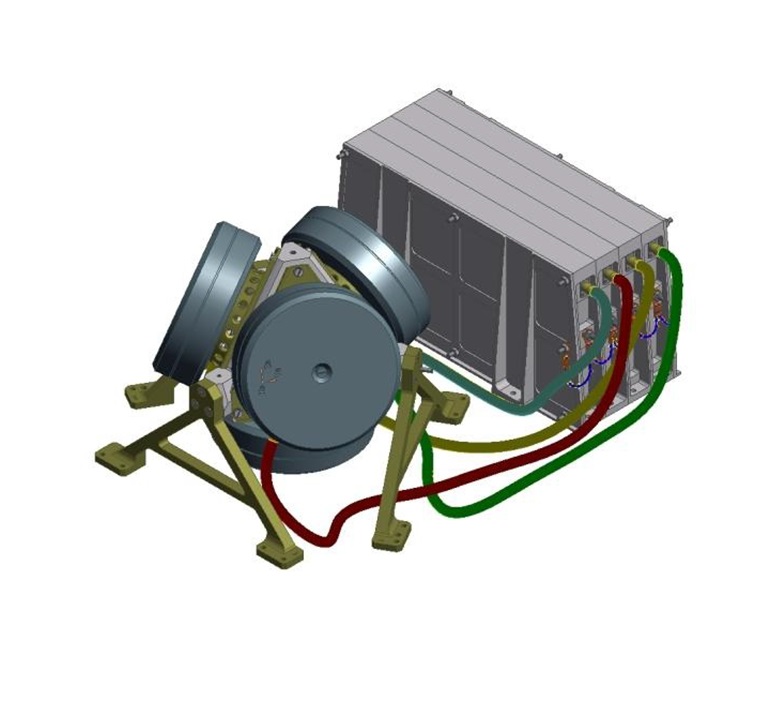
A redundant, free-form gyroscopic angular velocity vector meter designed for spacecraft orientation and stabilization control systems, featuring four independent measurement channels.
Key figurescomparable across the catalogue
- Mass
- 13 kg
- Design life
- 17 years
Normalised to common units so this product can be compared with others in its category. The supplier's own wording is below.
As published by the supplier
- Purpose
- Measurement of angular increments (rate integral) on sensitive axes of four measurement channels and transmission of that information to the object’s control system.
- Year of release
- 2019
- Design life
- 17 years
- Flight qualification of the product
- No
- Brief history of flight qualification
- The instrument is being developed for future spacecrafts.
- Measurement range
- ±100°/s
- Random component of the zero signal in a particular switch-on lasting 24 hours with an averaging time of 100 s
- not more than 10-3 °/h
- Working conditions
- Outer space
- Mass
- 13 kg
About
The Gyroscope Sensor for Measuring Angular Velocity Vector Projections-4 is designed to measure angular increments (rate integral) along the sensitive axes of four measurement channels and transmit this information to the object’s control system. It is a redundant, free-form gyroscopic angular velocity vector meter specifically developed for spacecraft orientation and stabilization control systems. The device features an unsealed two-block construction, comprising an electronic device unit with four independent channels (consisting of electronic and optoelectronic modules) and an inertial unit containing four fiber optic gyroscopes. Key features include precision accuracy, a non-sealed double-block construction, and support for MCO or SpaceWire interfaces. Notably, it does not require a temperature control system. The product was released in 2019 and has a guaranteed service life of 17 years. While it does not yet have flight qualification, it is currently in the testing phase and is being developed for future spacecraft.
Documentation
No public datasheet yet — request the datasheet / ICD from the supplier.