Paladin
 Magdrive
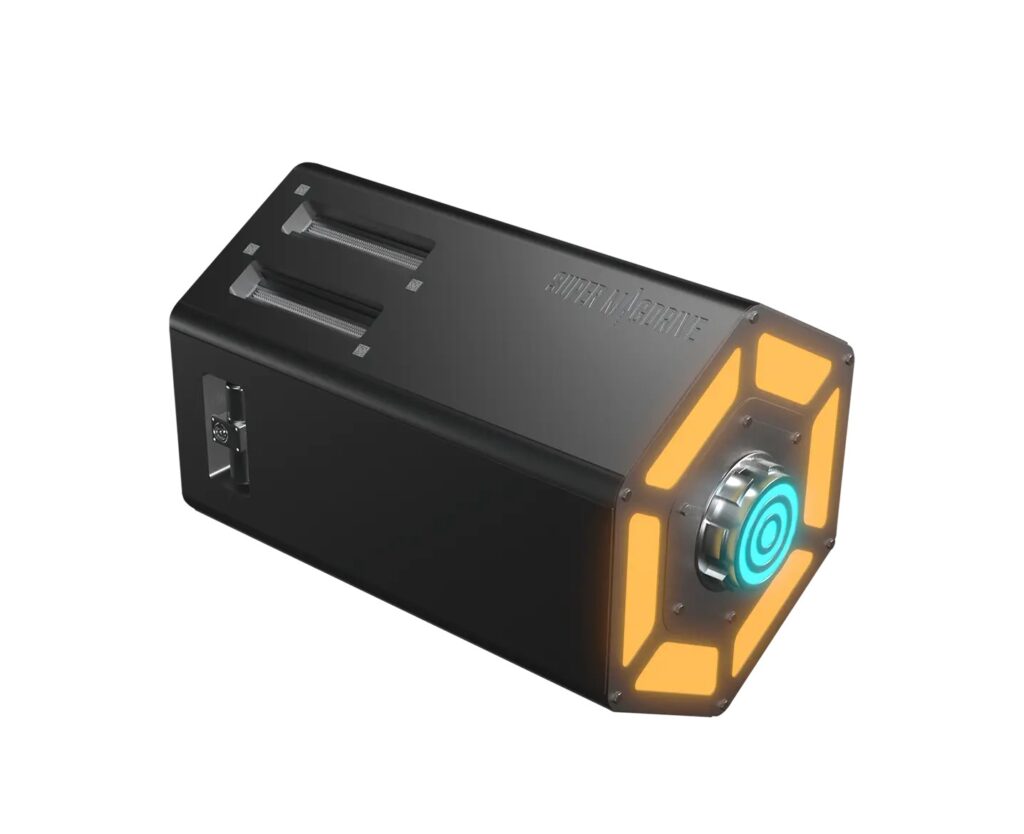
Paladin is a pulsed plasma propulsion system that uses solid metal propellants to generate high-velocity plasma for satellite thrust.
Typed specifications10 values
Discloses 5 of 10 fields engineers filter by in this category (category median 3).
- Propulsion family
- electric datasheet p.1
- Mass
- 250 g datasheet p.1
- Thrust
- 1 mN datasheet p.1
- Envelope (L×W×H)
- 40 x 40 x 50 mm datasheet p.1
- Specific impulse
- 1 000 s datasheet p.1
- Propellant
- iodine datasheet p.1
- Supply voltage
- 3.3 V nom. · datasheet p.1
- Design lifetime
- 15 years datasheet p.1
- Satellite class
- CubeSat attitude control · datasheet p.1 CubeSat main propulsion
Each value is typed with its unit and measurement condition and cites the datasheet page it was taken from. Nothing is guessed: a field that is absent here has not been published by the manufacturer. machine-extracted ✓ checked by NewSpace Market ✓ manufacturer confirmed by the manufacturer.
As published by the supplier8 lines, in the manufacturer's own wording
- Thrust
- 1 mN
- Thrust (2)
- 15 mN
- Thrust (3)
- 40 mN
- Thrust (4)
- 70 mN
- Thrust (5)
- 150 mN
- Thrust (6)
- 250 mN
- Thrust (7)
- 450 mN
- Thrust (8)
- 500 mN
About
The Paladin thruster operates by vaporizing various solid metal propellants into a plasma, which is then accelerated to ultra-high velocities in discrete ‘shots’. These plasma shots are subsequently passed through a high-field magnetic chamber, which further accelerates and directs the plasma exhaust. This process is designed to produce market-leading thrust while maintaining a highly competitive specific impulse. The system incorporates a pulsed power system (PPS) capable of delivering multi-kA, MW class electrical current pulses to the plasma injector. Its performance is customizable, allowing for adjustable specific impulse and deep throttling, making it suitable for rendezvous, proximity operations, and precise maneuvering. An integrated microprocessor enables command through the satellite’s master controls, ensuring an easy-to-integrate propulsion solution. The use of storable metal propellant eliminates the need for heavy fuel tanks, cryogenics, or pressurization, and also removes associated handling hazards. Furthermore, the thruster offers directional thrust capabilities, allowing a single unit to vector up to 10 degrees by altering its magnetic properties, which can be used for both main propulsion and attitude control.
Documentation
Need the full ICD, test reports or a specific revision? Ask the supplier directly.