Micro-A Thrusters
 Micro Aerospace Solutions
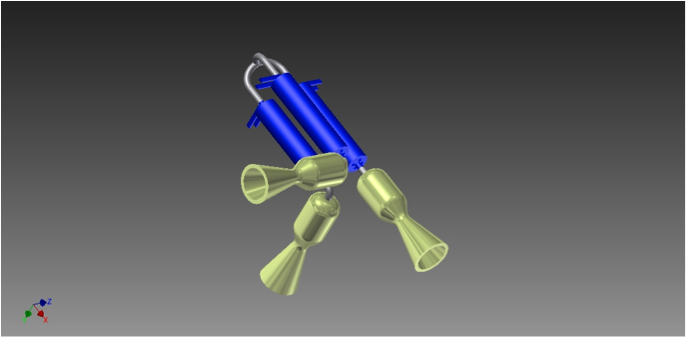
Micro-A offers a range of monopropellant microthrusters from 0.005 N to 22 N, utilizing propellants like hydrogen peroxide, hydrazine, Tridyne gas, and cold gas, alongside custom propulsion system development.
Typed specifications39 values
Discloses 2 of 10 fields engineers filter by in this category (category median 3).
- Thrust
- 5 mN product page 100 mN | 500 mN | 1 000 mN | 5 mN +3
- Specific impulse
- 100 s product page 110 s | 120 s | 120 s | 150 s +3
- Power consumption
- 0.5 W product page 0.5 W | 1 W | 2 W | 0.5 W +2
- Min impulse bit
- 1.2 mN·s product page 9 mN·s | 4 mN·s | 8.5 mN·s | 1.7 mN·s +3
- Feed / tank pressure
- 350 000 bar product page 350 000 bar | 350 000 bar | 350 000 bar | 350 000 bar +3
Each value is typed with its unit and measurement condition and cites the datasheet page it was taken from. Nothing is guessed: a field that is absent here has not been published by the manufacturer. machine-extracted ✓ checked by NewSpace Market ✓ manufacturer confirmed by the manufacturer.
As published by the supplier70 lines, in the manufacturer's own wording
- Model
- M005HP
- Thrust
- 0.005 N
- ISP (sec.)
- 100
- Inlet pressure
- 350000 Pa
- Minimum impulse bit (N-sec)
- 1.2x10^-4
- Mass (grams)
- 10
- Exit diameter
- 3.81 mm
- Pulse life
- >500,000
- Power
- 0.5 W
- Model (2)
- M010HP
- Thrust (2)
- 0.1 N
- ISP (sec.) (2)
- 110
- Inlet pressure (2)
- 350000 Pa
- Minimum impulse bit (N-sec) (2)
- 9*10^-4
- Mass (grams) (2)
- 11
- Exit diameter (2)
- 5 mm
- Pulse life (2)
- >500,000
- Power (2)
- 0.5 W
- Model (3)
- M050HP
- Thrust (3)
- 0.5 N
- ISP (sec.) (3)
- 120
- Inlet pressure (3)
- 350000 Pa
- Minimum impulse bit (N-sec) (3)
- 4x10^-3
- Mass (grams) (3)
- 15
- Exit diameter (3)
- 6.35 mm
- Pulse life (3)
- >500,000
- Power (3)
- 1.0 W
- Model (4)
- M100HP
- Thrust (4)
- 1.0 N
- ISP (sec.) (4)
- 120
- Inlet pressure (4)
- 350000 Pa
- Minimum impulse bit (N-sec) (4)
- 8.5x10^-3
- Mass (grams) (4)
- 20
- Exit diameter (4)
- 7.6 mm
- Pulse life (4)
- >500,000
- Power (4)
- 2.0 W
- Model (5)
- M005
- Thrust (5)
- 0.005 N
- ISP (sec.) (5)
- 150
- Inlet pressure (5)
- 350000 Pa
- Minimum impulse bit (N-sec) (5)
- 1.7x10^-4
- Mass (grams) (5)
- 10
- Exit diameter (5)
- 3.81 mm
- Pulse life (5)
- >100,000
- Power (5)
- 0.5 W
- Model (6)
- M010
- Thrust (6)
- 0.05 N
- ISP (sec.) (6)
- 160
- Inlet pressure (6)
- 350000 Pa
- Minimum impulse bit (N-sec) (6)
- 6x10^-3
- Mass (grams) (6)
- 12
- Exit diameter (6)
- 4.45 mm
- Pulse life (6)
- >100,000
- Power (6)
- 0.5 W
- Model (7)
- M050
- Thrust (7)
- 0.5 N
- ISP (sec.) (7)
- 170
- Inlet pressure (7)
- 350000 Pa
- Minimum impulse bit (N-sec) (7)
- 3x10^-2
- Mass (grams) (7)
- 15
- Exit diameter (7)
- 8.9 mm
- Pulse life (7)
- >100,000
- Power (7)
- 1.0 W
- Model (8)
- M100
- Thrust (8)
- 1.0 N
- ISP (sec.) (8)
- 200
- Inlet pressure (8)
- 350000 Pa
- Minimum impulse bit (N-sec) (8)
- 3x10^-2
- Mass (grams) (8)
- 30
- Exit diameter (8)
- 8.9 mm
About
Micro-A develops a variety of microthrusters and propulsion systems for spacecraft, ranging in thrust from 0.005 Newtons to 22 Newtons. These systems can utilize various monopropellants including hydrogen peroxide, hydrazine, Tridyne gas (a mixture of nitrogen, hydrogen, and oxygen), and cold gas. Hydrogen peroxide offers moderate performance in a ‘green’ propellant package, while hydrazine provides higher performance and is used in many US government systems. Tridyne gas offers cold gas safety with performance comparable to hydrogen peroxide, providing a safe, non-toxic alternative for cubesats and other nanosatellites. The company also develops custom thruster systems integrating different valve types, such as refrigerant-based propellant thrusters and nitrous oxide-alcohol systems.
Micro-A has expertise in propellant design and testing, with thrust stand systems capable of measuring thrust from milli-Newtons to Newtons, as well as temperature, pressure, and flow rates. They have designed a gel-propellant system for microspacecraft to boost from Low-Earth Orbit to higher orbits, offering lower mass and volume with performance comparable to solid motors (Isp ~290 seconds). This gel-propellant system is safer, not susceptible to electrostatic discharge or leakage, and more efficient than hybrid propulsion modules. They also offer bi-propellant propulsion systems, including a hydrogen peroxide-kerosene engine that can operate at 150 pounds of thrust in bi-prop mode (autoigniting kerosene using hydrogen peroxide decomposition heat) or in monoprop mode as a simple hydrogen peroxide thruster.
A key innovation is their catalyst design for monopropellant thrusters. Unlike traditional pellet beds that degrade over time, Micro-A uses an innovative metal gauze catalyst design for hydrogen peroxide thrusters, offering increased system performance and lifetime. This design has demonstrated operation for over 500,000 pulses with proper propellant decomposition. Additionally, Micro-A consults on electric propulsion system development and analysis, defining requirements to advance technology readiness levels and partnering with electric propulsion companies for small satellite applications.
Documentation
No public datasheet yet — request the datasheet / ICD from the supplier.