H-IIB
 Mitsubishi Heavy Industries Launch Services
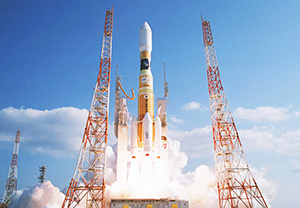
Japan's retired heavy-lift launch vehicle used exclusively to launch the HTV (Kōnotori) cargo spacecraft to the ISS, with a perfect 9-for-9 success record.
Key figurescomparable across the catalogue
- Payload capacity
- 19,000 kg
Normalised to common units so this product can be compared with others in its category. The supplier's own wording is below.
As published by the supplier
- Payload to LEO
- 19,000 kg
- Payload to iss orbit
- 16,500 kg
- Height
- 56.6 m
- First stage diameter
- 5.2 m
- Launch mass
- 531,000 kg
- First stage engines
- 2× LE-7A (LH₂/LOX)
- First stage thrust
- 2,196 kN
- Second stage engine
- 1× LE-5B (LH₂/LOX)
- Solid rocket boosters
- 4× SRB-A3
- Primary payload
- HTV (Kōnotori) ISS cargo vehicle
- Total launches
- 9 (100% success rate)
- First flight
- September 10, 2009
- Final flight
- May 20, 2020
- Status
- Retired
- Launch site
- Tanegashima Space Center, Japan
About
The H-IIB was Japan’s heavy-lift launch vehicle, developed jointly by JAXA and Mitsubishi Heavy Industries as a more powerful derivative of the H-IIA. It was designed specifically to launch the H-II Transfer Vehicle (HTV, known as Kōnotori — ‘White Stork’) cargo spacecraft to supply the International Space Station with crew provisions, experiments, and hardware. The H-IIB conducted nine missions from its inaugural flight on September 10, 2009, through its final flight on May 20, 2020 — achieving a perfect 9-for-9 success record.
The key performance improvement over H-IIA came from widening the first stage diameter from 4 m to 5.2 m to accommodate two LE-7A engines instead of one, more than doubling first-stage thrust to 2,196 kN. The vehicle also carried four SRB-A3 solid rocket boosters for additional liftoff thrust, and its first stage held 70% more propellant than H-IIA. This configuration enabled the H-IIB to lift 19,000 kg to low Earth orbit — the highest payload capacity of any Japanese launch vehicle until the H3-24.
Each Kōnotori cargo spacecraft carried approximately 6 tonnes of pressurized cargo and up to 1.5 tonnes of unpressurized external cargo to the ISS. The HTV program demonstrated Japan’s critical role in ISS logistics and the country’s capability to operate large, autonomous spacecraft. The H-IIB was retired following HTV-9’s successful mission in May 2020, with H3 eventually taking over Japan’s heavy-lift capability.
All nine missions launched from the Yoshinobu Launch Complex at the Tanegashima Space Center in southern Japan.
Documentation
No public datasheet yet — request the datasheet / ICD from the supplier.