OrbAstro Technologies
 OrbAstro
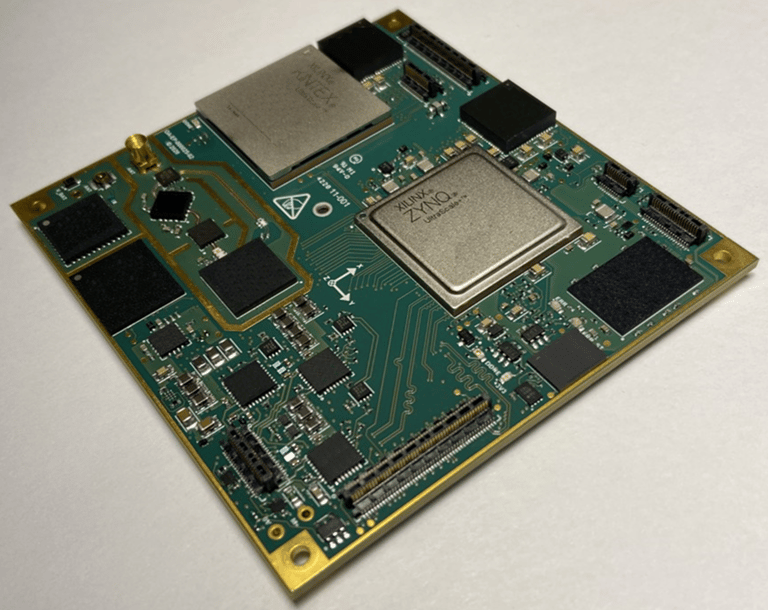
OrbAstro offers a suite of advanced technologies for satellites, including ultra-robust system architecture, high-powered payload hosting, high-throughput data architecture, and fine pointing control.
Key figurescomparable across the catalogue
- Power
- 2,000 W
- Data rate
- 4,000 Mbps
Normalised to common units so this product can be compared with others in its category. The supplier's own wording is below.
As published by the supplier
- Nanosatellite Peak Payload Power
- 2 kW
- ESPA-class Satellite Peak Payload Power
- 8 kW
- Nanosatellite Solar Generation Capacity
- 168 W
- ESPA-class Satellite Solar Generation Capacity
- 3.7 kW
- Nanosatellite Battery Storage
- 576 Wh
- ESPA-class Satellite Battery Storage
- 1.8 kWh
- Flight Computer RAM
- 4 GB LPDDR4
- Payload Computer Storage
- 8 TB
- Nanosatellite Downlink Rate
- 2 Gbps
- ESPA-class Satellite Downlink Rate
- 4 Gbps
- Baseline Pointing Accuracy
- 0.1°
- Baseline Pointing Knowledge
- <0.01°
About
OrbAstro’s technologies are built with deep vertical integrity and compounding flight heritage, with every subsystem, flight code, and AIT process developed and built in unison under one roof. The ultra-robust and long-life system architecture features dual redundancy across core platform systems like EPS, S-band TT&C, magnetorquers, and ADCS sensors, with upgrade paths to full dual redundancy. ESPA-class platforms include enhanced CFRP-titanium-alloy shear panels for improved resilience against debris. OrbAstro battery systems use a thermal-gradient-tolerant chemistry that supports over 30,000 near-full discharge cycles and remains operational even after puncture. Platforms are designed for demanding payloads, offering peak power handling up to 2kW on nanosatellites and 8kW on ESPA-class satellites, with deployable solar-wing options providing significant generation capacity. High-throughput data architecture is supported by Zynq Ultrascale+ MPSoC flight computers, dedicated payload computers with extensive processing and storage, and Ka-band SDRs enabling downlink rates up to 4Gbps. Fine pointing, fast slewing, and high-delta-V control are achieved with 3-axis space-grade fibre-optic gyros, star trackers, magnetorquers, and reaction wheels, delivering precise and agile attitude control. Electric propulsion using water-based propellant is standard, providing substantial delta-V for orbit phasing, altitude control, and collision avoidance. The Abel AI engine provides intelligence for satellite health monitoring, RF optimisation, anomaly detection, and constellation-scale decision support, moving operators from reactive monitoring to predictive fleet management.
Documentation
No public datasheet yet — request the datasheet / ICD from the supplier.