Solar Weightless System
TDI SIE SB RAS (Technological Design Institute of Scientific Instrument Engineering)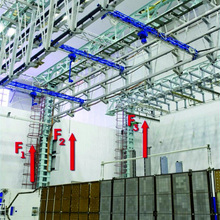
An automated ground-based system that simulates weightlessness for testing large-sized spacecraft elements such as solar panels.
Key figurescomparable across the catalogue
- Mass
- 80 kg
- Design life
- 10 years
- Lead time
- 12 months
Normalised to common units so this product can be compared with others in its category. The supplier's own wording is below.
As published by the supplier
- Purpose
- Designed for ground testing (weightlessness) of spacecraft equipment, solar panels
- Year of release
- 2016
- Design life
- 10 years
- Lead time
- 12 months
- Possibility to adapt the product to customer requirements
- Yes
- Number of suspension points weightlesselements
- 12 pcs
- Suspension point travel in the longitudinal direction
- up to 17 m
- Suspension point movement speed
- 1 m / min
- Unit weight
- up to 80 kg
- Suspension point travel in transverse and vertical directions
- up to 5 m
About
The Solar Weightless System is designed for ground testing (weightlessness simulation) of spacecraft equipment, particularly solar panels. It is an automated system for weighting (offloading gravity from) large-sized elements of spacecraft, such as solar panels, allowing them to be tested under simulated zero-gravity conditions on the ground. The system features 12 suspension points (weightless elements), each capable of longitudinal travel of up to 17 m at a movement speed of 1 m/min, and travel of up to 5 m in the transverse and vertical directions. Each unit can support a weight of up to 80 kg. The system compensates for gravity with an energy cost of less than 10%. It was first released in 2016, has a guaranteed service life of 10 years, an estimated production/delivery time of 12 months, and can be adapted to customer requirements.
Documentation
No public datasheet yet — request the datasheet / ICD from the supplier.