Large Deployable Solar Arrays
 Source Energy
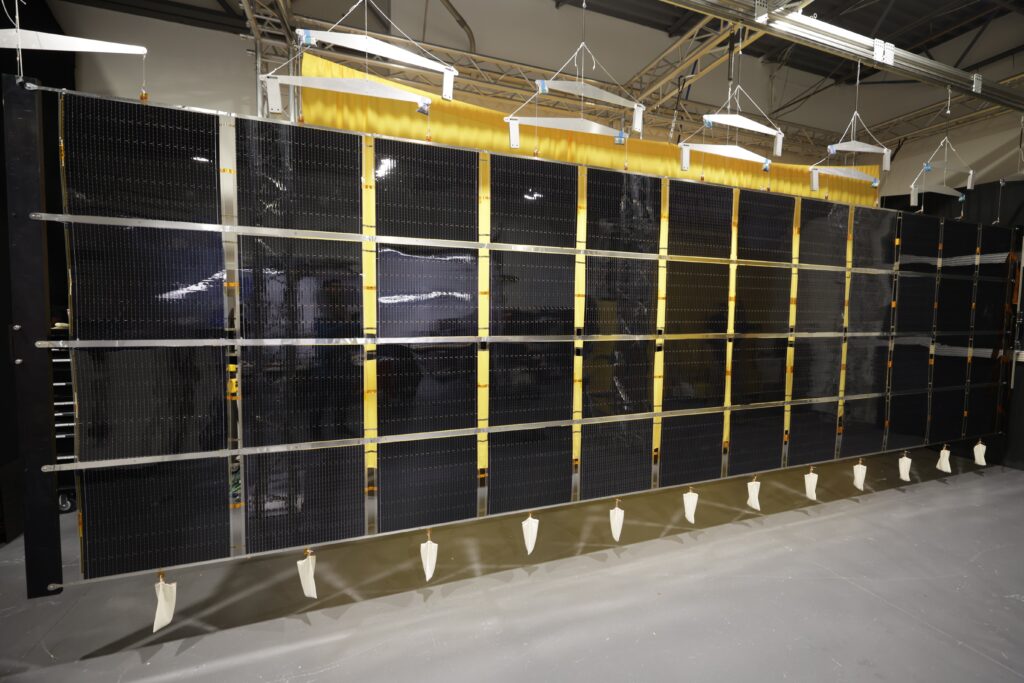
Source Energy’s Large Deployable Solar Arrays are designed for high-power rideshare spacecraft requiring multi-kilowatt power budgets. The architecture features aluminium or carbon fibre pantograph booms deploying Z-folded photovoltaic blankets, driven by strain energy. The system includes four Hold Down and Release Mechanisms (HDRMs) and eight kinematic mount interfaces, with a CFRP facesheet and aluminium honeycomb […]
Typed specifications2 values
Discloses 1 of 12 fields engineers filter by in this category (category median 3).
- Deployable
- yes product page
- Design lifetime
- 7 years product page
Each value is typed with its unit and measurement condition and cites the datasheet page it was taken from. Nothing is guessed: a field that is absent here has not been published by the manufacturer. machine-extracted ✓ checked by NewSpace Market ✓ manufacturer confirmed by the manufacturer.
As published by the supplier12 lines, in the manufacturer's own wording
- Boom material
- Aluminium or Carbon Fibre Pantograph
- Deployment mechanism
- Strain energy driven
- Blanket fold
- Z-folded photovoltaic blanket
- Hold down
- 4 HDRMs and 8 kinematic mount interfaces
- Structure
- CFRP facesheet and aluminium honeycomb blanket box
- Design lifetime
- 7 years LEO
- Bifacial
- Yes — generates power from both sides
- Prototype power output
- 3 kW (beta prototype)
- Fault tolerance
- Redundant string and circuit wiring; micrometeorite and shading tolerant
- Magnetic signature
- Low magnetic moment
- Sada compatible
- Yes
- Gse interfaces
- Built-in offload GSE interfaces
About
Source Energy’s Large Deployable Solar Arrays are designed for high-power rideshare spacecraft requiring multi-kilowatt power budgets. The architecture features aluminium or carbon fibre pantograph booms deploying Z-folded photovoltaic blankets, driven by strain energy. The system includes four Hold Down and Release Mechanisms (HDRMs) and eight kinematic mount interfaces, with a CFRP facesheet and aluminium honeycomb blanket box for the stowed configuration.
The arrays generate power from both sides (bifacial design), exhibit low magnetic moment signature for magnetically sensitive missions, and feature small stowed volume. A Solar Array Drive Assembly (SADA) compatible interface allows rotation tracking and is also available as a blanket enclosure for standalone systems or as a flat-sat ground verification configuration.
Key electrical features include redundant string and circuit wiring, fault tolerance to localised micrometeorite strikes and shading, and a 7-year design lifetime for LEO missions. A 3 kW beta prototype has been built and characterised. Built-in offload GSE interfaces simplify ground handling and integration. The arrays are designed by veterans of SpaceX’s original Starlink mega-constellation solar array programme and Crew Dragon solar array development.
Documentation
No public datasheet yet — request the datasheet / ICD from the supplier.