HYDROS-C Water Electrolysis Thruster
 Tethers Unlimited, Inc. (AMERGINT)
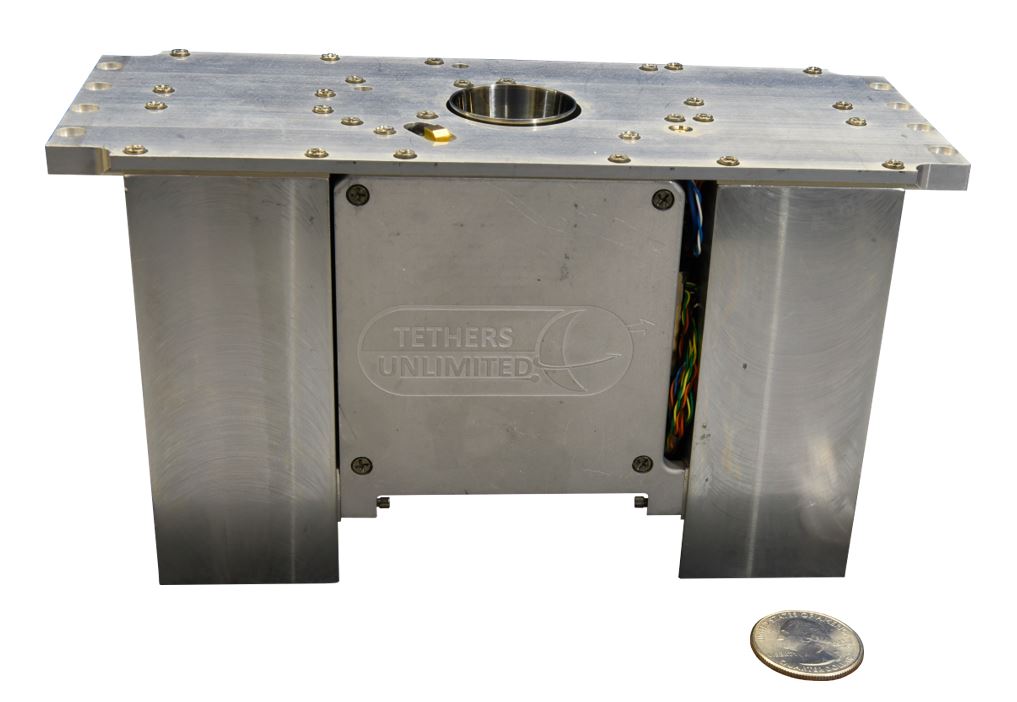
CubeSat-scale green water-electrolysis thruster: splits stored water into hydrogen/oxygen for bipropellant combustion, with flight units delivered including NASA's PTD mission.
Typed specifications28 values
Discloses 8 of 10 fields engineers filter by in this category (category median 3).
- Propulsion family
- water datasheet p.1 water derived from product name/propellant
- Mass
- 2.2 kg Dry · datasheet p.2 2.7 kg Wet | 2.7 kg wet mass
- Thrust
- 2.2 mN Orbit-Averaged · datasheet p.2 1 200 mN min · max
- Envelope (L×W×H)
- 190 x 130 x 92mm datasheet p.2
- Specific impulse
- 310 s min · datasheet p.2
- Total impulse
- 2 151 N·s min · Delivered · datasheet p.2 1.75 N·s min · per Thrust Event | 2 151 N·s min · total impulse delivered; unit not printed
- Propellant
- water datasheet p.1
- Power consumption
- 16 W Nominal MAX · datasheet p.2 3.5 W Standby | 5 W min · MAX W/ Heaters | 25 W max · MAX W/ Heaters | 5–25 W MAX W/ Heaters +1
- TRL
- 9 datasheet p.2
- Thruster technology
- water electrolysis datasheet p.1
- Number of starts or pulses
- 761 total # thrust events · datasheet p.2
- Min impulse bit
- 1 750 mN·s min · impulse per thrust event · datasheet p.2
- Propellant mass (full load)
- 500 g datasheet p.2 500 g water capacity
- Flight heritage
- Proven capability on-orbit datasheet p.1
- Missions flown
- 9 Qualification Level · datasheet p.2
- Dry mass
- 2.2 kg datasheet p.2
Each value is typed with its unit and measurement condition and cites the datasheet page it was taken from. Nothing is guessed: a field that is absent here has not been published by the manufacturer. machine-extracted ✓ checked by NewSpace Market ✓ manufacturer confirmed by the manufacturer.
As published by the supplier16 lines, in the manufacturer's own wording
- Specific impulse
- > 310 s
- Thrust
- > 1.2 N
- Power
- 5-25 W
- Total impulse
- > 2,151 Ns
- Water tank
- Customizable
- Flight status
- Flight units delivered; flying on NASA Pathfinder Technology Demonstrator (PTD)
- Orbit-Averaged Thrust
- 2.2 mN
- Thrust Efficiency
- 0.13 mN/W
- Dry Mass
- 2.2 kg
- Wet Mass
- 2.7 kg
- Time to Refill Gas Plenums
- 825 s
- Size
- 190 x 130 x 92 mm
- Power (MAX) W/ Heaters
- 5-25 W
- Power (Nominal MAX)
- 16 W
- Power (Standby)
- 3.5 W
- Qualification Level
- TRL 9
About
HYDROS is TUI’s hybrid electrical/chemical propulsion technology providing green, safe, high-thrust, high-fuel-economy propulsion using water as propellant, so it is safe for personnel during satellite integration and poses no significant risk to primary payloads during launch. Once on-orbit, HYDROS uses a zero-G electrolysis system to split water into hydrogen and oxygen for bipropellant combustion through a rocket nozzle, providing higher thrust efficiency at lower input power than electric propulsion, and higher specific impulse than monopropellant chemical propulsion. HYDROS-C is the CubeSat-sized configuration, with a customizable water tank sized to mission requirements and integrated avionics that simplify commanding and host-spacecraft integration. NASA is using TUI’s HYDROS-C unit on the first Pathfinder Technology Demonstrator (PTD) mission.
Documentation
Need the full ICD, test reports or a specific revision? Ask the supplier directly.