OHP Chassis
 Thermavant
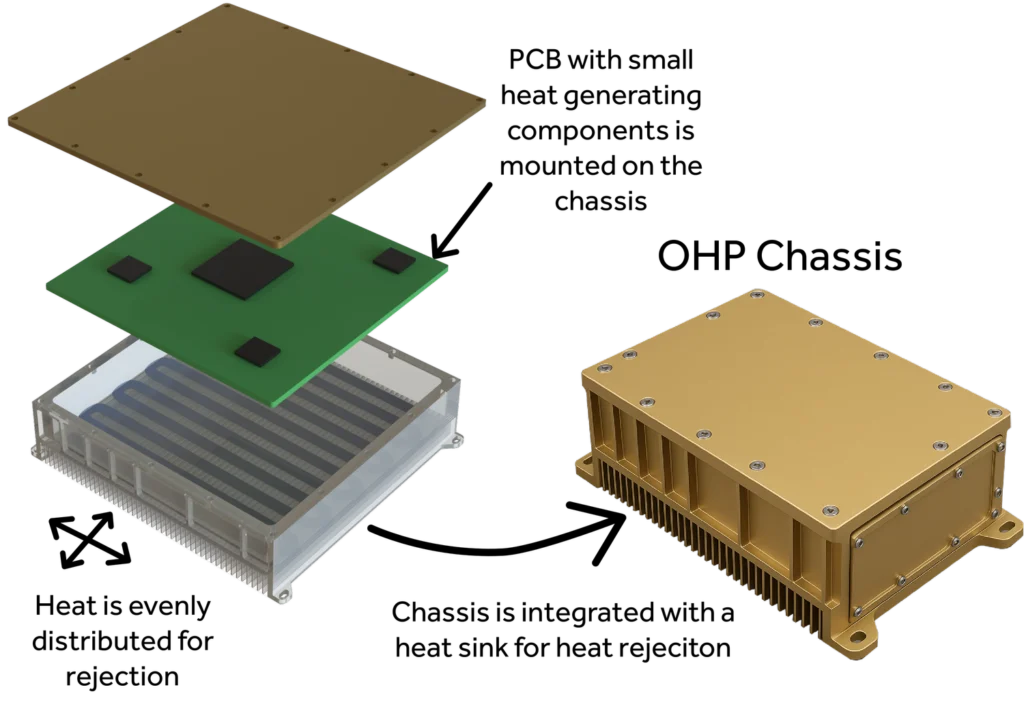
Oscillating heat pipe (OHP) embedded electronics chassis and enclosures that structurally house circuit cards, RF modules, and Li-ion cells while conducting heat directly to spacecraft radiators, cold plates, or air-cooled sidewalls.
Typed specifications5 values
Discloses 1 of 7 fields engineers filter by in this category (category median 2).
- Mass
- 995 g product page 1 351 g
- Operating temperature
- -20 °C product page -55 °C
- Flight heritage
- 200+ demonstrated OHP chassis units for air and space applications, ~30 currently on orbit; qualified thru MIL-STD thermal cycling, vibration, shock, and pressure cycling (TRL 9) product page
Each value is typed with its unit and measurement condition and cites the datasheet page it was taken from. Nothing is guessed: a field that is absent here has not been published by the manufacturer. machine-extracted ✓ checked by NewSpace Market ✓ manufacturer confirmed by the manufacturer.
As published by the supplier21 lines, in the manufacturer's own wording
- Simple chassis example thermal performance (OHP)
- 11 °C rise per 120 W
- Simple chassis example thermal performance (solid Al)
- 35 °C rise per 120 W (3.2x worse than OHP)
- Simple chassis example mass (OHP)
- 995 g
- Simple chassis example mass (solid Al)
- 1,049 g (1.1x worse than OHP)
- Simple chassis shape & structure
- Al 6061 T4/T6, approx. 12" x 8" x 1.0" thick, min. 0.1" thickness at center
- Simple chassis temperature range
- -20 °C to +75 °C
- Complex chassis example thermal performance (OHP)
- 5 °C rise per 150 W
- Complex chassis example thermal performance (solid Al)
- 35 °C rise per 150 W (7.0x worse than OHP)
- Complex chassis example mass (OHP)
- 1,351 g
- Complex chassis example mass (solid Al)
- 1,486 g (1.1x worse than OHP)
- Complex chassis shape & structure
- Al 6061 T4/T6, approx. 10" x 5" x 1.0" thick, min. 0.15" thickness at vertical walls
- Complex chassis temperature range
- -55 °C to +105 °C
- Materials
- Al and Al composites (0 to T6 temper, most common); Cu and Cu composites incl. Copper-Molybdenum; Ni alloys incl. Invar and Kovar
- Working fluids
- Water, ketones, alkanes, alcohols, hydrochlorofluorocarbons, perfluorocarbons, hydrofluorocarbons; cryogenic (below 100 K) to liquid metal (above 1,000 °C) options
- Heat flux range
- < 1 W/cm² to > 300 W/cm²
- Heat load per ohp
- 1 W to > 10,000 W
- Ohp length range
- 2 cm to 2 m
- Gravity independence
- 0.3 m OHPs tested at 9 g adverse gravity; 1.2 m OHP tested at 1 g adverse gravity
- Coatings
- Chemical conversion coating and anodization
- Flight heritage
- 200+ demonstrated OHP chassis units for air and space applications, ~30 currently on orbit; qualified thru MIL-STD thermal cycling, vibration, shock, and pressure cycling (TRL 9)
- Lead time
- 4 weeks for recurring hardware; 4-6 months for custom new builds
About
Chassis are enclosures that structurally house internal circuit cards and other devices such as processors, optical components, RF modules, and Li-ion cells. They are designed to secure internal components against shock, vibration, and launch loads while conducting heat away from those components to external heat sinks. ThermAvant Technologies’ OHP-embedded chassis radically improve thermal conductivity in the x-y and z-planes while preserving structural integrity, and are developed to integrate with spacecraft radiators, liquid-cooled cold plates, and air-cooled sidewalls for aerospace, defense, communications, and edge computing applications.
The OHP is embedded directly into the chassis with no separate components to fail or add bulk; it functions as a solid structural piece while passively moving heat with zero moving parts. Over 200 OHP chassis units have been demonstrated for air and space applications, with approximately 30 units currently on orbit, qualified through MIL-STD thermal cycling, vibration, shock, and pressure cycling (TRL 9). Typical lead times run 4 weeks for recurring hardware and 4-6 months for new custom designs.
Documentation
No public datasheet yet — request the datasheet / ICD from the supplier.