OHP Radiators
 Thermavant
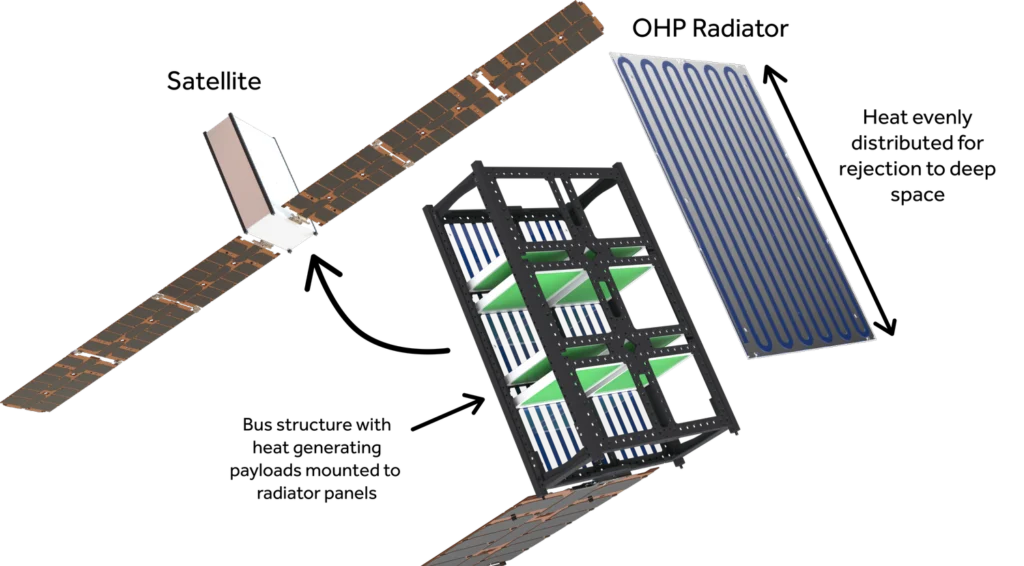
Oscillating heat pipe (OHP) embedded spacecraft radiators and structural panels for on-orbit waste-heat rejection, delivering up to 9x higher thermal conductance and 40% lower density than solid aluminum radiators.
Typed specifications7 values
Discloses 1 of 7 fields engineers filter by in this category (category median 2).
- Mass
- 3 200 g product page
- Envelope (L×W×H)
- Al 6061 T4, approx. 19" x 19" x 0.04-0.16" thick (variable thickness) product page
- Operating temperature
- -20 °C product page -55 °C
- Flight heritage
- +1,000 on-orbit or delivered-for-launch OHP spacecraft radiators as of mid-2025 (TRL 9); qualified thru MIL-STD vacuum chamber, thermal cycling, vibration, shock, pressure cycling product page <10 units qualified and delivered for launch as of mid-2025; not yet deployed on lunar surface as of mid-2025 | Co-developed with Albedo: 30% mass reduction and 70% volume savings over legacy thermal systems for VLEO mid-size satellites
Each value is typed with its unit and measurement condition and cites the datasheet page it was taken from. Nothing is guessed: a field that is absent here has not been published by the manufacturer. machine-extracted ✓ checked by NewSpace Market ✓ manufacturer confirmed by the manufacturer.
As published by the supplier24 lines, in the manufacturer's own wording
- Simple radiator example thermal performance (OHP)
- 2 °C rise per 150 W
- Simple radiator example thermal performance (solid Al)
- 18 °C rise per 150 W (9x worse than OHP)
- Simple radiator effective density (OHP)
- 1.6 g/cm³ (Al 6061 T4 w/ selective coating)
- Simple radiator effective density (solid Al)
- 2.7 g/cm³ (1.7x worse than OHP)
- Simple radiator shape & size
- Al 6061 T4, approx. 19" x 19" x 0.04-0.16" thick (variable thickness)
- Simple radiator temperature range
- -20 °C to +100 °C
- Complex (lunar rover) radiator thermal performance (OHP)
- 1 °C per 20 W (e.g. 6 °C / 125 W)
- Complex (lunar rover) radiator thermal performance (solid Al)
- 1 °C per 3.7 W (5.4x worse than OHP)
- Complex radiator mass (OHP panel)
- 3.2 kg
- Complex radiator mass (solid Al, mass-equivalent)
- 3.9 g reference; 1.2x worse than OHP by conductance-to-mass
- Complex radiator shape & structure
- Individual panels 800 mm x 350 mm x 3-13 mm (3 mm thinnest OHP section); arrayed to 1.6 m x 1.1 m radiator
- Complex radiator temperature range
- -55 °C to +70 °C
- 2d/3d radiator strap sizing
- 0.2 m to 1.5 m length, widths <0.1 m to >0.2 m, thickness 1-5 mm
- 2d/3d radiator strap heat load
- < 10 W to > 1 kW
- 2d/3d radiator strap heat flux
- < 1 W/cm² to > 100 W/cm²
- Materials
- Al and Al composites (0 to T6 temper); Cu and Cu composites incl. Copper-Molybdenum; Titanium; Stainless steel; Ni alloys incl. Invar/Kovar; low-CTE refractory metals incl. Mo and W
- Working fluids
- Water, ketones, alkanes, alcohols, hydrochlorofluorocarbons, perfluorocarbons, hydrofluorocarbons; cryogenic (below 100 K) to liquid metal (above 1,000 °C) options
- Heat flux range
- < 1 W/cm² to > 300 W/cm²
- Heat load per ohp
- 1 W to > 10,000 W
- Ohp length range
- 2 cm to 2 m
- Gravity independence
- 0.3 m OHPs tested at 9 g adverse gravity; 1.2 m OHP tested at 1 g adverse gravity
- Flight heritage (simple radiator)
- +1,000 on-orbit or delivered-for-launch OHP spacecraft radiators as of mid-2025 (TRL 9); qualified thru MIL-STD vacuum chamber, thermal cycling, vibration, shock, pressure cycling
- Flight heritage (lunar rover radiator)
- <10 units qualified and delivered for launch as of mid-2025; not yet deployed on lunar surface as of mid-2025
- Flight heritage
- Co-developed with Albedo: 30% mass reduction and 70% volume savings over legacy thermal systems for VLEO mid-size satellites
About
Radiators are the rejection component of a spacecraft’s thermal control system, where waste heat from onboard electronics, power-energy systems, RF devices, sensors, life support, and other payloads is expelled to deep space. ThermAvant Technologies’ OHP-embedded radiators are designed as simple 2-D or complex 3-D form factors. OHPs can be used as a purely thermal solution (e.g., thin, long-distance straps bonded to structural panels) or designed into structural panels as a multifunctional solution; ThermAvant has also developed deployable OHPs. Commercial and defense satellite makers are increasingly transitioning to OHP-based radiators for next-generation spacecraft to optimize size, weight, power, cost, and integration complexity.
Under NASA-funded SBIR efforts, ThermAvant developed high-efficiency, thin, lightweight OHP-embedded radiators for medium- and high-heat-flux payloads, including a demonstrator with an effective density 40% lighter than solid aluminum and 9x higher thermal conductance. ThermAvant has also delivered meter-scale structural OHP radiator panels for a lunar surface rover, improving thermal conductance 6.4x versus mass-equivalent solid aluminum panels while maintaining ≤1 °C temperature variance across adverse gravity orientations. ThermAvant and Albedo co-developed the world’s first OHP-based thermal control system for very low Earth orbit mid-size satellites, achieving a 30% mass reduction and 70% volume savings over legacy thermal systems. As of mid-2025, more than 1,000 OHP spacecraft radiators have been delivered for launch or are on-orbit (TRL 9).
Documentation
No public datasheet yet — request the datasheet / ICD from the supplier.