Centurion Rocket Engine
 Rocket Propulsion Systems (RPS)
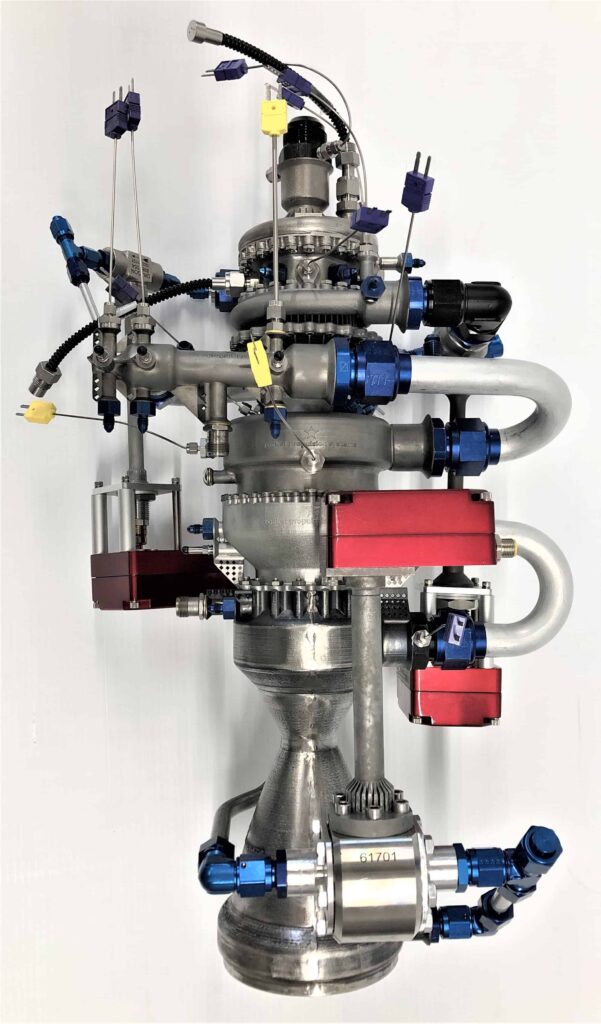
The Centurion is a fuel-rich staged combustion rocket engine designed for small satellite launch vehicles and in-space stages, utilizing liquid oxygen (LOX) and liquid methane propellants.
Key figurescomparable across the catalogue
- Mass
- 15 kg
- Largest dimension
- 609.6 mm
- Thrust
- 1.5 N
- Specific impulse
- 316 s
Normalised to common units so this product can be compared with others in its category. The supplier's own wording is below.
As published by the supplier
- Oxidizer
- Liquid oxygen (LOX)
- Fuel
- Liquid methane (or Liquified Natural Gas)
- Cycle
- Fuel-rich staged combustion
- Combustion chamber pressure
- 103 bar [1500 psi]
- Specific impulse
- 316 sec
- Thrust
- 1.5 metric ton [3307 lbf]
- Dry weight
- 15 kg [33 lbm]
- Nozzle area expansion ratio
- 12
- Envelope
- 0.36 m [14 inch] diameter 0.61 m [24 inch] height
- Number of engines
- 6
- Total thrust
- 9 metric ton
- Specific impulse (sea level)
- 332
- Nozzle area expansion ratio (2)
- 20
- Dry weight (2)
- 90 kg
- Number of engines (2)
- 1
- Total thrust (2)
- 1.5 metric ton
- Specific impulse (2)
- 374
- Nozzle area expansion ratio (3)
- 40
- Dry weight (3)
- 15 kg
About
The Centurion rocket engine is a fuel-rich staged combustion engine designed for small satellite launch vehicles and in-space stages. It uses liquid oxygen (LOX) and liquid methane (or Liquified Natural Gas) as propellants, chosen for their availability, low cost, deep-space storability, and potential for in-situ resource utilization on Mars. The engine’s fuel-rich cycle is based on historical reliability demonstrated in man-rated engines like XLR-99, F-1, Space Shuttle Main Engine, and Merlin, aiming for high reusability in fielded engines. A high chamber pressure has been targeted to allow for future upgrades in size and thrust without significant changes in thrust-to-weight ratio.
The Centurion prototype, built in October 2022, features a nozzle area expansion ratio of 12 and is regeneratively cooled down to the nozzle exit. Fielded engines will incorporate uncooled nozzle extensions for larger expansion ratios. The engine is planned for commercialization in sea-level and vacuum variants, both sharing a common core prototype technology with differences in nozzle extensions and clustering. These engines are intended for small ground-launched vehicles carrying small satellites to LEO or for in-space stages performing missions from LEO parking orbit to MEO/GEO, Moon, Mars, and beyond.
The target price for the Centurion engine is $150K per engine, regardless of the variant, for the U.S. and Canada markets. This low price is achieved through innovative exploitation of fuel-richness in the engine cycle, clever use of additive manufacturing, and novel combustion device technologies. Reused engines for the first stage are targeted to be sold at 1/6th the price of new engines, with no reuse anticipated for vacuum engines. The engine is designed to enable competitive launch services at a price point of $1.5M (or $8300/kg for a 180 kg payload).
Exact specifications like launch vehicle/spacecraft interfaces, nozzle area expansion ratio, and total thrust will be determined with specific customers. The per-unit price for new engines and thrust-to-weight for both sea-level and vacuum variants are expected to remain close to $150K and 100:1 respectively. The Centurion engine prototype is scheduled for a thorough R&D hot-fire test campaign within 2023-2025, with commercialization activities expected in Q1-Q2 of 2025.
Documentation
No public datasheet yet — request the datasheet / ICD from the supplier.