Aurora ARM Thruster System
 Aurora Propulsion Technologies
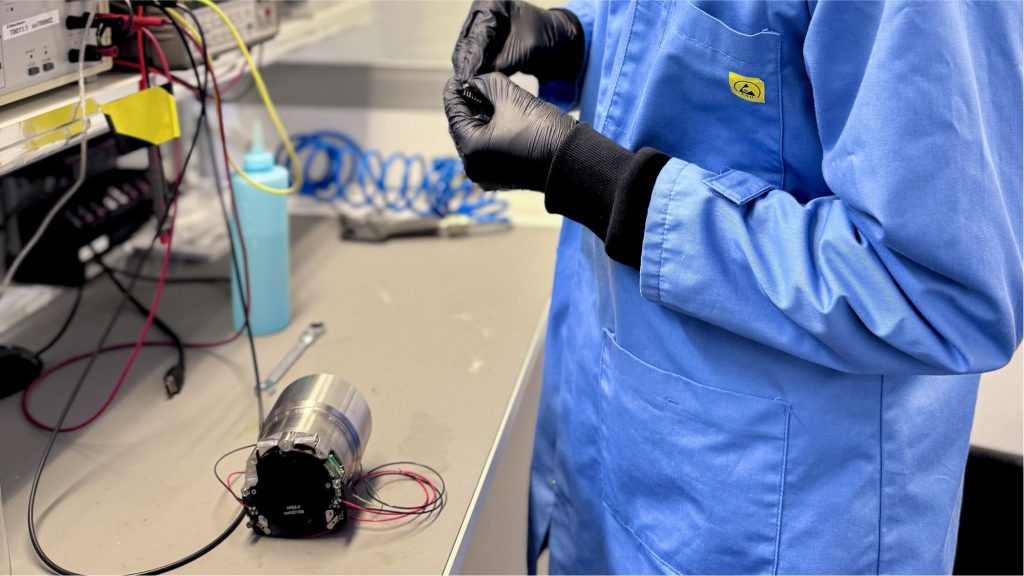
Plug-and-play, ITAR-free resistojet propulsion modules for CubeSats and small satellites up to 300kg, providing attitude control, orbital maneuvering, and zero-debris-compliant end-of-life disposal.
Typed specifications3 values
Discloses 1 of 10 fields engineers filter by in this category (category median 3).
- Envelope (L×W×H)
- Smallest CubeSats up to 300 kg small sats product page
- Propellant
- water product page
- Flight heritage
- 4 Years product page
Each value is typed with its unit and measurement condition and cites the datasheet page it was taken from. Nothing is guessed: a field that is absent here has not been published by the manufacturer. machine-extracted ✓ checked by NewSpace Market ✓ manufacturer confirmed by the manufacturer.
As published by the supplier9 lines, in the manufacturer's own wording
- Thrusters in orbit
- 14
- Space heritage
- 4 Years
- Supply chain
- European
- Products launched
- 14 ARM thrusters, 3 Plasma Brake tethers
- Launch scheduled
- 11 ARM thrusters, 2 Plasma Brake tethers
- Satellite size range
- Smallest CubeSats up to 300 kg small sats
- Propellant
- Unpressurised water (no hazmat logistics)
- ITAR status
- ITAR-free
- Compliance
- Zero-debris, FCC/ESA deorbiting requirements
About
Aurora’s ARM thruster family is a modular, plug-and-play propulsion system designed for satellite maneuvers in low Earth orbit. The thrusters use unpressurised water as propellant, eliminating hazmat handling and logistics concerns for operators. The system is built to fit standard form factors from the smallest CubeSats up to 300kg small satellites, aiming to save volume and maximise available payload space rather than trading payload capacity for propulsion. It supports zero-prep collision avoidance maneuvers and helps satellite operators meet FCC/ESA deorbiting and zero-debris compliance requirements from day one. The hardware is ITAR-free and produced through a European/localized supply chain, giving defence and sovereign customers autonomy and rapid hardware delivery shielded from geopolitical supply chain vulnerabilities. Product variants mentioned include the ARM-A (used as a 6-thruster attitude control system), ARM-C (used in 4-thruster configurations), and ARM-O (available in 1U dual-thruster and 0.6U single-system configurations). As of the page’s reporting, 14 ARM thrusters and 3 Plasma Brake tethers (a related deorsiting product) have been launched, with 11 more ARM thrusters and 2 more Plasma Brake tethers scheduled for launch; overall flight heritage spans 4 years. Flight heritage includes: AuroraSat-1 (built with SatRev, launched by Rocket Lab, carrying a 6-thruster ARM-A attitude control system and two Plasma Brake prototypes, developed in a record 7 months); Foresail-1 (components manufactured by Aurora); the Strider satellite (collaboration with Aliena, an In-Orbit Demonstration of the multi-modal MEPE propulsion system combining Aliena’s MUSIC Hall Effect Thruster with four Aurora resistojet thrusters sharing one propellant tank); EstCube-2 (Aurora-manufactured components); the Wisdom satellite (built/operated by C3S, featuring 4 Aurora ARM-C thrusters and an Aurora Plasma Brake); Foresail-1p (Plasma Brake with Aurora components); SpeQtral-1 (Aurora Plasma Brake enabling deorbit within the required 5 years); a South Asian customer receiving multiple 1U ARM-O dual thruster systems for a 2026 launch; and JinjuSat-2 (Gyeongsan National University), propelled by Aurora’s 0.6U ARM-O system.
Documentation
No public datasheet yet — request the datasheet / ICD from the supplier.