CODE+ Software Defined Drive Electronics
 Beyond Gravity (ex-RUAG Space)
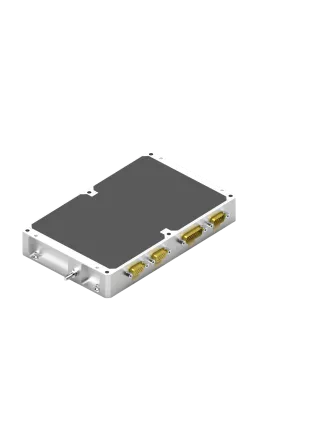
Software-defined drive electronics with a radiation-tolerant microcontroller, expanded sensing and in-orbit software patching.
Technical specifications
- Architecture
- Fully software-defined, radiation-tolerant microcontroller
- Command interface
- Dual UART; CCSDS command and telemetry packets
- Optional extension boards
- Signal multiplexing, MIL-STD-1553B communication interface
- Sensing
- Direct acquisition of analog and digital sensor inputs (motor current, position indicators, end-switches, temperature)
- Software maintenance
- In-orbit software patching
- Form factor
- Compact, stackable (same as CODE)
- Start-up time
- <500 ms
- Motor drive voltage
- max. 32 V
- Motor current
- max. 1 A
- Stepping rate
- max. 1000 steps/s
- Standby power consumption
- < 3 W
- Motor driver efficiency
- >75%
- Failure rate
- <350 FIT (Class 1 parts)
- Size
- 200 x 125 x 31 mm³
- Weight
- < 0.8 kg
- Operating temperature
- -30°C to +65°C (qual)
- Non-operating temperature
- -40°C to +75°C (qual)
- Minimum switch-on temperature
- -30°C
- Fundamental Frequency
- > 550 Hz
- Random vibration
- 18.4gRMS
- Radiation
- up to 50 kRAD (Si)
- Supply voltage
- 22 V to 38 V
- Interface
- DUAL-UART RS-422
About
Building on the proven foundation of the CODE unit, the CODE+ introduces a major step forward in capability and flexibility. With a radiation-tolerant microcontroller and a fully software-defined architecture, the CODE+ offers greater configurability, more precise monitoring of mechanism behavior, and advanced motor-control functions, all within the same compact, stackable form factor.
The CODE+ features a dual-UART command interface and supports module stacking to increase either the number of drive channels or system-level redundancy. Optional extension boards add capabilities such as signal multiplexing or a MIL-STD-1553B communication interface. The unit operates through CCSDS command and telemetry packets and supports in-orbit software patching.
CODE+ can directly acquire and process a broad range of analog and digital sensor inputs. This allows the electronics to sense what the mechanism is doing in real time, for example monitoring motor current, position indicators, end-switches, or temperature signals. This results in smoother, safer, and more accurate mechanism operations.
Documentation
Need the full ICD, test reports or a specific revision? Ask the supplier directly.