ENPULSION NANO Thruster (IFM Nano Thruster)
 ENPULSION GmbH
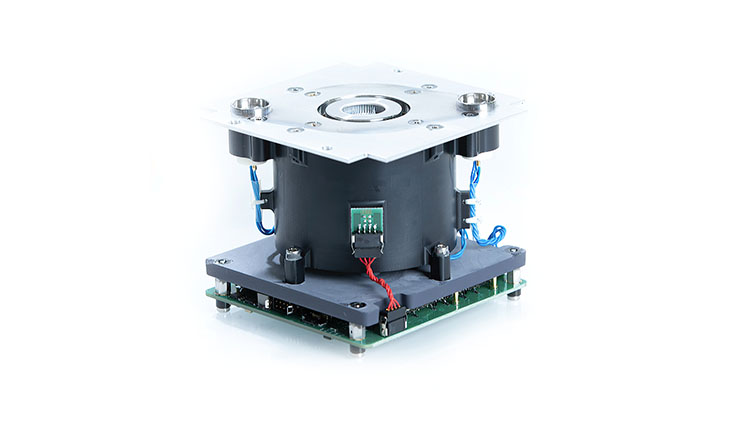
Self-contained indium FEEP electric propulsion system for CubeSats — up to 0.35 mN thrust, 2,000–6,000 s Isp, 680 g dry mass, >5,000 N·s total impulse.
Typed specifications46 values
Discloses 8 of 10 fields engineers filter by in this category (category median 3).
- Propulsion family
- electric datasheet p.1 electric derived from product name/propellant
- Mass
- 670 g dry · datasheet p.2 230 g propellant | 900 g wet
- Thrust
- 0.35 mN nominal thrust · datasheet p.2 0.01 mN min · dynamic thrust range | 0.4 mN max · dynamic thrust range | 0.01–0.4 mN DYNAMIC THRUST RANGE | 0.35 mN nom. · nominal thrust
- Envelope (L×W×H)
- 100.0 x 100.0 x 82.5 mm datasheet p.2 100.0 x 100.0 x 82.5 outside dimensions
- Specific impulse
- 2 000 s min · datasheet p.2 6 000 s max
- Total impulse
- 5 000 N·s min · datasheet p.2 5 000 N·s min · more than 5,000 Ns
- Propellant
- indium datasheet p.1
- Supply voltage
- 12 V nom. · supply voltage; data shown corresponds to 12 V configuration · datasheet p.2 12 V | 28 V nom. · supply voltage; other voltages upon request | 28 V | OTHER VOLTAGES UPON REQUEST
- Power consumption
- 40 W AT NOMINAL THRUST INCL. NEUTRALIZER · datasheet p.2 3.5 W hot standby power | 8 W starts at | 40 W total system power max | 8 W min · total system power, to operate thruster +2
- Data interface
- RS-422 datasheet p.2 RS-422 command interface RS422/RS485 | RS-485 | RS-485 command interface RS422/RS485
- Operating temperature
- -20 °C min · operational temperature envelope · datasheet p.2 40 °C max · operational temperature envelope | -20–40 °C temperature envelope (operational)
- Design lifetime
- 15 years technology development · datasheet p.1
- Thruster technology
- electrospray (FEEP or colloid) FEEP propulsion technology · datasheet p.1
- Operating life
- 20 000 h min · ongoing lifetime test, firing without degradation of the emitter · datasheet p.1
- Propellant mass (full load)
- 230 g datasheet p.2
- Power at thrust
- 40 W at nominal thrust, incl. neutralizer · datasheet p.2
- Survival temperature
- -40 °C min · non-operational temperature envelope · datasheet p.2 105 °C max · non-operational temperature envelope | -40–105 °C temperature envelope (non-operational)
- Flight heritage
- Successfully tested in orbit on a customer spacecraft in early 2018 datasheet p.1
- Dry mass
- 670 g datasheet p.2
Each value is typed with its unit and measurement condition and cites the datasheet page it was taken from. Nothing is guessed: a field that is absent here has not been published by the manufacturer. machine-extracted ✓ checked by NewSpace Market ✓ manufacturer confirmed by the manufacturer.
As published by the supplier12 lines, in the manufacturer's own wording
- Thrust range
- 0.01–0.35 mN
- Specific impulse
- 2,000–6,000 s
- Input power
- 8–40 W (3.5 W hot standby)
- Dry mass
- 680 g
- Wet mass
- 900 g
- Propellant mass
- 220 g (±5%)
- Propellant type
- Solid indium (FEEP)
- Total impulse
- >5,000 N·s
- Dimensions
- 100 × 100 × 82.5 mm
- Operating voltage
- 12 V or 28 V (others on request)
- Operating temp range
- -20 to +40°C
- Survival temp range
- -40 to +105°C
About
The ENPULSION NANO Thruster (formerly IFM Nano Thruster) is a fully self-contained Field Emission Electric Propulsion (FEEP) system for nano- and microsatellites. It uses solid indium as propellant, which is locally melted and electrostatically accelerated and ionized at the emitter tips, avoiding the need for pressurized tanks or toxic propellants.
The thruster provides continuously throttleable thrust from 10 to 350 µN with operator-selectable specific impulse between 2,000 and 6,000 seconds, trading off thrust against propellant efficiency. Total impulse capability exceeds 5,000 N·s from 220 g of propellant. The unit integrates the propellant tank, emitter, neutralizer, and power processing electronics into a single package matching a 1U CubeSat face, drawing 8–40 W depending on operating point, with a 3.5 W hot-standby mode. Applications include orbit raising, station-keeping, constellation phasing, formation flying, and deorbiting.
Documentation
- SatCatalog_-_Enpulsion_-_IFM_Nano_Thruster_-_Datasheet.pdf PDF source: satcatalog.s3.amazonaws.com ↗
Need the full ICD, test reports or a specific revision? Ask the supplier directly.