Low Power Stationary Plasma Thruster
 Glavkosmos
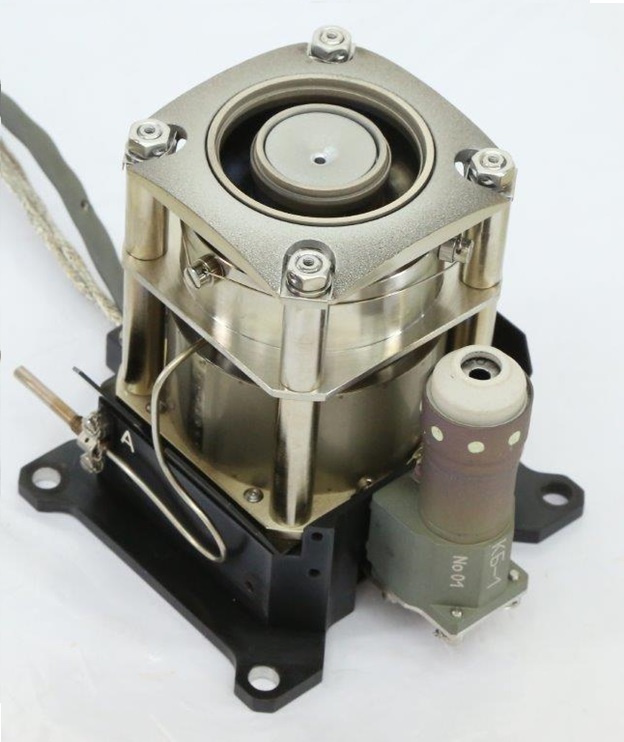
A low-power stationary plasma thruster designed for spacecraft station keeping, utilizing xenon propellant and featuring a hollow cathode.
Key figurescomparable across the catalogue
- Mass
- 1.1 kg
- Power
- 200 W
- Thrust
- 0.012 N
- Specific impulse
- 1,000 s
- Total impulse
- 0.04 N·s
- Design life
- 0.114 years
- Lead time
- 10 months
Normalised to common units so this product can be compared with others in its category. The supplier's own wording is below.
As published by the supplier
- Purpose
- Spacecraft (S/C) station keeping.
- Year of release
- 2009
- Design life
- 1000 hours 2000 vklyucheniy years
- Lead time
- 10 months
- Flight qualification of the product
- No
- Possibility to adapt the product to customer requirements
- Yes
- Discharge power
- 200/250 W
- Discharge voltage
- 200/250 V
- Discharge current
- 1.0 A
- Thrust
- 11.9/14.9 mN
- Specific impulse
- 1000/1200 s
- Efficiency
- 29/35%
- Specific power
- 181.8/227.3 W/kg
- Power-to-thrust ratio
- 16.8 W/mN
- Total impulse
- > 0.04/0.05 MN∙s
- Mass
- 1.1 kg
About
This Low Power Stationary Plasma Thruster is engineered for spacecraft station keeping, providing propulsion for maintaining orbital positions. The thruster operates using xenon as a propellant and consists of both anode and cathode units, incorporating a hollow cathode design. It was released in 2009 and boasts a guaranteed service life of 1000 hours and 2000 ignitions. The development status is an engineering model, and it features new structural materials and components. The mean diameter of its accelerating channel is 34 mm. While currently not flight qualified, the product can be adapted to customer requirements. Estimated production and delivery time is 10 months, not including material procurement (4 months) and parts/components procurement (6 months).
Documentation
No public datasheet yet — request the datasheet / ICD from the supplier.