MA61C CubeSat
 Space Products and Innovation (SPiN)
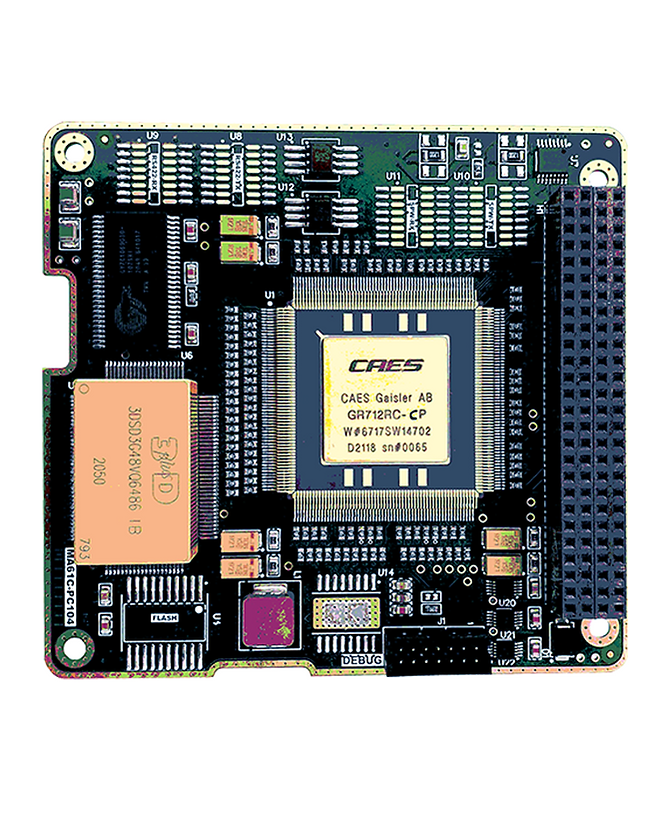
Plug-and-play Command and Data Handling (C&DH) unit for CubeSats, based on the PC/104 standard, with flight heritage (TRL 9).
Typed specifications38 values
Discloses 8 of 13 fields engineers filter by in this category (category median 5).
- Processor
- GR712RC dual-core LEON3 fault-tolerant SPARC V8 datasheet p.2
- Mass
- 150 g typ. · datasheet p.2 150 g
- CPU clock
- 50 MHz datasheet p.2
- Envelope (L×W×H)
- 95.89mm x 90.17mm datasheet p.2 95.89 x 90.17 size 95.89mm x 90.17mm
- RAM
- 3 072 MB SDRAM · datasheet p.2 64 MB SRAM
- Mass storage
- 0.063 GB FLASH · datasheet p.2
- Data interface
- SpaceWire datasheet p.2 CAN CAN-bus | USB Debug Port | RS-232 RS232 | RS-422 RS422 +9
- Operating temperature
- -40 °C product page -40–85 °C
- Processor architecture
- LEON / SPARC LEON3 SPARC V8 · datasheet p.2
- Board format
- custom datasheet p.2
- Radiation and fault mitigation
- rad-hard components radiation-hardened universal onboard computer · datasheet p.1
- Flight heritage
- TRL 9 - flown on SPiN-1 CubeSat (launched 25 May 2022) and ATMOS Space Cargo PHOENIX 1 (launched 22 April 2025) product page
- Satellite class
- CubeSat datasheet p.1
- Cores
- 2 dual-core · datasheet p.2
- RAM type
- SRAM datasheet p.2 SDRAM
- Program / boot memory
- 8 MB FLASH · datasheet p.2
- Data interface speed
- 1 Mbps CAN-bus · datasheet p.2 0.4 Mbps I2C | 20 Mbps SPI | 200 Mbps max · SpaceWire, up to
Each value is typed with its unit and measurement condition and cites the datasheet page it was taken from. Nothing is guessed: a field that is absent here has not been published by the manufacturer. machine-extracted ✓ checked by NewSpace Market ✓ manufacturer confirmed by the manufacturer.
As published by the supplier17 lines, in the manufacturer's own wording
- Interfaces supported
- SpaceWire, I2C, SPI, CAN, RS422, RS485, RS232, GPIO
- Mechanical standard
- PC/104
- Processor
- GR712RC dual-core 32-bit LEON3-FT SPARC V8
- Memory
- 64 Mbit SRAM, 64 Mbit FLASH
- Host interface
- USB (API + Windows GUI included)
- Flight heritage
- TRL 9 - flown on SPiN-1 CubeSat (launched 25 May 2022) and ATMOS Space Cargo PHOENIX 1 (launched 22 April 2025)
- Interface
- SpaceWire
- Interface (2)
- CAN-bus
- Interface (3)
- I2C
- Interface (4)
- SPI
- Interface (5)
- RS232
- Interface (6)
- RS422
- Interface (7)
- RS485
- Interface (8)
- USB Debug Port
- Dimensions
- 95.89 mm x 90.17 mm
- Mass
- 150 g
- Operating temperature
- -40°C to +85°C
About
MA61C CubeSat is SPiN’s intelligent, plug-and-play Command and Data Handling unit for CubeSat-class missions, which can also host the onboard software. It automatically adapts between the communication interfaces and protocol standards of different subsystem suppliers (AOCS sensors and actuators, communication, power, and payload subsystems) and the standard expected by the onboard computer, eliminating the need for manual configuration or driver installation.
The unit holds an internal database of Electronic Data Sheets (drivers), enabling plug-and-play functionalities such as device recognition, self-configuration, and driver installation without user intervention. It scans connections, detects incoming data, and routes and converts data between interfaces. MA61C CubeSat supports a wide range of interfaces – SpaceWire, I2C, SPI, CAN, RS422, RS485, RS232 and GPIO – all connected through the PC/104 standard, allowing it to be stacked directly into a CubeSat bus.
The core of MA61C is a GR712RC dual-core LEON3-FT SPARC V8 processor with a built-in timer based on an onboard oscillator, and onboard memory of 64Mbit SRAM and 64Mbit FLASH for storage of onboard software, drivers and data. MA61C ships with an Application Programming Interface (API) to command and monitor connected units, plus a Windows GUI for easy commanding and monitoring via USB.
By integrating MA61C, users streamline the entire CubeSat lifecycle – from design and supply-chain management to system integration – accelerating time to space. The CubeSat variant achieved TRL 9 flight heritage on the SPiN-1 1U CubeSat mission (launched 25 May 2022 on SpaceX Transporter-5, developed with Telespazio Germany, AAC Clyde Space, CrystalSpace, NewSpace Systems and TU München) and again on the ATMOS Space Cargo PHOENIX 1 re-entry capsule (launched 22 April 2025), where it operated continuously through flight and re-entry, collecting and transmitting component telemetry.
Documentation
Need the full ICD, test reports or a specific revision? Ask the supplier directly.