TET Satellite Family (TET-X / TET-XL)
 OHB System AG
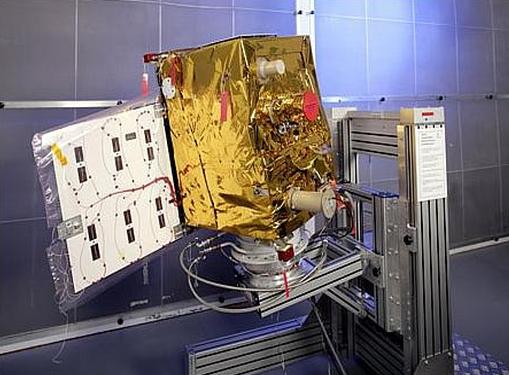
Scalable small-satellite platform family for technology demonstration and Earth observation: TET-X (120 kg, 50 kg payload) and TET-XL (200 kg, 80 kg payload), derived from the flight-proven TET-1 bus.
Typed specifications33 values
Discloses 5 of 7 fields engineers filter by in this category (category median 3).
- Envelope (L×W×H)
- 580 mm × 880 mm × 670 mm (W × H × D) TET-X · datasheet p.2 800 mm × 845 mm × 800 mm (W × H × D) TET-XL
- Design lifetime
- 7 years max · TET-XL: designed life-time up to 7 years in-orbit · datasheet p.2 3–5 years TET-X: designed life-time 3 – 5 years in-orbit
- Orbit
- LEO TET-X and TET-XL typical orbit: 450 km – 850 km altitude · datasheet p.2 SSO TET-X and TET-XL typical orbit: 53° – sun synchronous inclina…
- Max payload mass
- 50 kg TET-X: 50 kg for P/L · datasheet p.2 80 kg TET-XL: 80 kg for P/L
- Payload volume
- 90 L datasheet p.2
- Power available to payload
- 80 W min · TET-X: continuous 80 W (or more, depending on selected orbit … · datasheet p.2 160 W max · peak; TET-X: max. 160 W for 20 min | 460 W max · peak; TET-XL: max. 460 W for 25 min | 150 W max · TET-XL: continuous max. 150 W (depending on selected orbit an…
- Attitude control
- 3-axis stabilised TET-X and TET-XL: 3-axes stabilized (4 reaction wheels) · datasheet p.2
- Pointing accuracy
- 0.033 ° nom. · TET-X and TET-XL: typ. 2 arcmin · datasheet p.2
- Attitude knowledge
- 0.003 ° nom. · TET-X and TET-XL: typ. 10 arcsec · datasheet p.2
- Propulsion
- optional TET-X option: Micro Propulsion System · datasheet p.2
- Delta-v
- 60 m/s datasheet p.2
- Payload data downlink rate
- 100 000 kbps TET-X option: payload data downlink, X-Band · datasheet p.2 1 200 000 kbps TET-XL option: payload data downlink, Ka-Band | 400 000 kbps TET-XL option: payload data downlink, X-Band
- Radio band
- S communication S-Band: TC 4 – 256 kbit/s, TM 2,2 – 6 Mbit/s (T… · datasheet p.2 X option: payload data downlink X-Band (TET-X 100 Mbit/s, TET-X… | Ka TET-XL option: payload data downlink 1.2 Gbit/s Ka-Band
- Subsystems included
- solar arrays 3 solar panels (1 fixed plus 2 deployable), TET-X and TET-XL · datasheet p.2 ADCS 3-axes stabilized (4 reaction wheels) | S-band radio communication S-Band TC/TM
- Max satellite wet mass
- 120 kg TET-X: mass 120 kg for total S/C · datasheet p.2 200 kg TET-XL: mass 200 kg for total S/C
- Deployables
- hinges for solar wings 3 solar panels (1 fixed plus 2 deployable); option 5 solar pa… · datasheet p.2
- Deployables (as printed)
- 3 solar panels (1 fixed plus 2 deployable); option: 5 solar panels TET-X and TET-XL · datasheet p.2
- Flight heritage
- TET-1 launched July 22, 2012 on Soyuz-Fregat into ~510 km orbit; OOV mission (eleven payloads) completed end of October 2013; then used in DLR FireBird mission for forest fire detection datasheet p.2
- Satellite class
- smallsat 100-500 kg "The Small Satellite Series", two small satellite lines TET-X… · datasheet p.2
Each value is typed with its unit and measurement condition and cites the datasheet page it was taken from. Nothing is guessed: a field that is absent here has not been published by the manufacturer. machine-extracted ✓ checked by NewSpace Market ✓ manufacturer confirmed by the manufacturer.
As published by the supplier5 lines, in the manufacturer's own wording
- Variants
- TET-X (120 kg total, 50 kg payload); TET-XL (200 kg total, 80 kg payload)
- Orbit
- Low Earth Orbit (LEO)
- Attitude control
- Three-axis stabilised
- Flight heritage
- TET-1 (launched July 2012, DLR); BIROS (launched June 2016, DLR)
- TRL
- 9 (TET-1 and BIROS flight-proven)
About
The TET (Technology Experiment Carrier) satellite family from OHB System AG is a series of small, modular satellite platforms designed for technology-demonstration, scientific and Earth-observation missions in low Earth orbit. The flight-proven TET-1 bus launched in 2012 established the baseline, demonstrating HSRS infrared fire-detection payloads and technology experiments on behalf of DLR. OHB evolved this heritage into two marketable variants: TET-X, with a total platform mass around 120 kg and payload capacity up to 50 kg; and TET-XL, scaling the bus to approximately 200 kg total mass with up to 80 kg of payload capacity. Both variants feature a three-axis stabilised attitude control system, standardised payload and power interfaces, and on-board data handling for flexible payload accommodation. TET-X targets small scientific and technology-demonstration payloads, while TET-XL accommodates higher-performance instruments including high-resolution imagers and SAR-derived instruments. The BIROS (Bi-spectral InfraRed Optical System) fire-detection satellite, launched in 2016, is a follow-on mission based on the TET concept.
Documentation
Need the full ICD, test reports or a specific revision? Ask the supplier directly.