OreSat0
 OreSat (Portland State Aerospace Society)
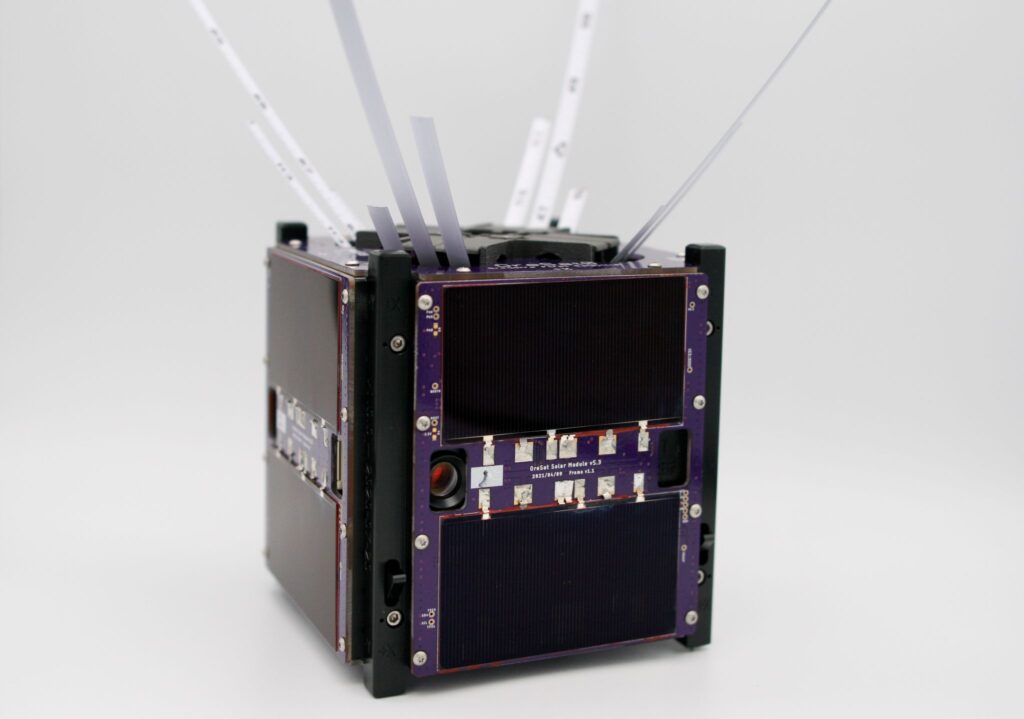
OreSat0 is a 1U CubeSat designed to provide flight heritage for critical subsystems of the OreSat system, including solar panels, batteries, radios, computer, GPS, and a star tracker.
Technical specifications
- Form factor
- 1U CubeSat
- Frame material
- 6061 Aluminum, Type II anodized black
- Frame version
- v1.2.0, 2021-09-18
- Solar modules
- 4x (v5.3)
- Solar cells per module
- 2x Spectrolab XTE GaAs
- Mppt
- On-board per solar module
- +z end cap version
- v1.1
- +z end cap magnetometers
- 2x HMC3883A (v1.1)
- Card 1: +z end card version
- v2.0
- Antenna
- Deployable tri-band turnstile antenna
- Antenna UHF frequency
- 436.5 MHz
- Antenna l band frequency
- 1.265 GHz
- Antenna l1 band frequency
- 1.575 GHz
- Melt wire resistor
- 3 W
- Card 2: c3 on-board computer version
- v5.0
- C3 OBC microcontroller
- STM32F439
- C3 OBC os
- ChibiOS
- C3 OBC transceiver
- OnSemi AX5043 UHF transceiver and L band receiver
- C3 OBC watchdog
- Radiation tolerant system watchdog
- C3 OBC storage
- 16 GB on-board data storage
- Card 3: sdr GPS receiver version
- v1.0
- Sdr GPS processor
- Octavo OSD335x-SM
- Sdr GPS os
- Linux
- Sdr GPS COTS receiver
- SkyTraq Venus 0838
- Sdr GPS experiment receiver
- Maxim MAX2771
- Card 4: dxwifi experiment version
- v1.0
- Dxwifi processor
- Octavo OSD335x-SM
- Dxwifi adapter
- Atheros AR9271 USB to WiFi adapter
- Dxwifi amplifier
- S band PA
- Dxwifi standard
- 802.11b
- Card 5: star tracker version
- v1.2
- Star tracker processor
- Octavo OSD335x-SM
- Star tracker camera
- OnSemi Ar0134 color CMOS camera
- Star tracker os
- Linux
- Star tracker software
- openstartracker
- Card 6: acs card version
- v1.1
- Acs IMU
- 6 DOF
- Card 7: battery card version
- v3.0
- Battery configuration
- 2x 2S1P packs of 18650 Li Ion cells
- Battery nominal voltage
- 7.2 V
- Battery capacity
- 2.6 Ah
- -Z end cap version
- v1.2
- Launch vehicle
- Astra's LV0009 rocket
- Launch date
- March 15, 2022
- Orbit
- 525 km sun synchronous low earth orbit
- Flight heritage
- Yes, launched and operated in space
- Re-entry prediction
- 2025
About
OreSat0 (pronounced “or-sat-zero”) is a 1U CubeSat developed to test critical subsystems and provide flight heritage for the larger OreSat mission. It serves as a “beepsat” or “sputnik” to prove the functionality of its components in space before their integration into the main mission. The satellite was launched into a 525 km sun-synchronous low Earth orbit aboard Astra’s LV0009 rocket on March 15, 2022. Its primary purpose is to demonstrate the reliability of its core systems, which include solar panels, batteries, radios, a computer, GPS, and a star tracker. The satellite’s frame is made from anodized black 6061 Aluminum, featuring an innovative “card clamps” design. Key internal systems include four solar modules, each with two Spectrolab XTE GaAs cells and an on-board MPPT, a +Z End Cap with two HMC3883A magnetometers, and a -Z End Cap also with two HMC3883A magnetometers. The satellite incorporates a C3 on-board computer (v5.0) with an STM32F439 running ChibiOS, an OnSemi AX5043 UHF transceiver and L band receiver, a radiation-tolerant system watchdog, turnstile deployment circuitry, an RTC, and 16 GB of on-board data storage. It also features an SDR GPS receiver (v1.0) with an Octavo OSD335x-SM running Linux, a SkyTraq Venus 0838 COTS GPS receiver, and a Maxim MAX2771 SDR GPS receiver experiment. An experimental DxWiFi system (v1.0) uses an Octavo OSD335x-SM, Atheros AR9271 USB to WiFi adapter, and an S band PA for 802.11b-from-space testing. The star tracker (v1.2) utilizes an Octavo OSD335x-SM and an OnSemi Ar0134 color CMOS camera running Linux and “openstartracker” software. An ACS card (v1.1) includes a 6 DOF IMU and communication circuitry for magnetometers. Power is supplied by a battery card (v3.0) with two 2S1P packs of 18650 Li-Ion cells, providing 38 Wh of storage. The satellite features a deployable tri-band turnstile antenna for UHF (436.5 MHz), L band (1.265 GHz), and L1 band (1.575 GHz). Despite initial communication challenges due to an oscillating LNA and a firmware bug, OreSat0 was successfully re-activated after 8 months in space and continued to transmit telemetry. It is currently in a decaying orbit and is predicted to re-enter Earth’s atmosphere in 2025.
Documentation
No public datasheet yet — request the datasheet / ICD from the supplier.