S-Band Multibeam Phased Array Ground Station
 Quasar Satellite Technologies
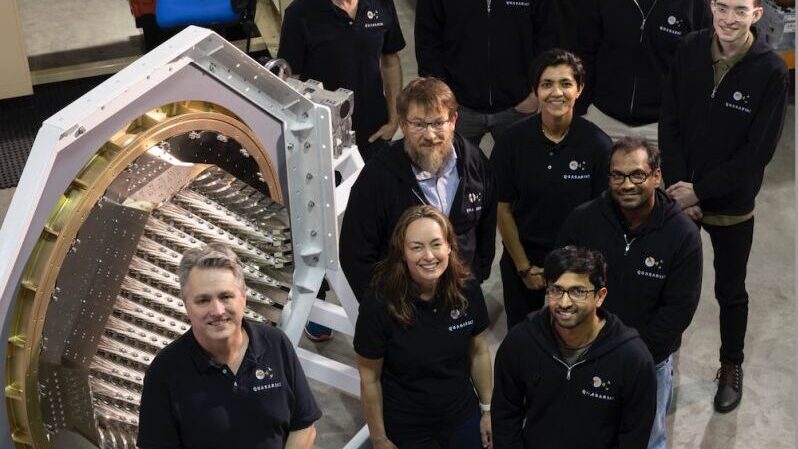
Quasar's first commercial ground station product: a compact, cryogenically cooled S-band phased array antenna capable of simultaneously communicating with multiple LEO satellites without mechanical steering.
Typed specifications1 values
Discloses 1 of 13 fields engineers filter by in this category (category median 2).
- Frequency bands
- S TX/RX · description
Each value is typed with its unit and measurement condition and cites the datasheet page it was taken from. Nothing is guessed: a field that is absent here has not been published by the manufacturer. machine-extracted ✓ checked by NewSpace Market ✓ manufacturer confirmed by the manufacturer.
As published by the supplier10 lines, in the manufacturer's own wording
- Frequency band
- S-band
- Beam count
- Up to 100 simultaneous independent beams
- Scanning
- Full hemisphere, electronically steered (no mechanical movement)
- Cooling
- Cryogenically cooled (world's first for commercial SATCOM)
- Architecture
- Pure digital, true multibeam phased array
- Satellite compatibility
- Constellation-agnostic (any S-band LEO satellite)
- Software
- Software-defined; cloud-managed via Microsoft Azure
- Form factor
- Compact flat-panel array (~coffee table footprint)
- Commercial release
- Mid-2023
- Technology origin
- CSIRO (Australian Square Kilometre Array Pathfinder)
About
Quasar’s S-band multibeam phased array ground station was the company’s first commercial product, released in mid-2023. It replaces conventional parabolic dish antennas — which can only track one satellite at a time — with a compact electronically scanned array roughly the size of a coffee table that can simultaneously track and communicate with multiple satellites using hundreds of independent steerable beams.
The system is based on proprietary phased array technology developed at CSIRO’s radio astronomy division and licensed exclusively to Quasar. Unlike competing phased arrays that typically support two to three beams and are frequency-locked to specific satellite constellations, Quasar’s true multibeam digital architecture is satellite-agnostic and can serve any LEO satellite in S-band without reconfiguration.
The antenna operates at cryogenic temperatures — described by the company as the world’s first cryogenically cooled commercial satellite communications solution — which dramatically improves receiver sensitivity and enables detection of the weak signals common in LEO downlinks. The system is software-defined, allowing dynamic reconfiguration for different satellites, orbits, and mission requirements. It integrates with Quasar’s cloud-based ground station management software running on Microsoft Azure, providing satellite operators with automated pass scheduling, telemetry forwarding, and data delivery.
Documentation
No public datasheet yet — request the datasheet / ICD from the supplier.