Reflectarray Antenna
 Anywaves
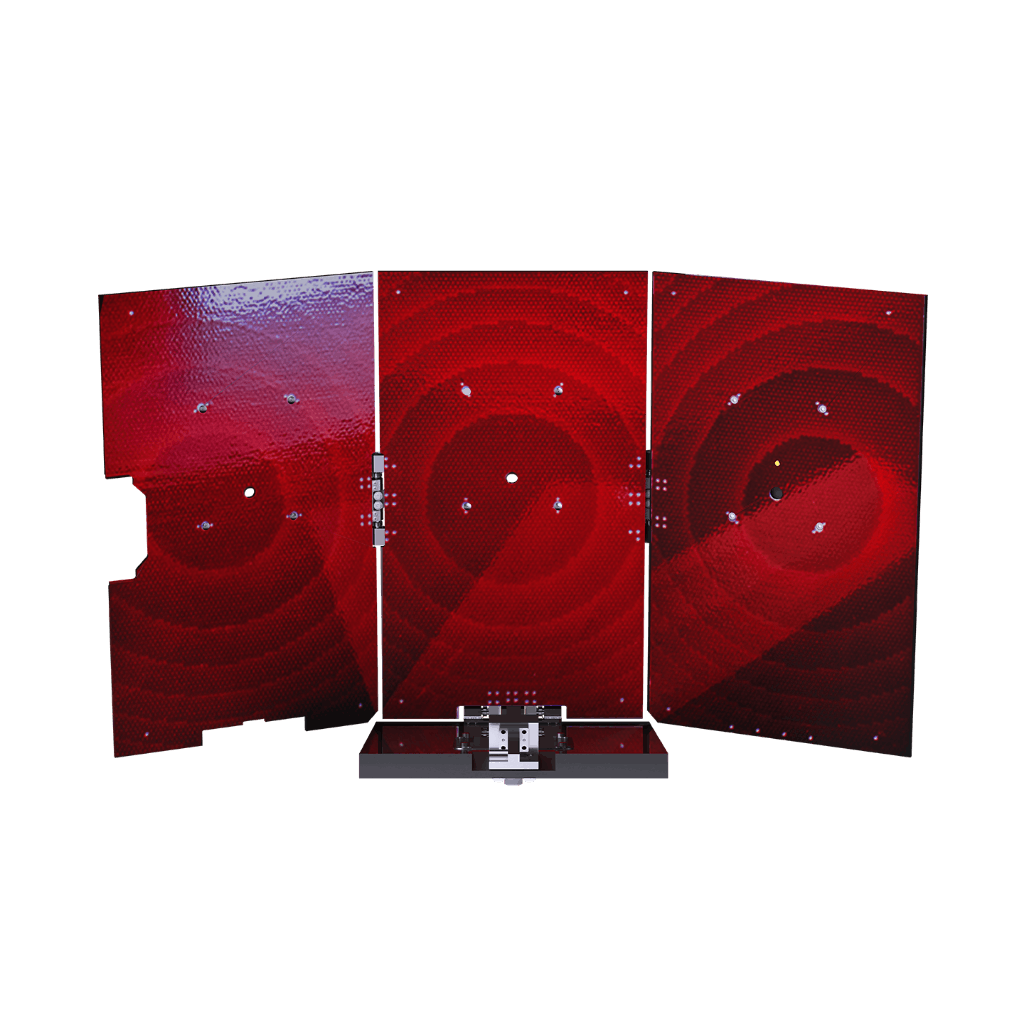
The Reflectarray Antenna replicates the performance of a parabolic reflector using a series of flat, foldable panels engineered to reflect and phase-control RF waves, delivering high gain from X-band to Ka-band.
Typed specifications2 values
Discloses 0 of 10 fields engineers filter by in this category (category median 3).
- Envelope (L×W×H)
- 360 × 210 × 30 mm (compact stowed volume for launch) product page
- TRL
- 9 product page
Each value is typed with its unit and measurement condition and cites the datasheet page it was taken from. Nothing is guessed: a field that is absent here has not been published by the manufacturer. machine-extracted ✓ checked by NewSpace Market ✓ manufacturer confirmed by the manufacturer.
As published by the supplier6 lines, in the manufacturer's own wording
- Central frequency
- X-band to Ka-band (scalable toward Q/V band)
- Polarization
- Dual-circular polarization (simultaneous LHCP and RHCP)
- Realized gain
- Up to 40 dBi (design target — optimised per project)
- Fractional bandwidth
- Up to 15%
- Stowed dimensions
- 360 × 210 × 30 mm (compact stowed volume for launch)
- TRL
- 9 — In orbit
About
The Reflectarray Antenna is a custom-designed, flight-proven high-gain payload antenna for small satellites. Originally developed under a CNES programme and now in orbit as the world’s first commercial reflectarray antenna on a small satellite, it delivers up to 40 dBi of gain from X-band to Ka-band using foldable flat panels that replicate the performance of a parabolic reflector. It is designed for missions where high gain, broadband performance, compact stowage and deployment reliability must be achieved simultaneously. The antenna unfolds through a robust passive deployment mechanism: no motor, no electrical actuation, no software dependency. Precision-guided folding systems and locking interfaces between the central and lateral panel sections ensure that the aperture deploys to its correct geometry every time, with structural rigidity maintained throughout the mission lifetime. Passive thermal control is integrated into the design, ensuring the panel geometry remains stable across the extreme thermal gradients of orbital operations. The Reflectarray Antenna supports dual-circular polarization — it transmits or receives Left Hand and Right Hand Circular Polarization simultaneously from the same aperture. This dual-pol capability is a significant system architecture advantage: it doubles the data throughput for a given aperture size in communications applications, enables polarimetric SAR in radar applications, and provides inherent link redundancy without requiring a second antenna. The fractional bandwidth of up to 15% further extends the frequency agility available to mission designers.
Documentation
Need the full ICD, test reports or a specific revision? Ask the supplier directly.