Auricam™
 Sodern
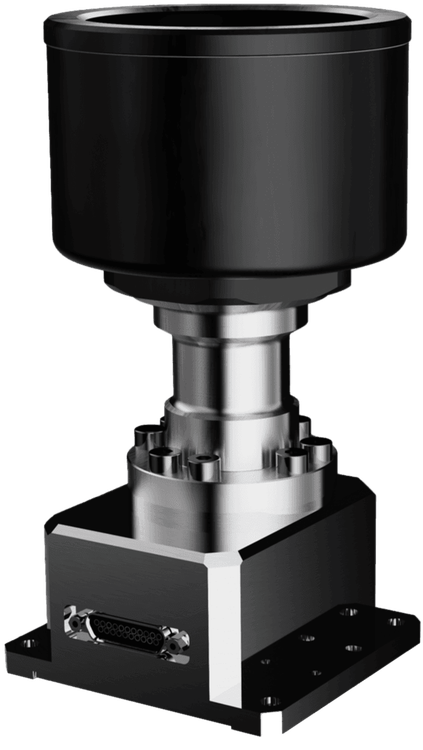
Auricam™ is a compact, off-the-shelf space camera designed for a wide range of missions including space surveillance, in-orbit services, monitoring, and navigation, offering optimal signal-to-noise ratio and various fields of view.
Typed specifications91 values
Discloses 6 of 14 fields engineers filter by in this category (category median 4).
- Ground sample distance (GSD)
- 5 m @ 10 km D80 · datasheet p.4 2 m @ 10km D35 | 0.2 m @ 1km D35 | 0.48 m @10 km D8 | 0.05 m @1km D8 +7
- Mass
- 420 g D35 · datasheet p.2 420 g D35 optical head | 450 g D80 | 450 g D80 optical head | 315 g Electronic unit +3
- Envelope (L×W×H)
- 80 x 80 x 140 mm D35 · datasheet p.2 80 x 80 x 140 mm D35 optical head | 71 x 65 x 155 mm D8 | 71 x 65 x 155 mm D8 optical head | 90 x 90 x 135 mm D80 +3
- Sensor resolution
- 4 Mpx datasheet p.2 2048 x 2048 pixels | 4.19 Mpx 2048 × 2048 px; as stated: «2048 x 2048 pixels»
- Supply voltage
- 5 V electronic unit power supply · datasheet p.2 5 V power supply | 4.6–6 V | 4.6–6 V power supply
- Power consumption
- 2 W datasheet p.5 2.4 W BOL Electronic unit | 2 W Electronic Unit, per OH (BOL) | 2.4 W Electronic Unit, per PU (BOL) | 2 W optical head (BOL) +2
- Data interface
- SpaceWire datasheet p.3 SpaceWire
- Operating temperature
- -35–55 °C baseplate temp. · datasheet p.5 -35–55 °C qualification operating range, baseplate temp.
- Design lifetime
- 15 years GEO · datasheet p.5 10 years LEO
- Export status
- ITAR-free datasheet p.4 EU dual-use EU Dual Use 6A003.b.5
- Camera type
- other Black & White (standard), visible · datasheet p.5 RGB Color (on request)
- Field of view
- 35 ° D35, diagonal · datasheet p.2 25 ° D35, square | 8 ° D8, diagonal | 5.7 ° D8, square | 80 ° D80, diagonal +1
- Focal length
- 25 mm D35 · datasheet p.4 114 mm D8 | 10 mm D80
- Survival temperature
- -45–60 °C baseplate temp, non-operating · datasheet p.5 -45–60 °C qualification non-operating range, baseplate temp. | -45–80 °C storage | -45–80 °C storage temperature
- Random vibration
- 14.1 g RMS D35, in plane · datasheet p.5 21.8 g RMS D35, out of plane | 14.1 g RMS D8, in plane | 21.8 g RMS D8, out of plane | 12 g RMS D80, in plane +1
- Flight heritage
- AurigaTM Star Tracker with 1400+ Units flying and 40+ millions hours of successful operation datasheet p.7 Navigation camera of JUICE mission | High performance Narrow Angle Camera of the Earth Return Orbiter (ERO) spacecraft
- Detector
- CMOS datasheet p.4
- Bit depth
- 8 bit pixel depth 8, 10 or 12 bits · datasheet p.3 10 bit pixel depth 8, 10 or 12 bits | 12 bit pixel depth 8, 10 or 12 bits
- F-number
- 5.6 D35, option · datasheet p.4 3.5 D35, standard fixed aperture | 6.3 D8, fixed aperture | 5.6 D80, option | 4 D80, standard fixed aperture +2
- Frame rate
- 10 fps 2x2 binned · datasheet p.5 2.5 fps full frame, 12 bits
- Sensor format (pixels)
- 2048 x 2048 pixels datasheet p.5
- Pixel pitch
- 5.5 µm pitch · datasheet p.5
- Exposure time
- 0.06–30 000 ms programmable integration time, printed 60 us - 30 s · datasheet p.5
- Data interface speed
- 160 Mbps max · SpaceWire, selectable 20 / 40 / 80 / 160 Mbps · datasheet p.3
Each value is typed with its unit and measurement condition and cites the datasheet page it was taken from. Nothing is guessed: a field that is absent here has not been published by the manufacturer. machine-extracted ✓ checked by NewSpace Market ✓ manufacturer confirmed by the manufacturer.
As published by the supplier7 lines, in the manufacturer's own wording
- FOV
- 35 deg diagonal (25 deg square)
- Resolution
- 4 MPx
- Sensor
- CMOS (B&W or color)
- Dimensions
- 80 x 80 x 140 mm
- Mass
- 420 g
- Design lifetime
- 15 years
- Applications
- SSA, SDA, in-orbit servicing, navigation, monitoring
About
Auricam™ is a versatile space camera engineered to support a broad spectrum of missions, including space surveillance and detection (SSA, SDA), in-orbit services, monitoring, and navigation. It boasts an optimal size, weight, and power consumption (SWAP) ratio, making it compact and readily available off-the-shelf with short delivery times due to its design for high production rates. The camera features a baffle that ensures an optimal signal-to-noise ratio in all conditions and provides protection against stray light. It delivers 4 MPx resolution images in the visible range, available in black and white or color. The system comprises an Optical Head and an Electronic Unit, with several fields of view offered to meet diverse operational needs: 80°, 35°, and 8°. An optional Electronic Unit can manage two cameras via a SpaceWire interface. Sodern also offers an Auricam™ numerical model, a software library to enhance simulation and validation workflows by simulating realistic images, considering detector noises, sequencing effects, optical distortion, intra and inter-pixel sensitivity, straylight effects, PSF, and proton effects. This model includes a star catalog for integrating 3D models. Electronic ground support equipment (EGSE) is available for driving Auricam™ during testing. The company provides flexible camera acceptance test plans, ranging from minimum performance tests for cost optimization to full environmental and performance characterization. Technical support options include remote assistance, mission-specific radiation and performance assessments, additional on-demand technical support, and customization to help find the best cost-performance trade-off for specific needs.
Documentation
Need the full ICD, test reports or a specific revision? Ask the supplier directly.