Sodern Auriga SA
 Sodern
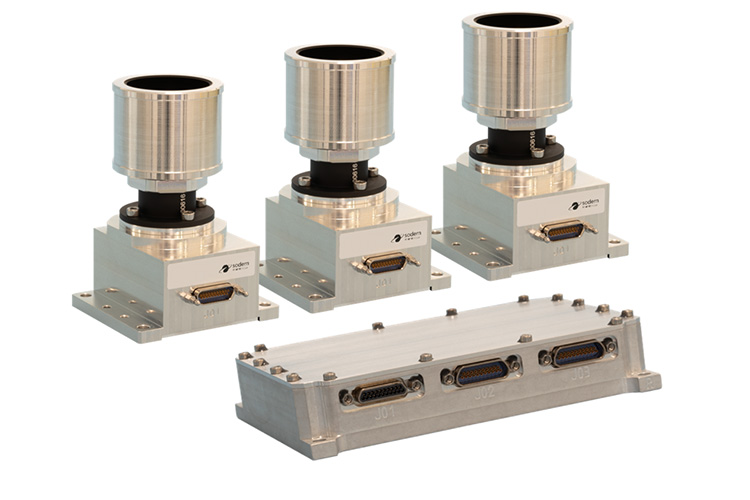
The Sodern Auriga SA is a compact, radiation-resistant star tracker optimized for small satellite platforms and CubeSats, offering high performance and reliability for missions up to 15 years in orbit.
Typed specifications57 values
Discloses 10 of 12 fields engineers filter by in this category (category median 8).
- Accuracy, cross-boresight
- 61.2 arcsec bias (worst case) · datasheet p.2 6.6 arcsec high frequency spatial (pixel) error XY @ 3 sigma | 9 arcsec low frequency spatial (FOV) error XY @ 3 sigma | 11 arcsec temporal noise on XY @ 3 sigma
- Mass
- 315 g EU · datasheet p.2 315 g EU mass | 225 g OH, including baffle
- Accuracy, about boresight (roll)
- 38 arcsec high frequency spatial (pixel) error Z @ 3 sigma · datasheet p.2 51 arcsec low frequency spatial (FOV) error Z @ 3 sigma | 70 arcsec temporal noise on Z @ 3 sigma
- Envelope (L×W×H)
- 91 x 117 x 25 (height) EU · datasheet p.2 91 x 117 x 25 (height) mm EU size | 66 x 56 x 94 (height) mm OH size, including baffle | 66 x 56 x 94 (height) OH, including baffle
- Update rate
- 8 Hz datasheet p.2 8 Hz output rate, 8 or 10 | 10 Hz | 10 Hz output rate, 8 or 10
- Max tracking rate
- 0.3 °/s acquisition, baseline · datasheet p.2 0.3 °/s Acquisition, in baseline | 2 °/s Acquisition, up to | 3 °/s Tracking, up to | 2 °/s max · acquisition, up to +1
- Sun exclusion angle
- 35 ° Baffle · datasheet p.2 35 ° baffle Sun exclusion angle
- Field of view
- 9 ° product page
- Lost-in-space acquisition time
- 3.8 s typical · datasheet p.2 3.8 s time from lost-in-space, typ | 3.8 s typ.
- Supply voltage
- 5 V nom. · datasheet p.2 5 V nom. · EU power supply, 5 V (±5%); OH supplied by EU
- Power consumption
- 2.5 W EU, typical · datasheet p.2 3.4 W EU, max | 1.1 W OH, max | 0.8 W OH, typical | 3.4 W max · EU, max +1
- Data interface
- RS-422 EU output data · datasheet p.2 RS-422 EU: RS422 UART (115200 baud) | SpaceWire OH to EU interface | UART EU output data
- Operating temperature
- -20–40 °C operating · datasheet p.2
- Design lifetime
- 15 years GEO with EOR · datasheet p.2 10 years LEO 400-1200 km | 10 years LEO 400-1200km
- Configuration
- separate optical head and electronics unit up to 3 optical heads may be connected to 1 electronic unit t… · datasheet p.2
- Survival temperature
- -30–70 °C storage · datasheet p.2
- Random vibration
- 14 g RMS in plane · datasheet p.2 22 g RMS out of plane
- Flight heritage
- Flight proven since 2019 datasheet p.2
- Satellite class
- smallsat 100-500 kg specifically designed for small satellites missions · datasheet p.1
- Missions flown
- 1 in orbit demonstration · datasheet p.1
- Baffle
- integrated baffle protection for direct Sun and Earth illumination · datasheet p.2
- Volume (with baffle)
- 0.208 U EU size (mm): 91 x 117 x 25 (height) · datasheet p.2 0.59 U OH size (mm, including baffle): 66 x 56 x 94 (height)
- Earth exclusion angle
- 22 ° baffle Earth exclusion angle · datasheet p.2
Each value is typed with its unit and measurement condition and cites the datasheet page it was taken from. Nothing is guessed: a field that is absent here has not been published by the manufacturer. machine-extracted ✓ checked by NewSpace Market ✓ manufacturer confirmed by the manufacturer.
As published by the supplier32 lines, in the manufacturer's own wording
- Operating temperature range
- -20/+40 °C
- Storage temperature
- -30/+70 °C
- Mechanical environment (in/out of plane)
- 14/22 gRMS gRMS / 2000gSRS @2000 Hz
- Oh size (mm, including baffle)
- 66 x 56 x 94 (height)
- Eu size
- 91 x 117 x 25 (height) mm
- Oh mass (g, including baffle)
- 205
- Eu mass
- 315 g
- Eee parts class for oh
- ECSS Class 3 equivalent and Automotive
- Eee parts class for eu
- ECSS Class 3 equivalent and Automotive
- Reliability for oh
- 230 FIT (FIDES method @20°C)
- Reliability for eu
- 470 FIT (FIDES method @20°C)
- Design life
- 10 in LEO 400-1200 km; 15 in GEO with EOR
- Oh power supply
- Supplied by EU
- Eu power supply
- 5 V (±5%)
- Oh power consumption (W, typ/max)
- 0.8/1.1
- Eu power consumption (W, typ/max)
- 2.5/3.4
- Output data
- EU: RS422 UART (115200 baud)
- Output rate
- 8 or 10 Hz
- Bias (worst case)
- 0.017 deg
- Thermo-elastic error (worst case)
- 1 arcsec/°C
- Low frequency spatial (FOV) error xy/z @ 3σ
- 9/51 arcsec
- High frequency spatial (pixel) error xy/z @ 3σ
- 6.6/37 arcsec
- Temporal noise on xy/z @ 3σ
- 11/69 arcsec
- Time from lost-in-space (typ)
- < 4s
- Slew rate in acquisition
- 0.3 deg/s
- Slew rate in tracking
- Up to 3 deg/s²
- Acceleration in acquisition
- Up to 1 deg/s²
- Acceleration in tracking at 10 hz
- Up to 2.5 deg/s²
- Full moon in the field of view
- No performance degradation
- Baffle sun exclusion angle
- 35 deg
- Baffle earth exclusion angle
- 22 deg
- Solar flare acquisition/tracking
- Robust
About
The Sodern Auriga SA is a compact star tracker designed for small satellite missions and constellations, particularly for platforms under 500kg and CubeSats from 6U. It incorporates the latest high-tech components and is optimized for space environments, featuring radiation-resistant design with a thicker casing and hardened optics. This allows for a lifetime of over 15 years in geostationary orbit and 10 years in low Earth orbit (LEO 400-1,200km). The Auriga SA is designed for cost reduction through standardized components while maintaining excellent technical performance and reliability. Its small volume (66 x 59 x 94 mm) and light weight (225g) make it one of the most compact star trackers in its category. Over 1200 Auriga™ units are already in orbit with a 100% mission success rate, with in-orbit demonstration since 2019. The system consists of an Optical Head (OH) and an Electronic Unit (EU) for plug-and-play integration. The Optical Head includes baffle protection for direct Sun and Earth illumination, and up to three Optical Heads can be connected to a single Electronic Unit via a SpaceWire interface. The Electronic Unit features embedded software for processing OH data and computing attitude, and can perform OH FDIR (Fault Detection, Isolation, and Recovery) through an autonomous individual OH switch ON/OFF. It operates at an assumed 10 Hz refresh rate and includes an embedded Star Catalog and algorithms inherited from 50 years of experience with star trackers, including the Hydra Star Tracker.
Documentation
Need the full ICD, test reports or a specific revision? Ask the supplier directly.