Solar arrays
 Hemeria
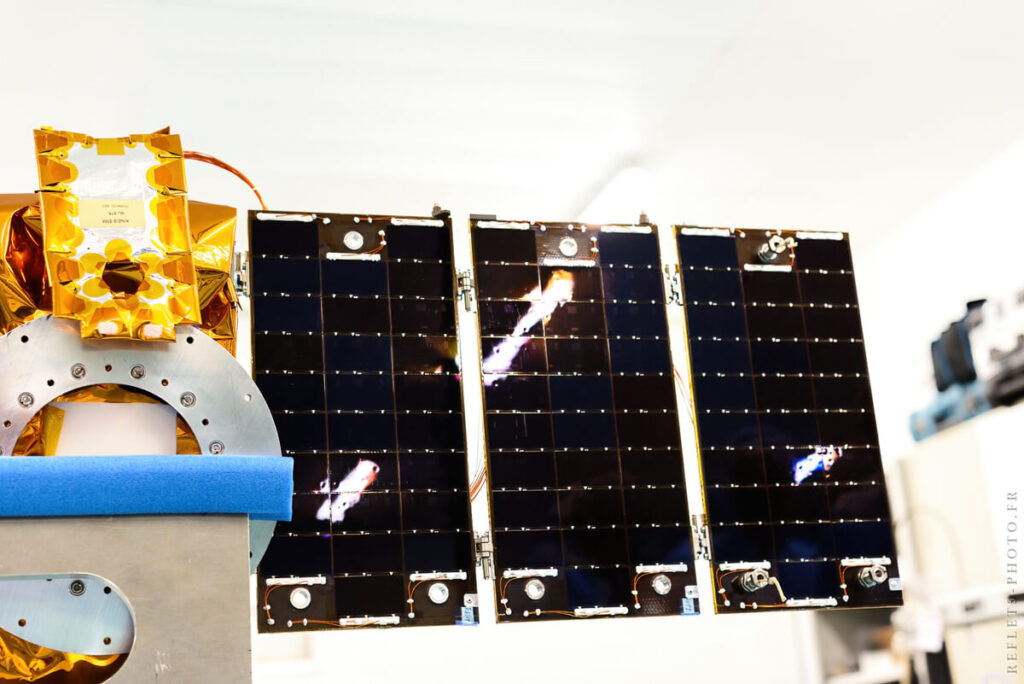
HEMERIA designs and builds solar arrays for all types of spacecraft, nano or micro satellites, rovers and transfer vehicles, offering a reliable and proven solution with controlled costs and short lead-times.
Typed specifications2 values
Discloses 0 of 12 fields engineers filter by in this category (category median 3).
- Design lifetime
- 8 years datasheet p.2
- Flight heritage
- solar arrays for the KINEIS constellation (180), and for the Idefix rover (MMX) datasheet p.2
Each value is typed with its unit and measurement condition and cites the datasheet page it was taken from. Nothing is guessed: a field that is absent here has not been published by the manufacturer. machine-extracted ✓ checked by NewSpace Market ✓ manufacturer confirmed by the manufacturer.
As published by the supplier11 lines, in the manufacturer's own wording
- Number of panels
- 1-3 panels per array
- Range
- From 30 W to 1 KW
- Cells
- Azurspace AZUR 3G30A / Spectrolab XTE CIC
- Lifetime
- From 5 to 8 years in orbit
- Electrical I/F
- Sub D connector
- Orbit
- LEO, GEO, MEO, Exploration
- Lead-time
- Design and acceptance tests: 6 to 9 months · Design / qualification: 2 to 3 months
- Substrate
- CFRP skin with aluminum honeycomb panel
- Frequency in retracted position
- > 100 Hz
- Mass
- Mechanical 0.5 kg for an array of 3 panels · Panel + PVA : 3.4 kg/m²
- Loads
- >15 grams quasi-static design load · >15 grams random vibrations
About
HEMERIA is committed to on-time supply of high-quality industrial solar arrays solutions for spacecraft, in the 30W to 1KW range, using a CNES-approved manufacturing process. These solar arrays are designed for various orbits including LEO, GEO, MEO, and exploration missions, with a lifetime of 5 to 8 years in orbit. They feature 1-3 panels per array, utilizing Azurspace AZUR 3G30A or Spectrolab XTE CIC cells. The substrate is made of CFRP skin with an aluminum honeycomb panel, and hinges are developed in-house. HEMERIA also offers qualified repair processes for their solar arrays. The design and acceptance tests typically take 6 to 9 months, while design and qualification can be completed in 2 to 3 months. These solar arrays have been approved on missions such as ANGELS, Smallsat, IDEFIX, KINEIS, and the MMX Rover.
Documentation
Need the full ICD, test reports or a specific revision? Ask the supplier directly.