Spacecraft orientation and stabilization system
 Glavkosmos
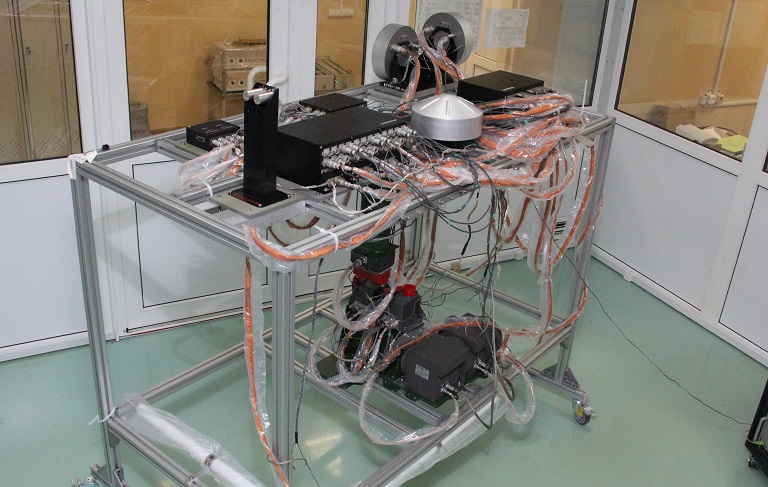
A high-precision orientation and stabilization system for medium-orbit spacecraft, designed to manage spacecraft attitude, perform programmable turns, and ensure energy levels.
Key figurescomparable across the catalogue
- Mass
- 50 kg
- Power
- 120 W
- Lead time
- 24 months
Normalised to common units so this product can be compared with others in its category. The supplier's own wording is below.
As published by the supplier
- Year of release
- 2019
- Lead time
- 24 months
- Flight qualification of the product
- Yes
- Brief history of flight qualification
- "Condor-E" spacecraft
- Possibility to adapt the product to customer requirements
- Yes
- Orbit
- MEO
- Weight without connecting harnesses
- 50 kg
- The accuracy of orientation determination
- 1 angular minute
- Accuracy of orientation maintenance
- 3 angular minutes
- Discrepancy in
- 2 angular minutes
- Discrepancy in indicating the flight attitude of the associated axes of the spacecraft relative to the ics (inertial coordinate system) during target operations
- 20 angular seconds when using two SCMU (Stars Coordinate Measurement Unit) devices
- Stability
- 0.001 degree per second
- Working supply voltage
- 27 V
- Average orbit pass energy consumption
- 120 W
- Time of establishing the orbital orientation on control engines of momentum wheels
- ≤ 2 hours
- Time of establishing the orbital orientation on liquid rocket engines (LRE)
- ≤ 0.5 hours
- Information exchange channel with self-monitoring execution block
- GOST R 52070-2003
About
The Spacecraft Orientation and Stabilization System is engineered for critical attitude control tasks on medium-orbit spacecraft with moments of inertia ranging from 100 to 5000 kg·m². Its primary functions include initial stabilization and damping after separation from the upper stage, securing and maintaining the spacecraft in a specific oriented state, and precisely orienting the spacecraft during target operations. The system also facilitates programmable turns and u-turns, restores spacecraft orientation, and ensures the necessary energy level. It features a three-circuit electrical reaction wheel system with a magnetic kinetic moment reset mechanism and control of Liquid Rocket Engines (LRE). Designed for leaky compartments, it ensures information interaction through a redundant Multiplex Information Exchange Channel (MIEC) bus. The system is built using radiation-resistant elements from the Russian rocket and space industry. It was released in 2019 and has flight heritage on the “Condor-E” spacecraft. The product can be adapted to customer requirements.
Documentation
No public datasheet yet — request the datasheet / ICD from the supplier.