Tanques soldados por Friction Stir Welding (FSW)
 VENG S.A.
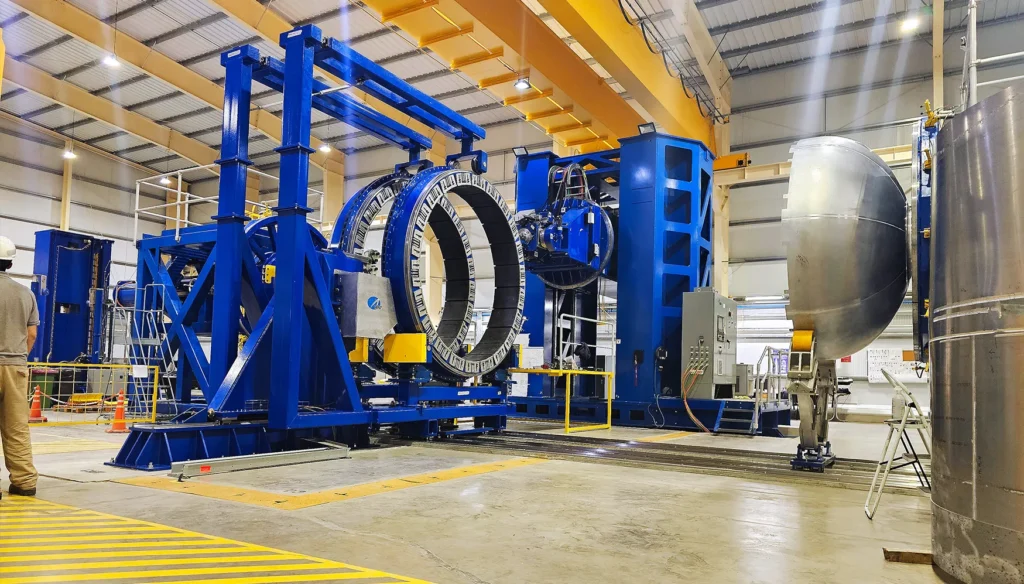
Friction Stir Welded (FSW) pressurized aluminum 2219 propellant tank structures developed by VENG for the first stage of the Tronador II-250 space launch vehicle.
Typed specifications10 values
Discloses 2 of 9 fields engineers filter by in this category (category median 3).
- Envelope (L×W×H)
- 3,5 metros de longitud, 2,5 metros de diámetro y 3,2 milímetros de espesor datasheet p.13
- Material (wetted or shell)
- Aleaciones de aluminio datasheet p.13 aluminium alloy aluminio 2219 de uso espacial | aluminio 2219 de uso espacial
- Component
- tank datasheet p.13 tank
- Tank shape
- cylindrical datasheet p.14
- Tank mounting
- skirt datasheet p.14
- Port fitting
- Soldaduras longitudinales, circunferenciales datasheet p.13 Tope, Solapadas
Each value is typed with its unit and measurement condition and cites the datasheet page it was taken from. Nothing is guessed: a field that is absent here has not been published by the manufacturer. machine-extracted ✓ checked by NewSpace Market ✓ manufacturer confirmed by the manufacturer.
As published by the supplier16 lines, in the manufacturer's own wording
- Prototype tank length
- 3.5 m
- Prototype tank diameter
- 2.5 m
- Prototype tank wall thickness
- 3.2 mm
- Tank material
- Aluminum 2219 (space grade)
- Welding standard
- American Welding Society (AWS) international standards
- Final lox tank length
- 8 m
- Final kerosene tank length
- 6 m
- Fabricante (Manufacturer)
- Nova Tech Engineering Inc.
- Geometría (Geometry)
- Soldaduras longitudinales, circunferenciales (Longitudinal, circumferential welds)
- Juntas (Joints)
- Tope, Solapadas (Butt, Lap)
- Materiales (Materials)
- Aleaciones de aluminio (Aluminum alloys)
- Espesores (Thicknesses)
- 2,4 mm – 13 mm
- Longitud de soldadura (Weld length)
- 2600 mm (máxima)
- Rpm herramienta (Tool RPM)
- 5 rpm – 2000 rpm
- Carga máxima (Max load)
- 53400 N
- Torque máximo (Max torque)
- 450 Nm
About
VENG has developed the capability to design, fabricate and integrate pressurized and non-pressurized structures using the Friction Stir Welding (FSW) manufacturing technique, a solid-state welding process that joins two pieces using a non-consumable tool without melting the base material, achieving very high joint efficiencies in alloys where conventional fusion welding degrades mechanical properties significantly. This makes FSW widely used in the space, naval and military industries, mainly for welding aluminum alloys. As its latest milestone, VENG designed, manufactured and integrated a prototype first-stage tank for the Tronador II-250 launcher: 3.5 meters long, 2.5 meters in diameter, with 3.2 mm wall thickness, welded using the friction-stir method under American Welding Society (AWS) international standards — a technology used for the first time in the country. All tank components are made of space-grade aluminum 2219. The tank structure comprises a Casquete (dome/closure element), Pollera de Tanque (envelope extension enabling connection to other primary structures), Envuelta (cylindrical tank section), and Interfaz, joined by several weld types: Circumferential Flange/Dome weld, Meridional Gore weld, Circumferential Dome/Envelope weld, Longitudinal Stringer/Envelope weld, Circumferential Envelope/Envelope weld, and Longitudinal Envelope/Envelope weld. This prototype is a milestone for the Tronador project, carried out jointly by VENG and Argentina’s national space agency CONAE, as it is the enabling technology toward the final manufacture of first-stage structural tanks, which will be 8 meters long for liquid oxygen and 6 meters long for kerosene; these tanks simultaneously serve as both fuselage and propellant storage. The Tronador project aims to place satellites into low orbits at 600 km altitude using a launcher developed entirely within Argentina, with Tronador II forming part of CONAE’s ISCUL (Inyector Satelital para Cargas Útiles Livianas) program. The welds are produced at VENG’s Friction Stir Welding Center (FSWC), equipped with a Nova Tech Engineering Inc. machine capable of longitudinal and circumferential welds, butt and lap joints, on aluminum alloys, with thicknesses from 2.4 mm to 13 mm, maximum weld length of 2600 mm, tool speed from 5 to 2000 rpm, maximum load of 53400 N and maximum torque of 450 Nm.
Documentation
Need the full ICD, test reports or a specific revision? Ask the supplier directly.