WarpHub InterSat
 WARPSPACE Inc.
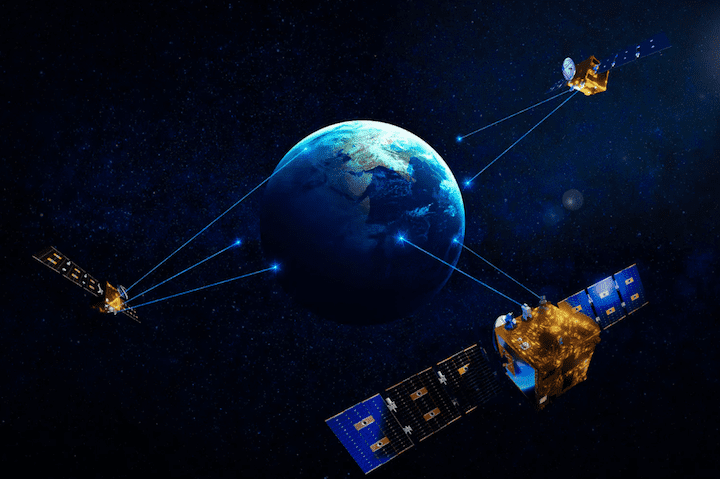
World's first commercial optical inter-satellite data relay network service, using three MEO relay satellites to provide 1 Gbps+ near-real-time downlink connectivity for LEO Earth observation satellites.
Key figurescomparable across the catalogue
- Data rate
- 1,000 Mbps
Normalised to common units so this product can be compared with others in its category. The supplier's own wording is below.
As published by the supplier
- Service type
- Optical inter-satellite data relay network
- Constellation size
- 3 relay satellites
- Relay orbit
- MEO, 8,000–10,000 km altitude
- User satellite orbit
- LEO, 500–1,000 km altitude
- Isl data rate (user to relay)
- ≥1 Gbps (optical)
- Ground downlink data rate (relay to ground)
- ≥1 Mbps (RF)
- Future data rate target
- 10–100 Gbps
- Availability
- 24/7, near real-time
- Optical terminal (relay satellite)
- Mynaric CONDOR Mk 3
- Satellite bus
- ReOrbit Gluon (software-defined, autonomous)
- Ground operations
- Amazon Web Services (EKS, Aurora)
- Ground station network
- Global, including Leaf Space
- First demonstration
- WARP-01, deployed from ISS March 2021
- First constellation satellite
- WARP-02 / LEIHO, launch planned 2025
About
WarpHub InterSat is WARPSPACE’s flagship optical inter-satellite data relay network service — the world’s first commercial offering of its kind. The constellation consists of three relay satellites positioned in Medium Earth Orbit (MEO) at approximately 8,000–10,000 km altitude. Each relay satellite carries an optical communication terminal (Mynaric CONDOR Mk 3) and is built on ReOrbit’s software-defined Gluon satellite bus, chosen for its autonomy and fault-tolerance capabilities. The MEO altitude is deliberately selected to maximize the visible area of the relay satellite relative to LEO user satellites while minimizing optical terminal aperture requirements.
LEO Earth observation satellites — typically operating at 500–1,000 km altitude — face a critical bottleneck: each satellite can communicate with a ground station for fewer than 10 minutes out of every 90-minute orbit, meaning over 90% of acquired data is stranded on-board and never downlinked in time. WarpHub InterSat eliminates this constraint by acting as a persistent optical relay bridge, enabling user satellites to transmit data at 1 Gbps or higher in near-real-time 24/7, regardless of ground station geometry.
The system supports end-to-end data delivery from LEO user satellite to ground at gigabyte-scale throughput per pass. The relay-to-ground downlink uses RF (1 Mbps or above), while the satellite-to-satellite inter-satellite link (ISL) uses optical free-space communications, avoiding ITU spectrum coordination requirements that otherwise take up to five years for radio-frequency assignments. Ground infrastructure is distributed globally through contracted ground station partners including Leaf Space, and backend operations run on Amazon Web Services (Amazon EKS and Amazon Aurora).
The first WarpHub InterSat constellation satellite, nicknamed LEIHO (a reference to Mount Tsukuba’s Shinto heritage), is the WARP-02 spacecraft planned for launch in 2025. A technology precursor, WARP-01, was previously demonstrated from the ISS in March 2021. The constellation is designed to expand beyond the initial three satellites in response to customer demand, with future constellations targeting capacity growth to 10–100 Gbps data rates.
Documentation
No public datasheet yet — request the datasheet / ICD from the supplier.