ABSL CM2300 16s20p Li-ion Space Battery (56 V, 40 Ah)
 EnerSys / ABSL Space Products
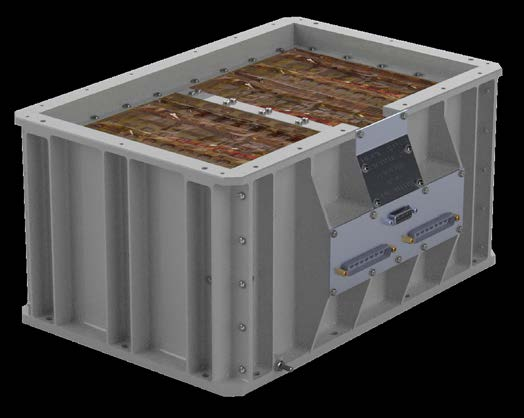
2300 Wh Li-ion space battery in 16s20p topology for a 56 V bus, 40 Ah nameplate capacity, 19.6 kg.
Typed specifications21 values
Discloses 5 of 12 fields engineers filter by in this category (category median 5).
- Energy
- 2 300 Wh datasheet p.1 2 300 Wh Energy
- Mass
- 19 600 g nom. · measured · datasheet p.1 19 600 g | 19 600 g Mass (kg measured)
- Capacity
- 40 Ah datasheet p.1 40 Ah Nameplate Capacity
- Cell chemistry
- Li-ion datasheet p.1 Li-ion (unspecified) Li-ion Space Battery, ABSL P20 cell
- Envelope (L×W×H)
- 260 x 359 mm (footprint), 177 mm (height) datasheet p.1
- Supply voltage
- 48–67.2 V Voltage Range · datasheet p.1
- Operating temperature
- 0–40 °C Operating · datasheet p.2
- Radiation tolerance (TID)
- 10 000 krad cell level, <1% decrease in capacity · datasheet p.2
- Cell configuration
- 16s20p datasheet p.1
- Connector
- interchangeable connector bracket datasheet p.1
- Survival temperature
- -20–50 °C Non-Operating · datasheet p.2
- Random vibration
- 15.4 g RMS random vibration, Overall GRMS · datasheet p.2
- Flight heritage
- 5.5 billion cell hours of in-orbit heritage using ABSL™ Li-ion cell technology datasheet p.1
- Shock qualification
- 2 000 g Shock input at 2000 Hz and 10,000 Hz, 3 shocks per axis · datasheet p.2
- Cell model
- P20 datasheet p.1
- Cell balancing
- none does not require cell balancing electronics · datasheet p.1
Each value is typed with its unit and measurement condition and cites the datasheet page it was taken from. Nothing is guessed: a field that is absent here has not been published by the manufacturer. machine-extracted ✓ checked by NewSpace Market ✓ manufacturer confirmed by the manufacturer.
As published by the supplier8 lines, in the manufacturer's own wording
- Cell
- ABSL P20
- Topology
- 16s20p
- Voltage range
- 67.2 - 48.0 V
- Nameplate capacity
- 40 Ah
- Energy
- 2300 Wh
- Footprint
- 260 x 359 mm
- Height
- 177 mm
- Mass (measured)
- 19.6 kg
About
The ABSL CM2300 in 16s20p topology is a Li-ion space battery built on the ABSL P20 cell, configured for a 56 V spacecraft bus and delivering 2300 Wh of energy.
EnerSys batteries supply power for platform and payload systems and are also essential prior to the deployment of any solar array apparatus. Whether a short-term repositioning energy requirement or high current demand such as a pyrotechnic system actuation, the batteries meet the challenges of space flight with advanced high voltage, long-life Li-ion solutions.
ABSL supplied the longest operating rechargeable Li-ion battery in space, the first to orbit Earth, Mars and Venus, the closest to orbit the sun, and the batteries trusted to power the James Webb Telescope, with over 6.5 billion cell hours in space without a mission failure.
Documentation
Need the full ICD, test reports or a specific revision? Ask the supplier directly.