Nova Satellite Bus
 Apex
Apex
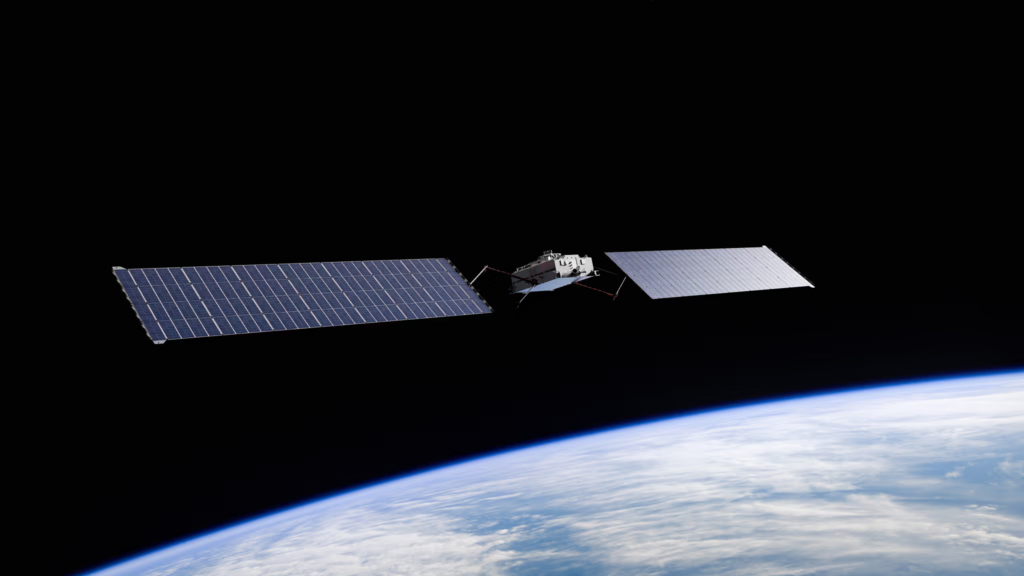
High-power 300 kg satellite bus with 1 kW payload power, 300 kg payload capacity, and precision pointing for proliferated communications and sensing constellations. First flight 2026.
Typed specifications11 values
Discloses 3 of 7 fields engineers filter by in this category (category median 3).
- Mass
- 300 kg product page
- Supply voltage
- 28 V product page
- Power consumption
- 1 W product page
- Design lifetime
- 7 years product page
- Max payload mass
- 300 kg max · product page
- Payload envelope (L × W × H)
- 965 × 1185 × 1000 mm (SpaceX XL Rideshare) product page
- Power available to payload
- 1 000 W EOL · product page
- Unregulated bus for the payload
- 28 V product page
- Attitude knowledge
- 0.007 ° max · product page
- Propulsion
- included product page
- Radio band
- S product page
Each value is typed with its unit and measurement condition and cites the datasheet page it was taken from. Nothing is guessed: a field that is absent here has not been published by the manufacturer. machine-extracted ✓ checked by NewSpace Market ✓ manufacturer confirmed by the manufacturer.
As published by the supplier17 lines, in the manufacturer's own wording
- Bus Dry Mass
- 300 kg
- Payload Mass
- up to 300 kg
- Payload Volume
- 965 u00d7 1185 u00d7 1000 mm (SpaceX XL Rideshare)
- Payload Power (OAP EOL 7yr)
- 1 kW
- Bus Voltage
- 28 V unregulated
- Pointing Knowledge
- <25 arcsec @ 3u03c3
- Pointing Control
- <50 arcsec @ 3u03c3
- Position Accuracy
- 10 m
- Velocity Accuracy
- 0.03 m/s
- Time Accuracy
- 30 ns RMS
- Propulsion
- HET Electric, up to 650 m/s delta-V
- TT&C
- S-band, up to 125 kbps
- Mission Downlink
- X-band, up to 350 Mbps (optional)
- Nominal Orbit
- 500u20131100 km circular, 45u00b0u2013135u00b0 inclinations
- Design Life
- 7 years @ 1100 km
- First Flight
- 2026 (planned)
- Launch
- SpaceX Falcon 9, NSSL
About
The Apex Nova is a high-performance satellite bus designed for demanding missions requiring large payload mass and power. With a 300 kg dry mass and up to 300 kg payload capacity, the Nova targets proliferated LEO communications, high-altitude sensing, missile warning & tracking, and other power-intensive missions.
The Nova provides 1 kW orbital average power (OAP EOL, 7-year mission) to payloads, enabling high-data-rate sensors, large phased arrays, and intensive signal processing payloads. Precision GNC delivers <25 arcsec pointing knowledge and <50 arcsec pointing control at 3σ.
An integrated high-efficiency Hall Effect Thruster (HET) provides up to 650 m/s delta-V for orbit maintenance, constellation phasing, and end-of-life disposal. Communications include S-band TT&C and optional X-band mission links at 350 Mbps.
The Nova fits in the SpaceX Rideshare XL envelope (965 × 1,185 × 1,000 mm), enabling cost-effective access to orbit. First flight planned for 2026.
Documentation
No public datasheet yet — request the datasheet / ICD from the supplier.