Branching Filter
 Glavkosmos
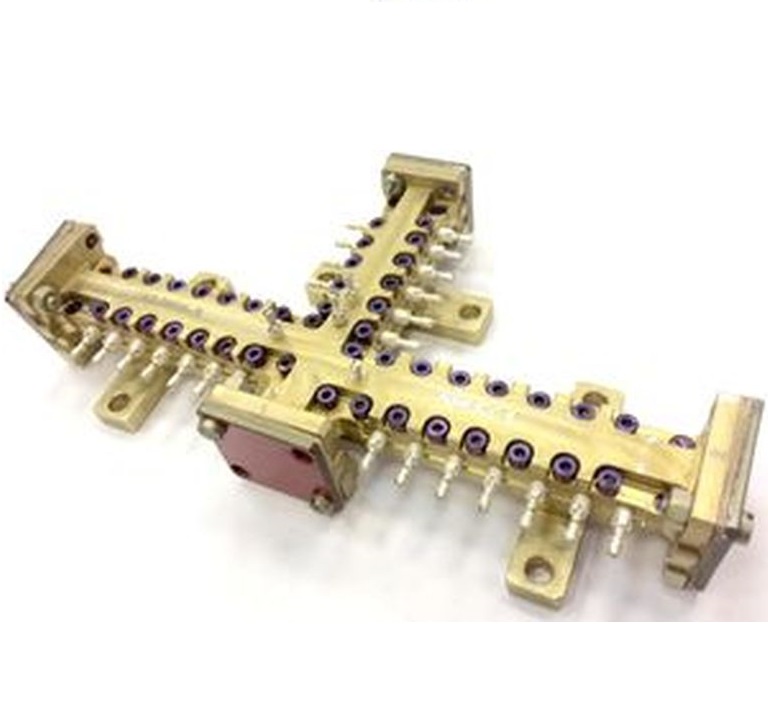
The Branching Filter is an HF element of antenna feed systems designed to provide signal transmission within specified frequency bands and suppress signals outside those bands.
Key figurescomparable across the catalogue
- TRL
- 9
Normalised to common units so this product can be compared with others in its category. The supplier's own wording is below.
As published by the supplier
- Swr in the frequency band 27000-27002 mhz
- not exceeding 1.2 between outputs 1.2
- Swr in the frequency band 30000-30002 mhz
- not exceeding 1.2 between outputs 1.3
- Swr in the frequency band 32508-32742 mhz
- not exceeding 1.2 between outputs 1.4
- Decay in the frequency band 27000-27002 mhz
- not exceeding 0.8 dB outputs 2-1
- Decay in the frequency band 30000-30002 mhz
- not exceeding 0.9 dB outputs 3-1
- Decay in the frequency band 32508-32742 mhz
- not exceeding 0.8 dB outputs 4-1
- Decay in the frequency band 32508-33000 mhz
- not less than 65 dB outputs 2-1, 4-1
- Decay in the frequency band 27000-27002 mhz (2)
- not less than 65 dB outputs 2-1, 4-1
About
The Branching Filter serves the critical purpose of ensuring precise signal transmission and suppression within an antenna feed system. It allows for the passage of signals in required frequency bands while effectively attenuating unwanted signals outside of these operational ranges. This component is an essential part of the high-frequency (HF) path within antenna systems, likely for spacecraft applications given the context of the website. Key performance parameters include specific SWR (Standing Wave Ratio) values across different frequency bands (27000-27002 MHz, 30000-30002 MHz, 32508-32742 MHz) and decay (attenuation) characteristics, both within and outside the operational bands. For instance, it boasts a decay of not less than 65 dB in certain frequency ranges, indicating strong signal suppression capabilities.
Documentation
No public datasheet yet — request the datasheet / ICD from the supplier.