L-Band Microwave Discrete Attenuator
 Glavkosmos
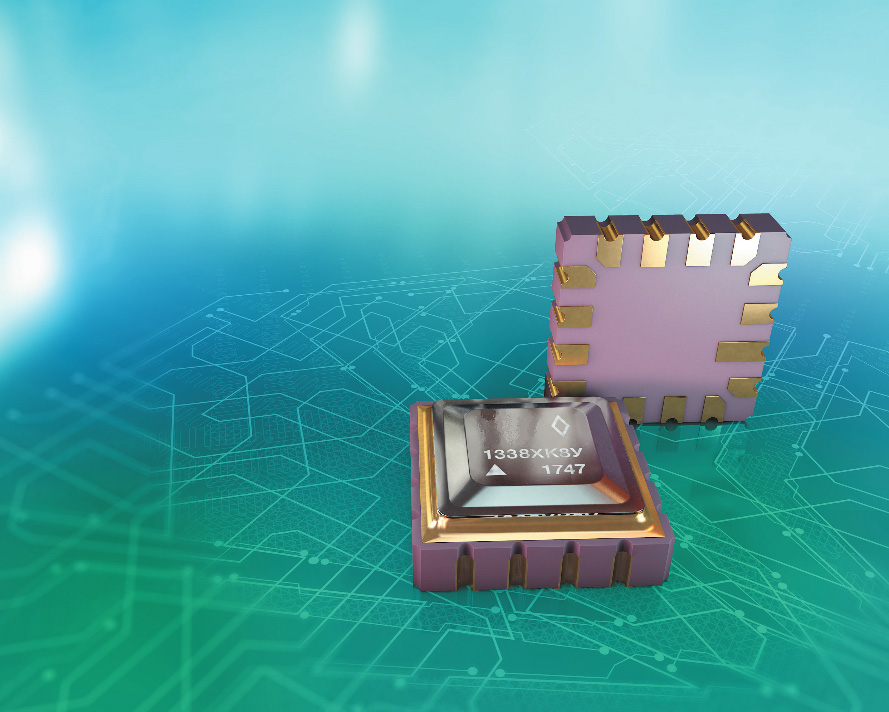
The L-Band Microwave Discrete Attenuator is a silicon-germanium BiKMOS MMIC designed to control the amplitude of L-band input signals for radio transceivers, including those used in satellite communications and navigation.
Key figurescomparable across the catalogue
- Mass
- 0.001 kg
- Power
- 0.25 W
- Design life
- 3 years
- Lead time
- 10 months
Normalised to common units so this product can be compared with others in its category. The supplier's own wording is below.
As published by the supplier
- Purpose
- Construction of radio transceivers.
- Year of release
- 2014
- Design life
- 3 years
- Lead time
- 10 months
- Flight qualification of the product
- No
- Possibility to adapt the product to customer requirements
- No
- W*h*t
- 6.35*6.35*1 mm
- Mass
- 1 g
- Supply voltage
- 5.0±0.15 V
- Operating temperature range
- -60 - +85 °C
- Digital supply voltage
- 2.5 V ± 0.15 V
- Case
- 5130.16.AN3
- Consumption current
- 0.05 A
- Clock frequency
- 100…1550 MHz
- Amplitude adjustment range
- 31.5 dB
- Gear ratio
- 3 dB
- Noise figure
- 7 dB
- Input compression point
- -5 dBm
About
The L-Band Microwave Discrete Attenuator (ATT) is a Monolithic Microwave Integrated Circuit (MMIC) developed using silicon-germanium BiKMOS technology. Its primary purpose is the construction of radio transceivers by controlling the amplitude of L-band input signals. The MMIC ATT is structured as a parallel-serial chain of resistive blocks, which are switched using MOS keys. An amplifier is integrated into the circuit to achieve a positive transfer coefficient. The switching of the ATT states is managed by a control circuit included within the MMIC, operating in parallel with a 6-bit code. This attenuator is specifically intended for L-band radio equipment, with applications including satellite communications and navigation, as well as radar equipment. The product was released in 2014 and has a guaranteed service life of 3 years. It is not flight qualified and cannot be adapted to customer requirements.
Documentation
No public datasheet yet — request the datasheet / ICD from the supplier.