Large Ku-band Antenna System which Forms Planimetric Directional Diagram
 Glavkosmos
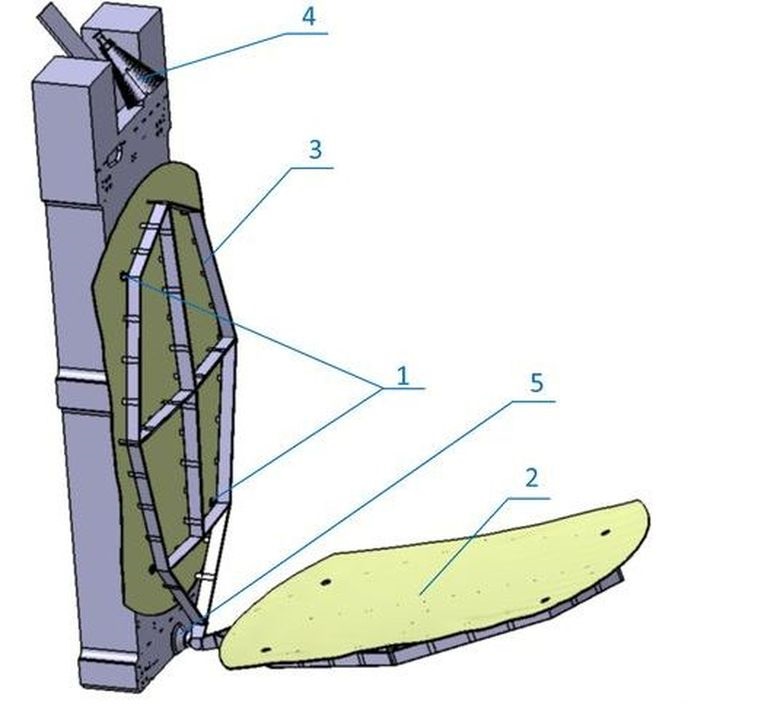
A large Ku-band antenna system designed for spacecraft, capable of forming a planimetric directional diagram for signal radiation and reception, with a 15-year guaranteed service life.
Key figurescomparable across the catalogue
- Design life
- 15 years
- Lead time
- 15 months
Normalised to common units so this product can be compared with others in its category. The supplier's own wording is below.
As published by the supplier
- Purpose
- Forming required servicing area; signal radiation within the operating frequency band 11.7 - 12.2 GHz; signal reception within the operating frequency band 14 - 14.5 GHz.
- Year of release
- 2013
- Design life
- 15 years
- Lead time
- 15 months
- Brief history of flight qualification
- Antenna underwent ground testing stage (preliminary tests).
- Frequency band
- Ku
- Reflector aperture dimensions
- 3.5×2 m
- Reflector and boom materials
- high-modulus CFRP material
- Reflector transfer mechanism
- provides rotation of the reflector to up to 90° angle from the stowed to the operational position and pointing within the range ±4 along each axis out of the two rotation axes with an error of 0.016
About
This Large Ku-band Antenna System is specifically designed for spacecraft applications. Its primary purpose is to form a required servicing area, radiate signals within the operating frequency band of 11.7 – 12.2 GHz, and receive signals within the operating frequency band of 14 – 14.5 GHz. The antenna system, released in 2013, boasts a guaranteed service life of 15 years. It features a reflector transfer mechanism that allows for rotation of the reflector up to a 90° angle from the stowed to the operational position. Furthermore, it provides pointing within a range of ±4 degrees along each of the two rotation axes with a high accuracy error of 0.016 degrees. The reflector and boom are constructed from high-modulus CFRP material, ensuring durability and lightweight performance. The system also supports polarization selection for received signals and the formation of required polarization for radiated signals. Although it has undergone ground testing (preliminary tests), it is explicitly identified as a ‘Spacecraft antenna’.
Documentation
No public datasheet yet — request the datasheet / ICD from the supplier.