Long March 3B
 CALT (China Academy of Launch Vehicle Technology)
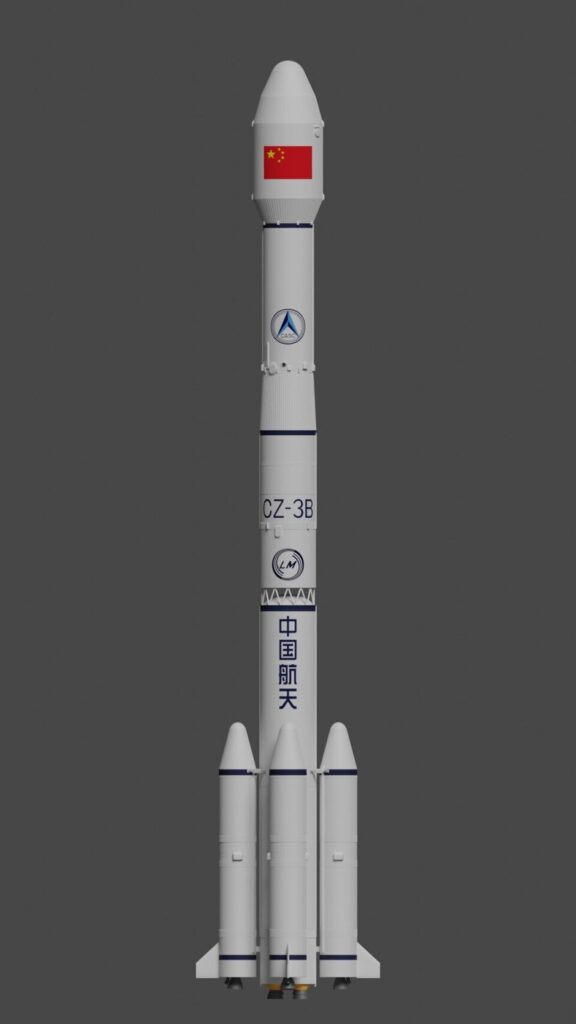
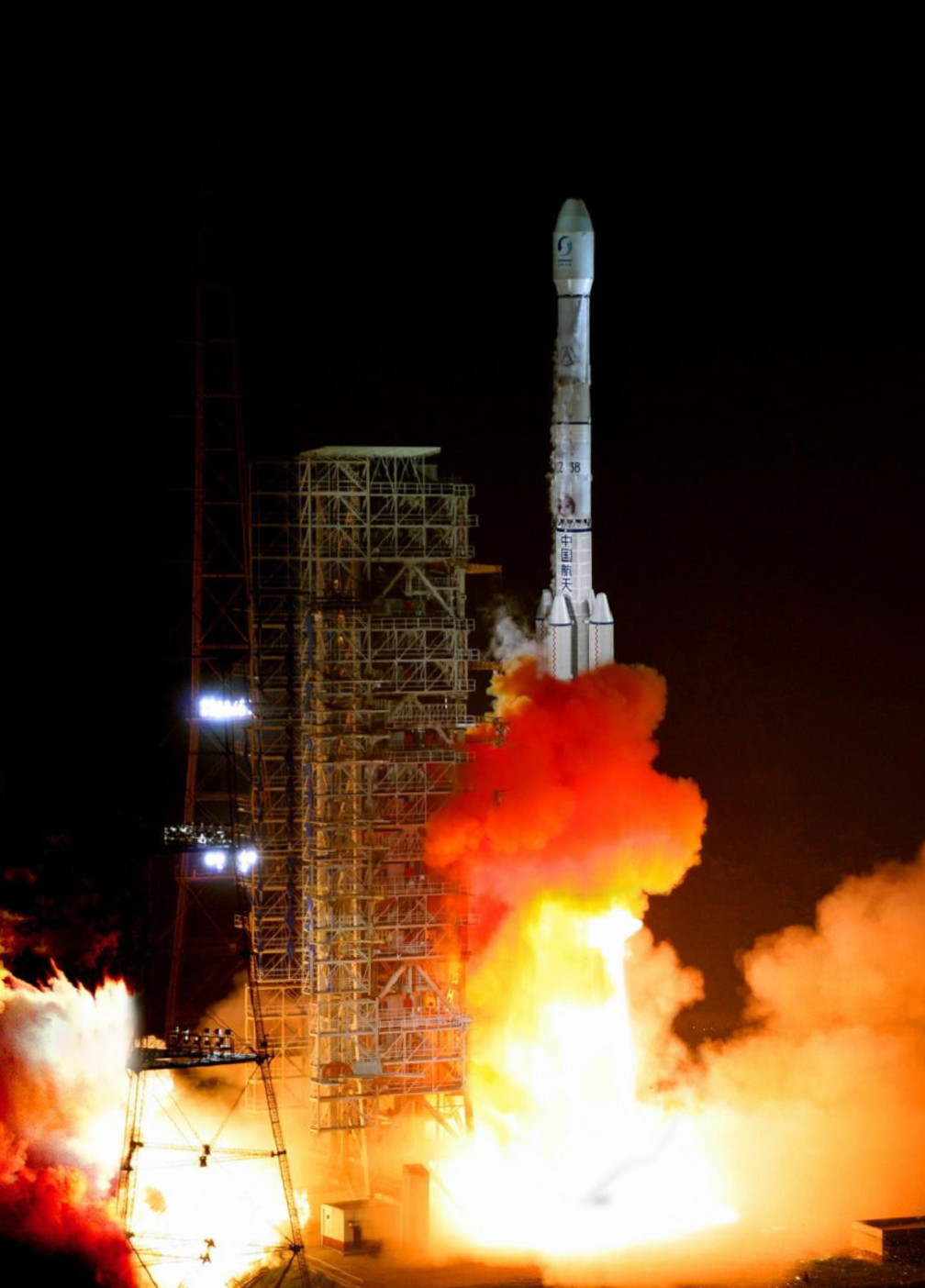
The Long March 3B (CZ-3B or LM-3B) is a Chinese orbital launch vehicle, the heaviest variant of the Long March 3 family, primarily used for placing communications and navigation satellites into geosynchronous orbits.
Key figurescomparable across the catalogue
- Mass
- 37,700 kg
- Payload capacity
- 11,500 kg
Normalised to common units so this product can be compared with others in its category. The supplier's own wording is below.
As published by the supplier
- Function
- Launch vehicle
- Manufacturer
- China Academy of Launch Vehicle Technology (CALT)
- Country of origin
- China
- Diameter
- 3.35 m (11.0 ft)
- Stages
- 3 / 4
- Payload to LEO mass
- 11,500 kg (25,400 lb)
- Payload to SSO mass
- 7,100 kg (15,700 lb)
- Payload to GEO mass
- 2,000 kg (4,400 lb)
- Payload to hco mass
- 3,300 kg (7,300 lb)
- Family
- Long March
- Derivative work
- Long March 3C
- Launch sites
- Xichang LC-2, LC-3
- Boosters (3b) no. boosters
- 4
- Boosters (3b) height
- 15.33 m (50.3 ft)
- Boosters (3b) diameter
- 2.25 m (7 ft 5 in)
- Boosters (3b) propellant mass
- 37,700 kg (83,100 lb)
- Boosters (3b) powered by
- 1 × YF-25
- Boosters (3b) maximum thrust
- 740.4 kN (166,400 lbf)
- Boosters (3b) specific impulse
- 2,556.2 m/s (260.66 s)
- Boosters (3b) burn time
- 127 seconds
- Boosters (3b) propellant
- N2O4 / UDMH
- Boosters (3b/e) no. boosters
- 4
- Boosters (3b/e) height
- 16.1 m (53 ft)
- Boosters (3b/e) diameter
- 2.25 m (7 ft 5 in)
- Boosters (3b/e) propellant mass
- 41,100 kg (90,600 lb)
- Boosters (3b/e) powered by
- 1 × YF-25
- Boosters (3b/e) maximum thrust
- 740.4 kN (166,400 lbf)
- Boosters (3b/e) specific impulse
- 2,556.2 m/s (260.66 s)
- Boosters (3b/e) burn time
- 140 seconds
- Boosters (3b/e) propellant
- N2O4 / UDMH
- First stage (3b) height
- 23.27 m (76.3 ft)
- First stage (3b) diameter
- 3.35 m (11.0 ft)
- First stage (3b) propellant mass
- 171,800 kg (378,800 lb)
- First stage (3b) powered by
- 4 × YF-21C
- First stage (3b) maximum thrust
- 2,961.6 kN (665,800 lbf)
- First stage (3b) specific impulse
- 2,556.5 m/s (260.69 s)
- First stage (3b) burn time
- 145 seconds
- First stage (3b) propellant
- N2O4 / UDMH
- First stage (3b/e) height
- 24.76 m (81.2 ft)
- First stage (3b/e) diameter
- 3.35 m (11.0 ft)
- First stage (3b/e) propellant mass
- 186,200 kg (410,500 lb)
- First stage (3b/e) powered by
- 4 × YF-21C
- First stage (3b/e) maximum thrust
- 2,961.6 kN (665,800 lbf)
- First stage (3b/e) specific impulse
- 2,556.5 m/s (260.69 s)
- First stage (3b/e) burn time
- 158 seconds
- First stage (3b/e) propellant
- N2O4 / UDMH
- Second stage height
- 12.92 m (42.4 ft)
- Second stage diameter
- 3.35 m (11.0 ft)
- Second stage propellant mass
- 49,400 kg (108,900 lb)
- Second stage burn time
- 185 seconds
- Second stage propellant
- N2O4 / UDMH
- Third stage height
- 12.38 m (40.6 ft)
- Third stage diameter
- 3.0 m (9.8 ft)
- Third stage propellant mass
- 18,200 kg (40,100 lb)
- Third stage powered by
- 2 × YF-75
- Third stage maximum thrust
- 167.17 kN (37,580 lbf)
- Third stage specific impulse
- 4,295 m/s (438.0 s)
- Third stage burn time
- 478 seconds
- Third stage propellant
- LH2 / LOX
- Fourth stage (optional) – yz-1 powered by
- 1 × YF-50D
- Fourth stage (optional) – yz-1 maximum thrust
- 6.5 kN (1,500 lbf)
- Fourth stage (optional) – yz-1 specific impulse
- 315.5 s (3.094 km/s)
- Fourth stage (optional) – yz-1 propellant
- N2O4 / UDMH
About
The Long March 3B, also known as CZ-3B and LM-3B, is a Chinese orbital launch vehicle manufactured by the China Academy of Launch Vehicle Technology (CALT). Introduced in 1996, it is launched from Launch Area 2 and 3 at the Xichang Satellite Launch Center in Sichuan. This three-stage rocket features four strap-on liquid rocket boosters and is the heaviest variant within the Long March 3 rocket family. Its primary mission is to deploy communications and navigation satellites into geosynchronous orbits.
An enhanced version, the Long March 3B/E (or G2), was introduced in 2007 to boost the rocket’s geostationary transfer orbit (GTO) cargo capacity, enabling it to lift heavier geosynchronous orbit (GEO) communications satellites. The Long March 3B also served as the foundation for the medium-capacity Long March 3C, which first flew in 2008. As of December 26, 2025, the Long March 3B, 3B/E, and 3B/G5 variants have achieved 110 successful launches, with 2 failures and 2 partial failures, resulting in a success rate of 96.5%. It holds the distinction of being the first Long March series rocket to reach 100 orbital launches.
Development of the Long March 3B began in 1986 to cater to the international GEO communications satellite market. Notable missions include the successful launch of China’s first lunar lander, Chang’e 3, and lunar rover, Yutu, into lunar-transfer orbit in December 2013 by a Long March 3B/E. Since 2015, the Long March 3B and 3C can optionally incorporate a YZ-1 upper stage, which has been utilized for dual launches or deploying BeiDou navigation satellites into medium Earth orbit (MEO).
Key features include its multi-stage design, liquid rocket boosters, and adaptability for various orbital insertions. The Long March 3B/E variant specifically features an enlarged (taller) first stage and boosters to enhance GTO payload capacity.
Documentation
Need the full ICD, test reports or a specific revision? Ask the supplier directly.