Long March 5
 CALT (China Academy of Launch Vehicle Technology)
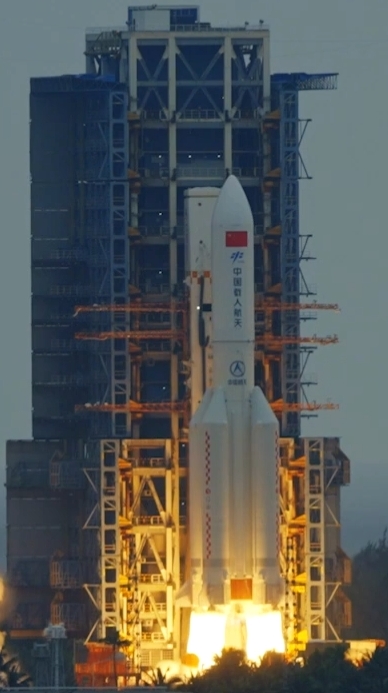
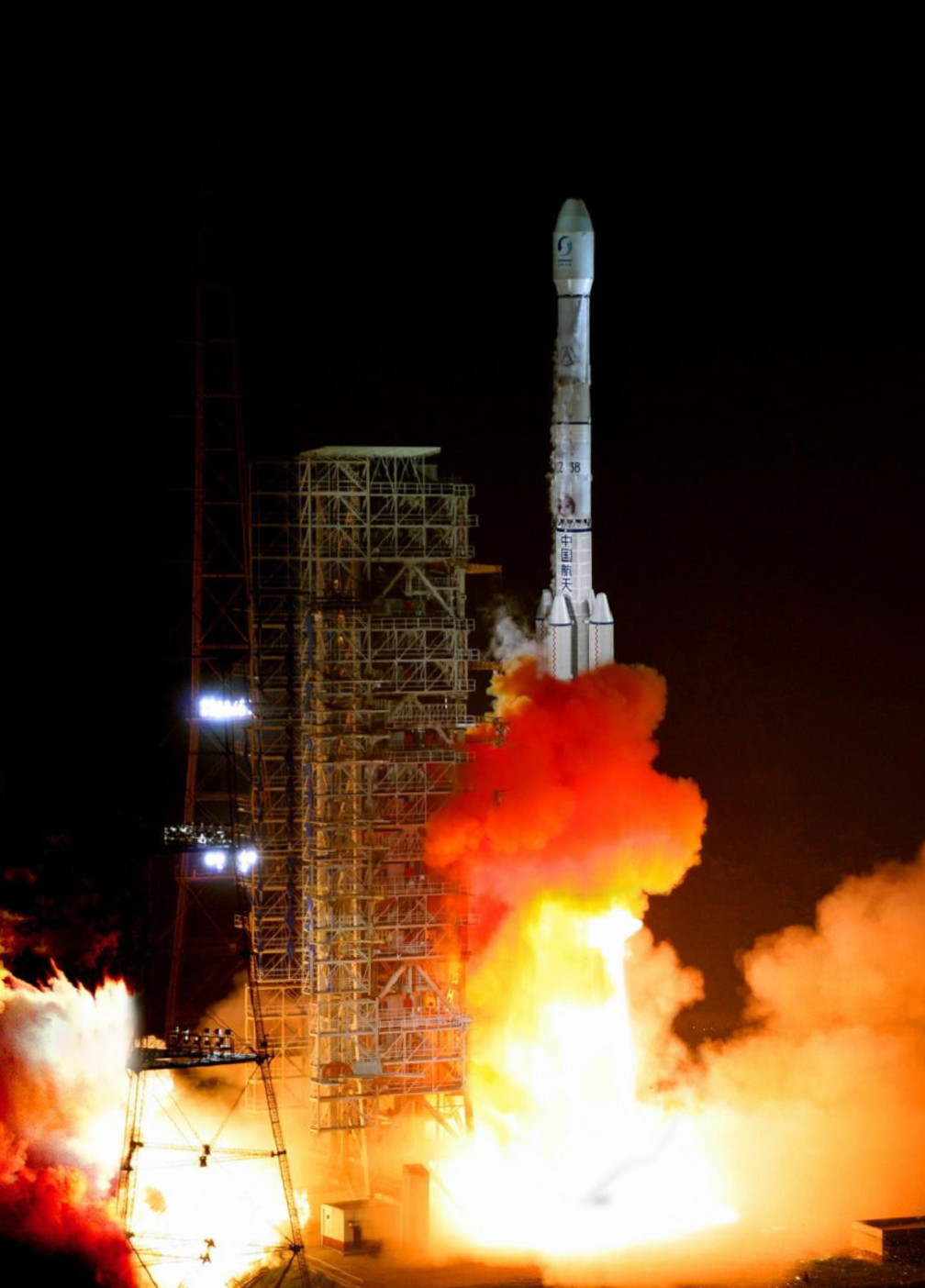
Long March 5 (CZ-5) is China's most powerful heavy-lift orbital launch vehicle, developed by CALT, capable of delivering up to 25,000 kg to LEO or 14,000 kg to GTO.
Key figurescomparable across the catalogue
- Mass
- 867,000 kg
- Payload capacity
- 25,000 kg
Normalised to common units so this product can be compared with others in its category. The supplier's own wording is below.
As published by the supplier
- Function
- Heavy-lift launch vehicle
- Manufacturer
- CALT
- Country of origin
- China
- Height
- 56.97 m (186.9 ft) (standard); 63.2 m (207 ft) (extended fairing)
- Diameter
- 5 m (16 ft)
- Lift-off mass
- 867 t (CGWIC)
- Stages
- 2
- Payload to LEO altitude
- 200 km × 400 km (120 mi × 250 mi)
- Payload to LEO mass
- 25,000 kg (55,000 lb)
- Payload to GTO mass
- 14,000 kg (31,000 lb)
- Payload to tli mass
- 8,800–9,400 kg (19,400–20,700 lb)
- Payload to GEO mass
- 5,100 kg (11,200 lb)
- Payload to SSO altitude (1)
- 700 km (430 mi)
- Payload to SSO mass (1)
- 15,000 kg (33,000 lb)
- Payload to SSO altitude (2)
- 2,000 km (1,200 mi)
- Payload to SSO mass (2)
- 6,700 kg (14,800 lb)
- Payload to MEO mass
- 13,000 kg (29,000 lb)
- Payload to tmi mass
- 6,000 kg (13,000 lb)
- Family
- Long March
- Status
- Active
- Launch sites
- Wenchang, LC-1
- Total launches
- 18
- Successes
- 17
- Failures
- 1 (CZ-5)
- Boosters designation
- CZ-5-300
- No. boosters
- 4
- Booster height
- 27.6 m (91 ft)
- Booster diameter
- 3.35 m (11.0 ft)
- Booster empty mass
- 13,800 kg (30,400 lb)
- Booster gross mass
- 156,600 kg (345,200 lb)
- Booster powered by
- 2 × YF-100
- Booster maximum thrust
- Sea level: 2,400 kN (540,000 lbf); Vacuum: 2,680 kN (600,000 lbf)
- Booster total thrust
- 9,600 kN (2,200,000 lbf)
- Booster specific impulse
- Sea level: 300 s (2.9 km/s); Vacuum: 335.1 s (3.286 km/s)
- Booster burn time
- 173 seconds
- Booster propellant
- LOX / RP-1
- First stage designation
- CZ-5-500
- First stage height
- 33.16 m (108.8 ft)
- First stage diameter
- 5 m (16 ft)
- First stage gross mass
- 186,900 kg (412,000 lb)
- First stage propellant mass
- 165,300 kg (364,400 lb)
- First stage powered by
- 2 × YF-77
- First stage maximum thrust
- Sea level: 1,036 kN (233,000 lbf); Vacuum: 1,400 kN (310,000 lbf)
- First stage specific impulse
- Sea level: 316.7 s (3.106 km/s); Vacuum: 428 s (4.20 km/s)
- First stage burn time
- 492 seconds
- First stage propellant
- LOX / LH2
- Second stage designation (CZ-5)
- CZ-5-HO
- Second stage height
- 11.54 m (37.9 ft)
- Second stage diameter
- 5 m (16 ft)
- Second stage empty mass
- 5,100 kg (11,200 lb)
- Second stage gross mass
- 36,000 kg (79,000 lb)
- Second stage propellant mass
- 29,100 kg (64,200 lb)
- Second stage powered by
- 2 × YF-75D
- Second stage maximum thrust
- 176.72 kN (39,730 lbf)
- Second stage specific impulse
- 442.6 s (4.340 km/s)
- Second stage burn time
- 700 seconds
- Second stage propellant
- LOX / LH2
- Third stage designation
- YZ-2 (Optional)
- Third stage diameter
- 3.8 m (12 ft)
- Third stage powered by
- 2 × YF-50D
- Third stage maximum thrust
- 13 kN (2,900 lbf)
- Third stage specific impulse
- 316 s (3.10 km/s)
- Third stage burn time
- 1,105 seconds
- Third stage propellant
- N2O4 / UDMH
About
Long March 5 (LM-5; Chinese: 长征五号; pinyin: Chángzhēng wǔ hào), also known as Changzheng 5 (CZ-5) and nicknamed “Pang-Wu” (胖五, “Fat-Five”), is a Chinese heavy-lift launch vehicle developed by the China Academy of Launch Vehicle Technology (CALT). It is the most powerful Chinese rocket and Long March rocket ever built, and the most powerful orbital launch vehicle operating outside of the United States. First launched in 2016, CZ-5 has carried cornerstones of the Chinese space program: all three modules of the Tiangong space station, two Moon sample returns, and one Mars mission. There are two variants: CZ-5 and CZ-5B. Maximum payload capacities are approximately 25,000 kg to low Earth orbit (CZ-5B) and approximately 14,000 kg to geostationary transfer orbit (CZ-5), making CZ-5B the world’s fifth most powerful orbital launch vehicle by payload to LEO and CZ-5 the second most powerful by payload to GTO, comparable to Vulcan Centaur, Ariane 6, and Angara A5. The hydrolox core stage uses two YF-77 engines, while its four kerolox boosters each use two YF-100 engines (ultimately derived from the Soviet RD-120). The hydrolox second stage uses two YF-75D engines. The Yuanzheng-2 (YZ-2) third stage, used only on the CZ-5 variant, is powered by two hypergolic YF-50D engines burning N2O4/UDMH. As of April 2026, Long March 5 variants have launched 17 times with 16 successes, all from the Wenchang Space Launch Site; ten launches were CZ-5 and seven were CZ-5B. The first CZ-5 launched in November 2016; a core stage failure on the second launch in June 2017 (traced to the YF-77 oxidizer turbo-pump) caused a 28-month hiatus before flights resumed. The CZ-5B first launched in 2020. CZ-5 has launched large space probes including Tianwen-1 (China’s first Mars orbiter, lander, and rover) and the Chang’e 5 and Chang’e 6 lunar sample return missions, as well as military satellites of the Shijian and Tongxin Jishu Shiyan geostationary programs and the Yaogan LEO program. The CZ-5B variant, lacking the Yuanzheng-2 upper stage, has launched larger LEO payloads including all Tiangong space station modules (Tianhe, Wentian, Mengtian) in 2021-2022, an uncrewed prototype of the Mengzhou lunar crew module in 2020, and 10-satellite polar orbit clusters of the Guowang satellite internet constellation since 2024. The CZ-5 is planned to launch the 2026 Chang’e 7 and 2029 Chang’e 8 Moon missions, the 2028 dual-launch Tianwen-3 Mars sample return, and the 2029 Tianwen-4 Jupiter orbiter/Uranus flyby mission, and potentially the Shensuo heliosphere probes. The CZ-5B is expected to launch the Xuntian space telescope in late 2026. The CZ-5 family includes three primary modular core stages of 5.2-m diameter (maximum); total length is 60.5 meters with a launch weight of 643 tons and thrust of 833.8 tons. Boosters range from 2.25 m to 3.35 m diameter. The first stage and boosters use a choice of 1200 kN thrust LOX/kerosene engines or 1550 kN thrust LOX/LH2 engines, and the upper stage uses improved versions of the YF-75 engine. Engine development began in 2000-2001, with CNSA-directed testing commencing in 2005; the YF-100 and YF-77 were successfully tested by mid-2007. Six CZ-5 variants were originally planned.
Documentation
No public datasheet yet — request the datasheet / ICD from the supplier.