Long March 7
 CALT (China Academy of Launch Vehicle Technology)
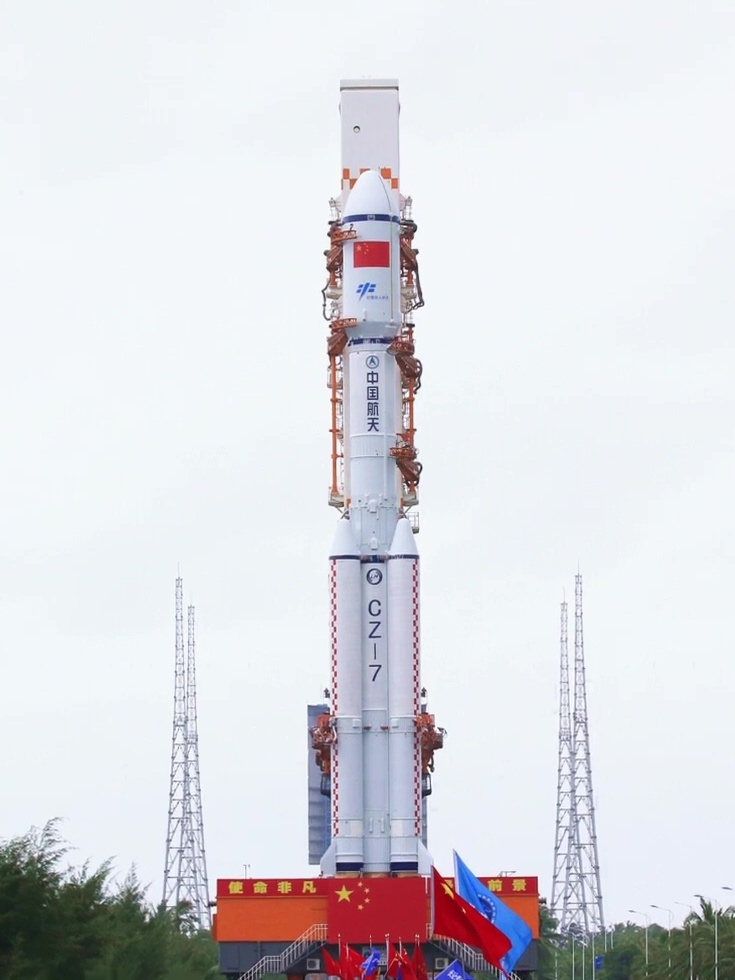
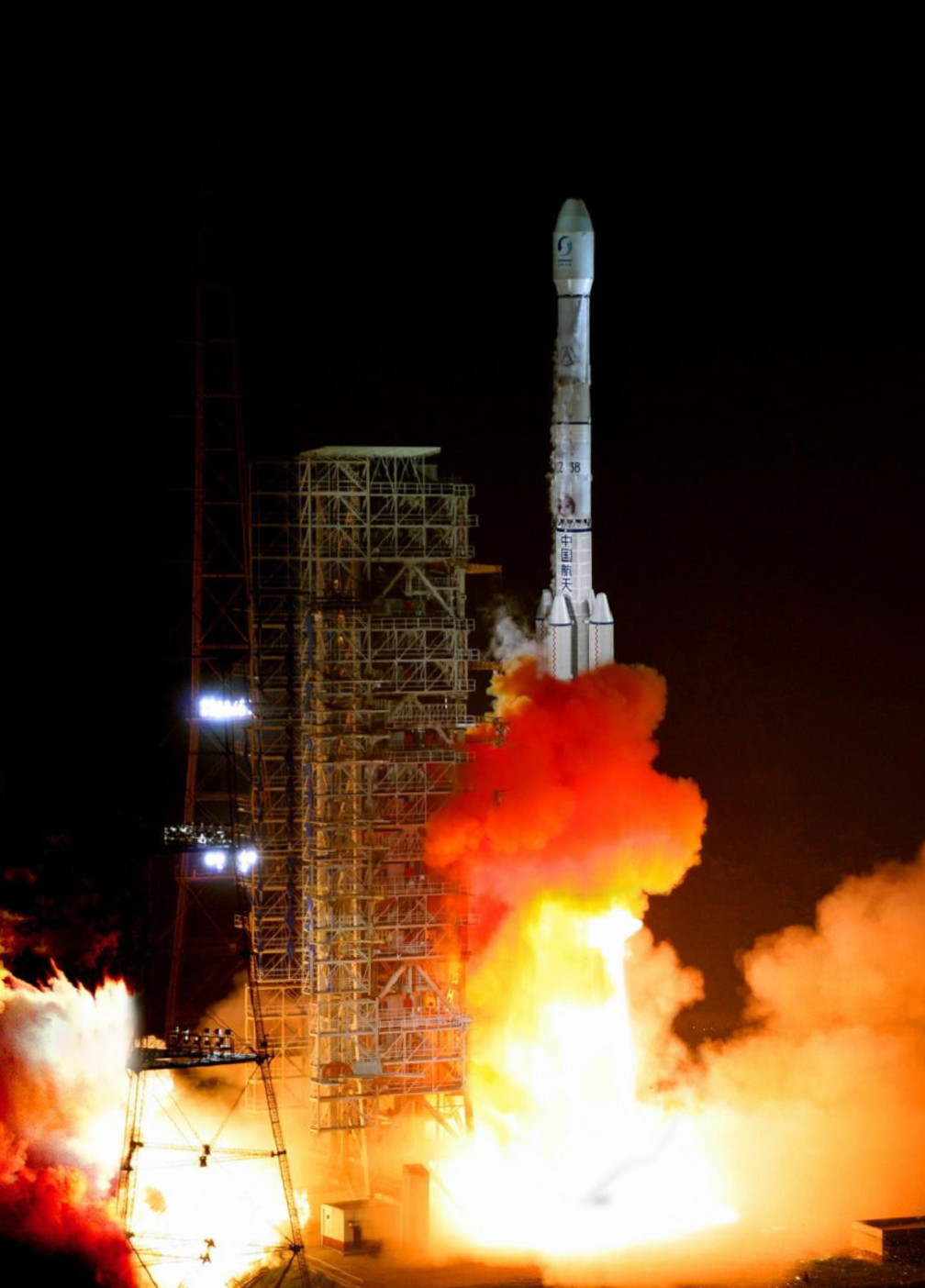
Chinese liquid-fuelled medium-lift launch vehicle of the Long March family, developed by CALT, used primarily to launch Tianzhou cargo spacecraft to the Tiangong space station.
Key figurescomparable across the catalogue
- Mass
- 2,800 kg
- Payload capacity
- 13,500 kg
Normalised to common units so this product can be compared with others in its category. The supplier's own wording is below.
As published by the supplier
- Function
- Medium to heavy-lift launch vehicle
- Manufacturer
- China Academy of Launch Vehicle Technology
- Country of origin
- China
- Diameter
- 3.35 m (11 ft)
- Payload to LEO - altitude
- 200 km × 400 km (120 mi × 250 mi)
- Payload to LEO - orbital inclination
- 42°
- Payload to LEO - mass
- 13,500 kg (29,800 lb)
- Payload to GTO - mass
- 7,000 kg (15,000 lb)
- Payload to tli - mass
- 5,000 kg (11,000 lb)
- Payload to SSO - altitude
- 700 km (430 mi)
- Payload to SSO - mass
- 5,500 kg (12,100 lb)
- Family
- Long March
- Status
- Active
- Launch sites
- Wenchang, LC-2
- Total launches
- 27 (7: 11, 7 A: 16)
- Success (es)
- 26 (7: 11, 7 A: 15)
- Failure
- 1 (7: 0, 7 A: 1)
- Boosters (k2) - no. boosters
- 4
- Boosters (k2) - height
- 27 m (89 ft)
- Boosters (k2) - diameter
- 2.25 m (7 ft 5 in)
- Boosters (k2) - powered by
- 1 × YF-100
- Boosters (k2) - maximum thrust
- SL: 1,200 kN (270,000 lbf) vac: 1,340 kN (300,000 lbf)
- Boosters (k2) - total thrust
- SL: 4,800 kN (1,100,000 lbf) vac: 5,360 kN (1,200,000 lbf)
- Boosters (k2) - specific impulse
- SL: 300 s (2.9 km/s) vac: 335 s (3.29 km/s)
- Boosters (k2) - propellant
- RP-1 / LOX
- First stage (k3) - diameter
- 3.35 m (11.0 ft)
- First stage (k3) - powered by
- 2 × YF-100
- First stage (k3) - maximum thrust
- SL: 2,400 kN (540,000 lbf) vac: 2,680 kN (600,000 lbf)
- First stage (k3) - specific impulse
- SL: 300 s (2.9 km/s) vac: 335 s (3.29 km/s)
- First stage (k3) - propellant
- RP-1 / LOX
- Second stage - diameter
- 3.35 m (11.0 ft)
- Second stage - powered by
- 4 × YF-115
- Second stage - maximum thrust
- 706 kN (159,000 lbf)
- Second stage - specific impulse
- 342 s (3.35 km/s)
- Second stage - propellant
- RP-1 / LOX
- Third stage (cz-7a) - diameter
- 3.0 m (9.8 ft)
- Third stage (cz-7a) - empty mass
- 2,800 kg (6,200 lb)
- Third stage (cz-7a) - gross mass
- 21,000 kg (46,000 lb)
- Third stage (cz-7a) - propellant mass
- 18,200 kg (40,100 lb)
- Third stage (cz-7a) - powered by
- 2 × YF-75
- Third stage (cz-7a) - maximum thrust
- 167.17 kN (37,580 lbf)
- Third stage (cz-7a) - specific impulse
- 4,295 m/s (438.0 s)
- Third stage (cz-7a) - burn time
- 478 seconds
- Third stage (cz-7a) - propellant
- LH2 / LOX
- Fourth stage (optional) yz-1a - powered by
- 1 × YF-50D
- Fourth stage (optional) yz-1a - maximum thrust
- 6.5 kN (1,500 lbf)
- Fourth stage (optional) yz-1a - specific impulse
- 315.5 s (3.094 km/s)
- Fourth stage (optional) yz-1a - propellant
- N2O4 / UDMH
About
The Long March 7 (Chang Zheng 7, CZ-7/LM-7), nicknamed ‘Bingjian’ (the Ice Arrow), is a Chinese liquid-fuelled medium-lift launch vehicle developed by the China Academy of Launch Vehicle Technology (CALT) as part of the new-generation Long March family alongside the heavier Long March 5 and smaller Long March 6. It made its inaugural flight on 25 June 2016 from the Wenchang LC-2 launch pad. Originally conceived as a re-engined, non-hypergolic replacement for the Long March 2F (as Long March 2F/H), the project was merged with the medium-class element of the Long March 5 programme. The rocket uses RP-1/LOX propellant instead of the toxic N2O4/UDMH used by older Chinese launchers, improving cost-effectiveness and reducing hazard. It has two kerolox base stages: four optional strap-on boosters and a core first stage each powered by YF-100 engines (six total at full configuration), and a second stage powered by four YF-115 engines. The Long March 7A variant, flying since March 2020, adds a hydrolox third stage powered by two YF-75 engines inherited from the Long March 3B. An optional Yuanzheng-1A (YZ-1A) upper stage, powered by a YF-50D engine burning N2O4/UDMH, enables multi-orbit deployment and direct injection to higher-energy orbits such as SSO. Depending on configuration (0, 2, or 4 boosters, plus optional upper stages), payload performance is scalable between 4,000 kg and 13,500 kg to LEO, 2,000-8,000 kg to SSO, and 4,000-7,000 kg to GTO. The vehicle plays a critical role in the Tiangong space station programme, launching Tianzhou robotic cargo and resupply spacecraft; it was initially planned as China’s next crew-rated launcher, a role later apparently shifted to the under-development Long March 10A. The design was developed using an all-digital 3D process (CAD-to-CAM) for the first time in the programme, and features indigenous, space-rated dual-processor PLC avionics with a distributed, scalable, fault-tolerant architecture. The Long March 7 also served as the basis for the Long March 8 variant, which uses fewer boosters.
Documentation
No public datasheet yet — request the datasheet / ICD from the supplier.