Mirror Antenna Reflector
 Glavkosmos
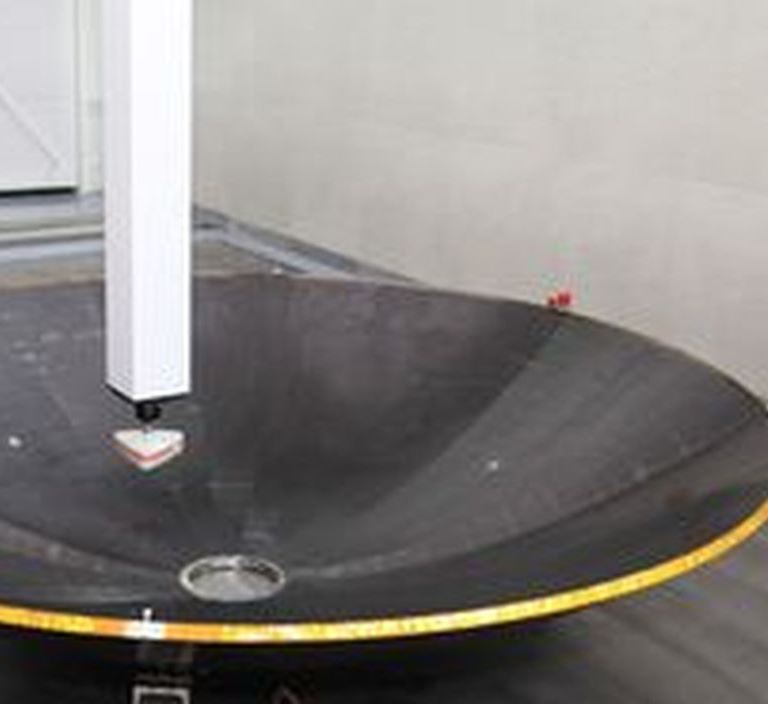
A mirror antenna reflector designed for space applications, supporting C, Ku, Ka, and Q frequency bands, and constructed from carbon fiber-reinforced plastic, beryllium, or titanium.
Key figurescomparable across the catalogue
- Largest dimension
- 2,200 mm
Normalised to common units so this product can be compared with others in its category. The supplier's own wording is below.
As published by the supplier
- Frequency band
- S, Ku, Ka, Q
- Materials
- Carbon fiber-reinforced plastic, beryllium, titanium
- Reflective surface roughness
- Ra 0.63 – 1.25
- Forming mandrel material
- Invar, composite forming mandrel
- Coating
- Multi-layer radar-reflective coating on the basis of aluminium, nichrome, aluminium oxide (if required)
- Overall dimensions (max, min)
- reflector max Ø – 2200 mm, reflector min Ø – 180 mm
About
The Mirror Antenna Reflector is a critical component of a mirror antenna system, intended for use in space applications. It is designed to operate across a wide range of frequency bands, including C, Ku, Ka, and Q, which are commonly used in satellite communications. The reflector is constructed from high-performance materials such as carbon fiber-reinforced plastic, beryllium, and titanium, chosen for their strength-to-weight ratio and thermal stability in the harsh space environment. The reflective surface boasts a roughness (Ra) between 0.63 and 1.25, ensuring efficient signal reflection. Forming mandrels are made from Invar or composite materials. For enhanced performance, the reflector features a multi-layer radar-reflective coating, which can be based on aluminum, nichrome, or aluminum oxide, depending on specific requirements. The overall dimensions of the reflector can vary significantly, with a maximum diameter of 2200 mm and a minimum diameter of 180 mm. The product can be optionally mounted on a boom and includes areas for hold-down locks and optical checking elements, facilitating integration and deployment in spacecraft.
Documentation
No public datasheet yet — request the datasheet / ICD from the supplier.