SUN SENSOR (AQUILA series)
 NewSpace Systems (NSS)
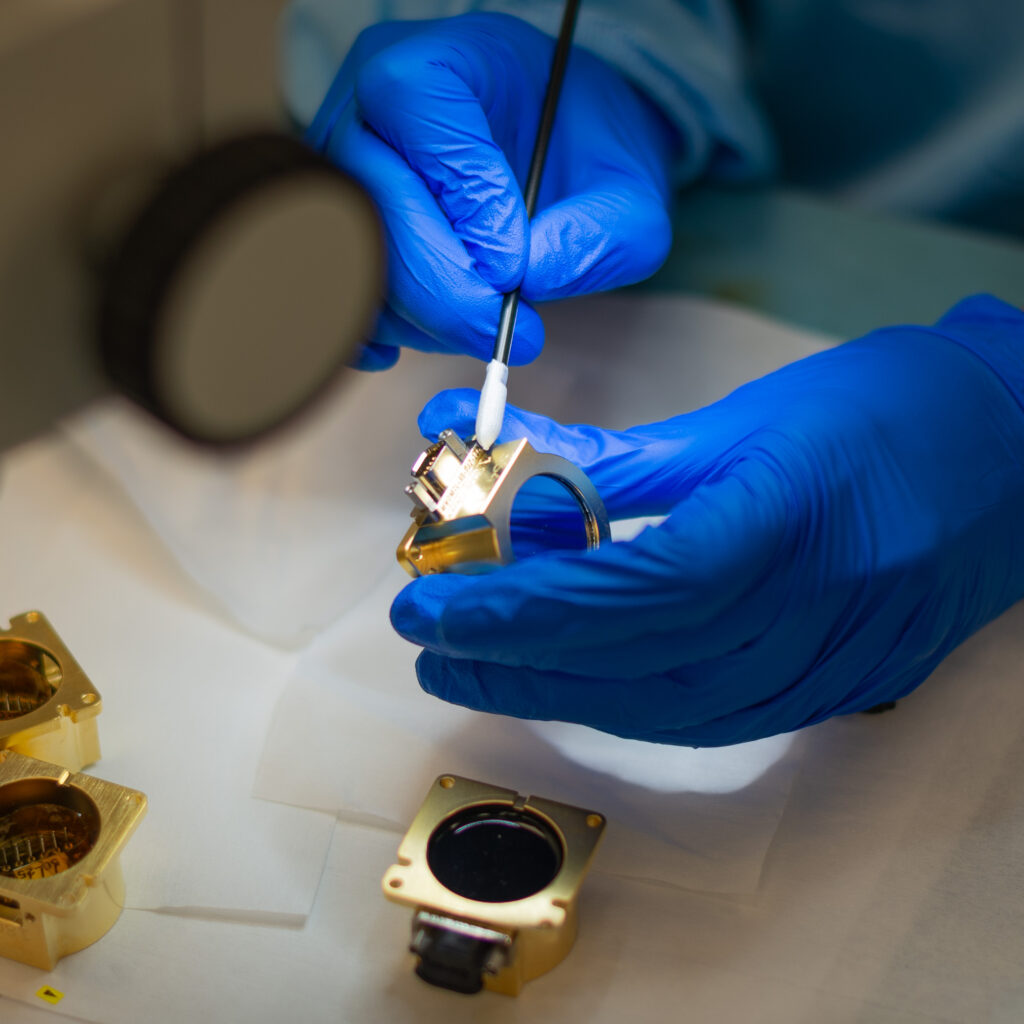
The AQUILA series sun sensors provide reliable and accurate sun-angle measurements for spacecraft attitude determination and control, suitable for primary and safe-mode sensing in high-reliability space applications.
Typed specifications49 values
Discloses 6 of 8 fields engineers filter by in this category (category median 4).
- Accuracy
- 0.5 ° max · AQUILA-A05 (NCSS-SA05): < 0.5 Average (unit not printed) · datasheet p.2 0.2 ° max · AQUILA-H02: < 0.2 RMS (unit not printed)
- Mass
- 37 g max · datasheet p.2 5 g max · AQUILA-A05 (NCSS-SA05) | 37 g max · AQUILA-H02
- Envelope (L×W×H)
- 34 mm × 40 mm × 20 mm datasheet p.2
- Update rate
- 10 Hz min · AQUILA-A05 (NCSS-SA05): > 10 Hz (limited by customer OBC) · datasheet p.2 5 Hz max | 5 Hz max · AQUILA-H02: <5 Hz
- Output type
- analog AQUILA-A05 (NCSS-SA05): 5 analogue channels · datasheet p.2 digital AQUILA-H02: RS-485 / RS-422
- Field of view
- 140 ° datasheet p.2 140 ° AQUILA-H02 | 114 ° max · AQUILA-A05 (NCSS-SA05): < 114°
- Supply voltage
- 5 V nominal · datasheet p.2 5–36 V AQUILA-H02: +5 V DC to +36 V DC (5 V nominal) | 5 V nom. · AQUILA-A05 (NCSS-SA05)
- Power consumption
- 0.2 W application mode Active · datasheet p.2 0.08 W bootloader mode | 0.015 W Idle: bootloader mode | 0.2 W max · AQUILA-H02: active (<40 mA) | 0.08 W max · AQUILA-H02: application mode (<20 mA) +1
- Data interface
- RS-485 datasheet p.2 RS-485 AQUILA-H02 | RS-422 | RS-422 AQUILA-H02
- Operating temperature
- -20 °C product page -20–60 °C AQUILA-A05 (NCSS-SA05): thermal (operational) | -25–70 °C AQUILA-H02: thermal (operational)
- Radiation tolerance (TID)
- 10 krad AQUILA-A05 (NCSS-SA05): qualification, component level · datasheet p.2 10 krad AQUILA-H02: qualification, component level | 10 krad component Level
- Design lifetime
- 5 years 5 years of life in-orbit (demonstrated in LEO, series) · datasheet p.1 5 years in orbit
- TRL
- 9 Aquila series · datasheet p.2
- Sensor class
- coarse datasheet p.1
- Connector
- 9-way female Micro-D datasheet p.2
- Random vibration
- 14.1 g RMS AQUILA-A05 (NCSS-SA05): random, qualification · datasheet p.2 34.93 g RMS AQUILA-H02: random, qualification
- Flight heritage
- 1,000+ sun sensors delivered; 260+ units in orbit; operational since 2014; utilized on 5+ constellations; TRL 9, in-orbit lifetimes > 5 years in LEO datasheet p.1
- Missions flown
- 1 000 datasheet p.1 260 min · 260+ units in orbit (series) | 260
- Quasi-static load
- 14.1 g random, AQUILA-A05 · datasheet p.2 34.93 g random, AQUILA-H02 | 26.25 g sine, AQUILA-A05 | 26.25 g sine, AQUILA-H02
- Shock qualification
- 2 000 g AQUILA-H02: shock, qualification · datasheet p.2
Each value is typed with its unit and measurement condition and cites the datasheet page it was taken from. Nothing is guessed: a field that is absent here has not been published by the manufacturer. machine-extracted ✓ checked by NewSpace Market ✓ manufacturer confirmed by the manufacturer.
As published by the supplier10 lines, in the manufacturer's own wording
- Flight heritage
- Over 5 years in Low Earth Orbit (LEO)
- Units delivered
- Over 1000
- Constellations baselined on
- Multiple (currently five different constellations)
- Field of view
- < 114°
- Accuracy
- < 0.5 Average
- Dimensions
- 33 mm × 11 mm × 6 mm
- Mass
- <5 g
- Operating temperature
- -20 °C to +60 °C
- Supply voltage
- 5 V DC
- Interface
- 5 analogue channels
About
The AQUILA series sun sensors determine a spacecraft’s orientation with respect to the sun, offering reliable and accurate sun-angle measurements for attitude determination and control. Designed for high-reliability space applications, these sensors are suitable for both primary and safe-mode attitude sensing. With over 1000 units delivered and extensive in-orbit heritage exceeding five years in Low Earth Orbit (LEO), the NSS Sun Sensors are baselined on multiple satellite constellations. Their robust design, ultra-compact form factor, low power consumption, and wide field of view make them a preferred choice for both commercial and institutional missions. The series includes models such as AQUILA-A05 and AQUILA-H02. Key features include ultra-small size and low mass, low power consumption, simple interfacing, a wide field of view, digital architecture (albedo immune), and embedded calibration for accurate sun-angle determination. These sensors can be used in conjunction with a magnetometer for simple attitude control or as safe-mode sensors on gyro or star-mapper-controlled systems. Four sensors can achieve full sky coverage. The Aquila has demonstrated lifetimes of over 5 years in LEO and is included on five different constellations.
Documentation
Need the full ICD, test reports or a specific revision? Ask the supplier directly.