CAVU OBC-1
 CAVU Aerospace
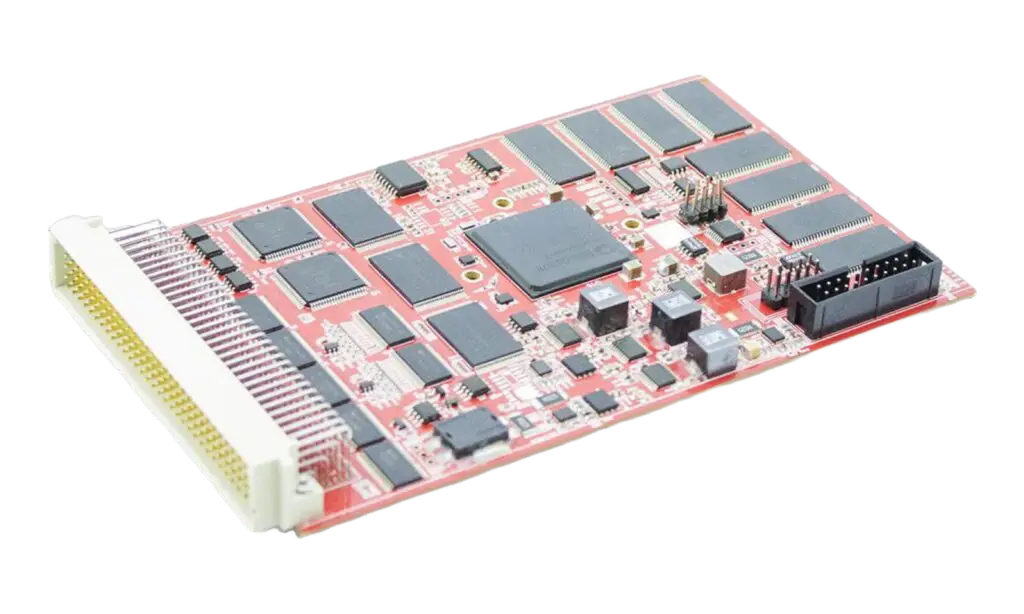
The CAVU OBC-1 is a cutting-edge, FPGA-based satellite computing system designed for reliable and efficient operation in space, featuring intelligent redundancy and advanced command and control capabilities.
Typed specifications66 values
Discloses 10 of 13 fields engineers filter by in this category (category median 5).
- Processor
- ARM Cortex-M3 on FPGA datasheet p.2 Microchip/Microsemi SmartFuion2 Flash Based FPGA
- Mass
- 75 g datasheet p.2 75 g 75gr
- CPU clock
- 128 MHz datasheet p.2 128 MHz 150 DMIPS @ 128MHz
- Envelope (L×W×H)
- 160x100mm datasheet p.2
- RAM
- 6 MB 48Mbits MRAM (Configurable as Triple 16Mbits) · datasheet p.2 10 MB 80Mbits MRAM | 10 MB MRAM 40 bits width (64Mbits+16Mbits ECC)
- Mass storage
- 96 GB SLC NAND Flash (Triple 32G) · datasheet p.2 96 GB total SLC NAND Flash (Triple 32G)
- Operating system
- 30 product page
- Supply voltage
- 5 V nom. · datasheet p.2 5 V 5V ±5% | 5 V min | 5 V max
- Power consumption
- 2 W max · datasheet p.2 1 W min | 1 W min · 1W ~ 2W | 2 W max · 1W ~ 2W
- Data interface
- CAN datasheet p.2 I2C 1x | RS-422 1x full-duplex RS422 | RS-232 1x RS232 | RS-485 2x half-duplex RS485 +9
- Operating temperature
- -40 °C min · datasheet p.2 85 °C max | -40–85 °C 10^-8 bar
- Radiation tolerance (TID)
- 30 krad datasheet p.2 30 krad Total Ionizing Dose, Krad (Si)/yr
- Design lifetime
- 3 years min · 3-5 years in LEO · datasheet p.2 3 years min · in LEO | 5 years max · 3-5 years in LEO | 5 years max · in LEO
- Processor architecture
- ARM Cortex-M ARM Cortex-M3 on FPGA · datasheet p.2
- Radiation and fault mitigation
- rad-hard components datasheet p.1 EDAC / ECC on RAM 80Mbits MRAM 40 bits width (64Mbits+16Mbits ECC) | other Latch-up Immune | current and upset monitoring On-Board Current & Temperature Monitoring | hardware watchdog On-Board Watchdog +3
- Random vibration
- 14 g RMS 3-Axis, 20~2000 Hz · datasheet p.2
- Shock qualification
- 2 000 g 2000-10000 Hz · datasheet p.2
- FPGA
- Microchip/Microsemi SmartFusion2 Flash Based FPGA datasheet p.2
- GPIO lines
- 100 100 GPIOs (overview, p.1) · datasheet p.1
- Performance
- 150 DMIPS 128MHz · datasheet p.2
- RAM type
- MRAM datasheet p.2
- Program / boot memory
- 256 MB 256K Serial FRAM · datasheet p.2 256 MB 256M Serial NOR | 6 MB ROM: MRAM (configurable as triple 16Mbits)
- SEL threshold LET
- 60 MeV·cm²/mg Latch-up Immune; SEE @ 60MeV · datasheet p.2
- Redundancy
- other scalable to more than 1 board as redundant · datasheet p.1
- Data interface speed
- 1 Mbps max · CAN2.0 up to · datasheet p.2
- Analog inputs
- 32 16 bits ADC (-10V ~ +10V) · datasheet p.2
Each value is typed with its unit and measurement condition and cites the datasheet page it was taken from. Nothing is guessed: a field that is absent here has not been published by the manufacturer. machine-extracted ✓ checked by NewSpace Market ✓ manufacturer confirmed by the manufacturer.
As published by the supplier32 lines, in the manufacturer's own wording
- Expected life-time
- 3-5 years in LEO
- Processor
- Microchip/Microsemi SmartFuion2 Flash Based FPGA
- Processor core
- ARM Cortex-M3 on FPGA
- Fpu
- on FPGA Upon Request
- Processor speed
- 150 DMIPS @ 128 MHz, Max 166 MHz
- Programming ide
- SoftConsole or Keil
- Debug
- via JTAG
- Ram
- 80Mbits MRAM 40 bits width (64Mbits+16Mbits ECC)
- Rom
- 48Mbits MRAM (Conffigurable as Triple 16Mbits)
- Nonvolatile flash memory
- Total 96Gbit SLC NAND Flash (Triple 32G)
- Serial fram
- 256K
- Serial nor
- 256M
- Radiation tolerance - total ionizing dose
- 30Krad (Si)/yr
- Latch-up
- Immune
- SEE
- @ 60MeV
- Temperature & pressure
- -40 C to +85 C @ 10-8 bar
- Shocks
- 2000 g, 2000-10000 Hz
- Random vibrations
- 14 g(RMS) 3-Axis , 20~2000 Hz
- Digital outputs
- 70 (5 V/3.3 V)
- Digital inputs
- 30 (5 V/3.3 V)
- ADC
- 32CH 16-bit (-10V ~ +10 V, +20 V Range Available)
- DAC
- 2CH 12-bit (0 V~5 V)
- Can2.0
- 4 (Up to 1 Mbps)
- Full-duplex RS422
- 1
- Half-duplex RS485
- 2
- RS232
- 1
- I2C
- 1
- SPI
- 1
- Dimensions
- 160x100 mm
- Mass
- 75gr
- Power supply
- 5 V ±5%, Custom Range Available
- Power consumption
- 1 W ~ 2 W
About
The CAVU OBC-1 is an advanced, FPGA-based satellite computing system engineered for critical space missions, emphasizing reliability and efficiency. It features a single-board, flash-based FPGA computer that is scalable for redundancy, allowing multiple modules to create a robust satellite computer system where one module can seamlessly take over if another fails. The system is designed to withstand space hazards such as radiation, cosmic rays, and solar flares, utilizing a Microchip/Microsemi SmartFusion2 Flash Based FPGA, which is SEU immune and consumes less power than conventional SRAM-based FPGA architectures. It offers up to three selectable boot regions from its bootloader and is fully customizable.
The OBC-1 module is compatible with a wide array of sensors and actuators, providing precise control over satellite systems. It supports various interfaces, including 100 GPIOs and 32-channel ADCs, making it a comprehensive solution for Attitude and Orbit Control System (AOCS) and Power Management computing requirements. The module provides high levels of control and adaptability, allowing for customization to meet specific mission demands. Special features include on-board current and temperature monitoring, an on-board watchdog, a triple real-time clock, and hot redundant on-board voltage converters. It has an expected lifetime of 3-5 years in Low Earth Orbit (LEO).
The processor is a Microchip/Microsemi SmartFusion2 Flash Based FPGA with an ARM Cortex-M3 on the FPGA, and an FPU available upon request. It operates at 150 DMIPS @ 128MHz, with a maximum of 166MHz, and supports SoftConsole or Keil Programming IDE and debug via JTAG. Memory includes 80Mbits MRAM (64Mbits + 16Mbits ECC) with 40 bits width, 48Mbits MRAM configurable as triple 16Mbits, 96Gbit SLC NAND Flash (triple 32G), 256K Serial FRAM, and 256M Serial NOR. The system is radiation tolerant up to 30Krad (Si)/yr Total Ionizing Dose, latch-up immune, and SEE @ 60MeV. It operates in temperatures from -40°C to +85°C at 10^-8 bar, can withstand shocks of 2000g (2000-10000Hz), and random vibrations of 14g(RMS) 3-Axis (20-2000Hz). Interfaces include 70 digital outputs (5V/3.3V), 30 digital inputs (5V/3.3V), 32-channel 16-bit ADCs (-10V to +10V, with +20V range available), and 2-channel 12-bit DACs (0V-5V). Serial interfaces include 4 CAN2.0 (up to 1Mbps), 1 full-duplex RS422, 2 half-duplex RS485, 1 RS232, 1 I2C, and 1 SPI.
Documentation
Need the full ICD, test reports or a specific revision? Ask the supplier directly.