32% Efficiency Triple Junction GaAs Solar Cell
 CAVU Aerospace
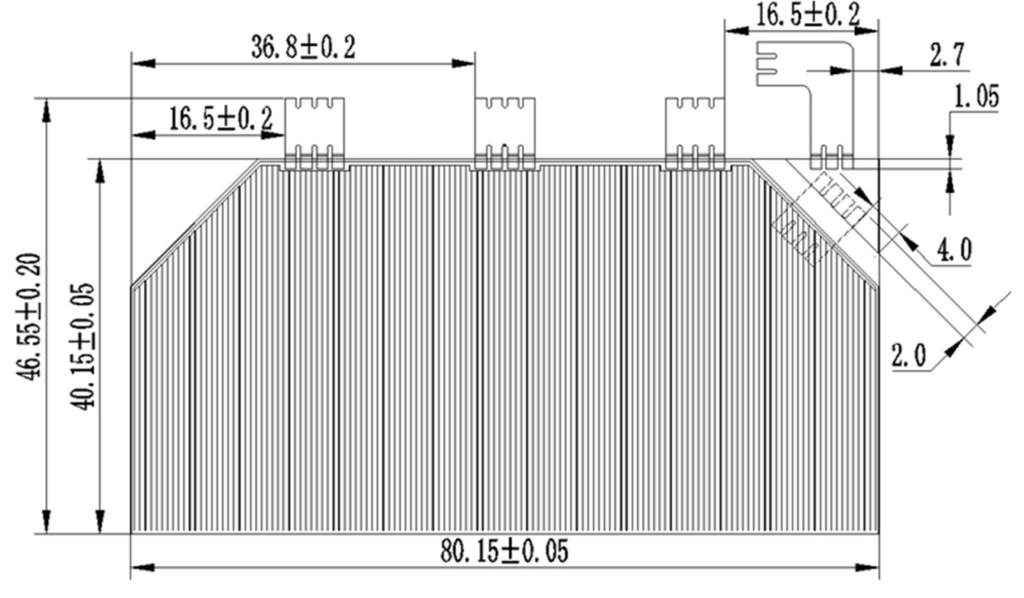
A premium, high-efficiency triple-junction GaAs solar cell designed for space missions, offering 32% efficiency at BOL and robust radiation tolerance for LEO and deep space applications.
Typed specifications23 values
Discloses 4 of 7 fields engineers filter by in this category (category median 2).
- Mass
- 2.4 g nom. · datasheet p.2 2.4 g bare cell, 2.40+/-0.35 g | 2.4 g
- Output power (BOL)
- 1.33 W product page
- Cell efficiency
- 32 % datasheet p.2 32 % average, AM0, 1 sun, 1353 W/m2, 25 C
- Envelope (L×W×H)
- (80.0±0.1)×(40.0±0.1)×(0.155±0.020) datasheet p.2 80.0 x 40.0 x 0.155 bare cell, +/-0.1 / +/-0.1 / +/-0.020 mm | 40.15 x 80.15 solar cell assembly (CIC), +/-0.05 mm
- Supply voltage
- 2.67 V product page
- Power consumption
- 1.33 W product page
- Array configuration
- solar cell assembly (CIC) Cover Glass Integrated Cell, CIC-3GA-4 · datasheet p.1
- Cell type
- triple-junction GaAs n/p triple-junction GaInP2/GaAs/Ge on Ge substrate · datasheet p.2
- Cell part number
- SC-3GA-4 (CIC-3GA-4) datasheet p.1
- Open-circuit voltage at the panel output (Voc)
- 2.68 V average open circuit voltage of one cell · datasheet p.2
- Short-circuit current (Isc)
- 0.58 A average short circuit current of one cell · datasheet p.2
- Cell area
- 30.15 cm² datasheet p.2
- Coverglass thickness
- 120 µm QIOPTIQ CMX, 120+/-20 um · datasheet p.3
- Panel thickness
- 0.36 mm CIC thickness, +/-0.01 mm · datasheet p.3
- Bypass diodes
- per cell discrete Si bypass diode on the assembly · datasheet p.3
- Power temperature coefficient
- -6.6 %/°C Voc coefficient, 1 MeV 5e14 e/cm2, 15-75 C · datasheet p.4 -6.2 %/°C Voc coefficient, BOL, 15-75 C
- Degradation over life
- 18 % max · electro irradiation, 1 MeV, 1e15 e/cm2 · datasheet p.2
Each value is typed with its unit and measurement condition and cites the datasheet page it was taken from. Nothing is guessed: a field that is absent here has not been published by the manufacturer. machine-extracted ✓ checked by NewSpace Market ✓ manufacturer confirmed by the manufacturer.
As published by the supplier17 lines, in the manufacturer's own wording
- Efficiency at BOL
- 32%
- Open circuit voltage (Voc)
- 2.666 V
- Maximum power (Pmax)
- 1.331 W
- Efficiency (AM0 spectrum, 25°C)
- 32.63%
- Radiation tolerance
- Maintains efficiency after exposure to high radiation levels
- Temperature stability
- Optimized for a wide range of temperatures
- PN junction structure
- n/p triple-junction, GaInP2/Gassing/Ge
- Top electrode
- AuGeNi/Au/Ag/Au
- Bottom electrode
- Pd/Ag/Au
- Antireflection film
- TiOx/Al2O3
- Bypass diode
- External bypass diode
- Area
- 30.15 cm2
- Weight
- 2.40±0.35 g
- Short Circuit Isc
- 580 mA
- Fill Factor
- 0.855
- Absorptance
- ≤0.92
- Emittance
- 0.84±0.03
About
The 32% Efficiency Triple Junction GaAs Solar Cell is a premium, high-efficiency solar cell engineered for space missions demanding robust and reliable energy sources. Its advanced triple-junction design, incorporating GaInP/InGaAs/Ge layers, is optimized to capture a broad spectrum of solar wavelengths, thereby maximizing power generation for satellites and spacecraft. With an impressive 32% efficiency at the beginning of life (BOL), this solar cell delivers superior performance and radiation tolerance, making it an ideal choice for both low-Earth orbit (LEO) and deep space missions. Key features include high efficiency (32% at BOL), triple junction technology for optimized energy capture across different wavelengths, and robust radiation resistance to maintain significant efficiency after prolonged exposure to the harsh space radiation environment. Its lightweight and compact design further enhances its suitability for satellites and spacecraft with strict weight limitations. The solar cell is specifically engineered to withstand high doses of radiation typically encountered in space, retaining a significant portion of its efficiency even after intense radiation exposure, ensuring its suitability for long-duration missions. It also boasts excellent temperature stability, optimized for a wide range of temperatures to enable stable operation in extreme space environments.
Documentation
Need the full ICD, test reports or a specific revision? Ask the supplier directly.