Photomultiplier Tube 1
 Glavkosmos
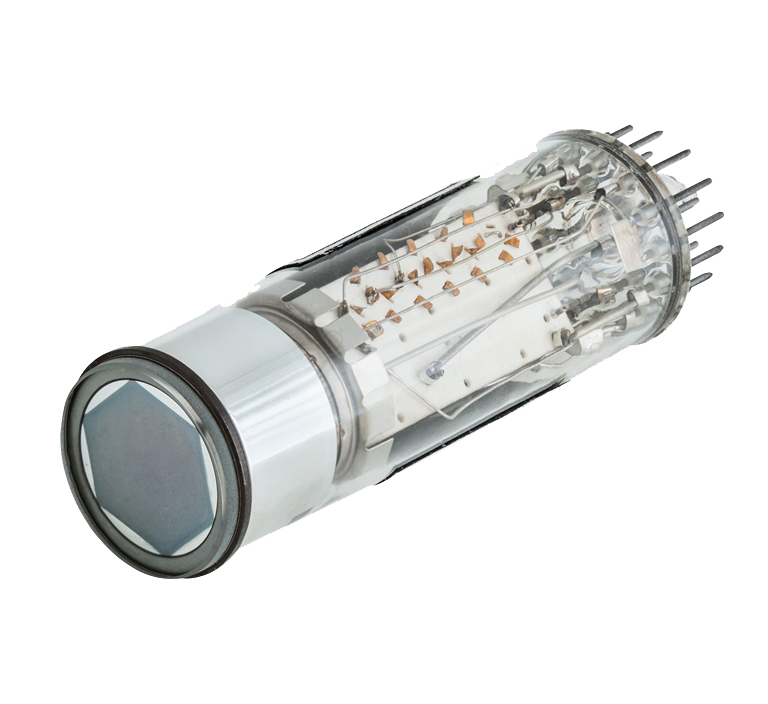
A photomultiplier tube for registering pulse signals in the visible and near-infrared ranges, used in multispectral research instrumentation.
Key figurescomparable across the catalogue
- Design life
- 4 years
- Lead time
- 3 months
Normalised to common units so this product can be compared with others in its category. The supplier's own wording is below.
As published by the supplier
- Purpose
- Registration of pulse signals within visible and near IR ranges for multispectral research
- Year of release
- 2005
- Design life
- 4 years
- Lead time
- 3 months
- Flight qualification of the product
- No
- Possibility to adapt the product to customer requirements
- Yes
- Photocathode diameter
- 10 mm
- Device diameter
- 22 mm
- Length
- 67 mm
- Spectral response
- 260 ÷ 750 nm
- Photocathode luminous sensitivity
- ≥80 μA/lm
- Dark current
- ≤5 nA
- Nominal supply voltage at anode luminous sensitivity of 100 a/lm
- ≤2200 V
- Pulse rise time
- ≤1.5 ns
- Photocathode
- SbKNaCs
About
Photomultiplier Tube 1 is a detector device intended for the registration of pulse signals within the visible and near-infrared spectral ranges for multispectral research applications. It uses an SbKNaCs photocathode and provides a spectral response spanning 260 to 750 nm. The device offers a photocathode luminous sensitivity of at least 80 μA/lm, low dark current (≤5 nA), and a fast pulse rise time of no more than 1.5 ns, making it suitable for precise pulse-signal detection tasks. It operates at a nominal anode supply voltage of up to 2200 V corresponding to an anode luminous sensitivity of 100 A/lm. The device is compact, with a photocathode diameter of 10 mm, an overall device diameter of 22 mm, and a length of 67 mm. It can be adapted to customer requirements. Related variants PMT-186 and PMT-186-1 also use the SbKNaCs photocathode with a linear 14-dynode multiplication system; PMT-186-1 additionally includes two pre-photocathode grids before the first dynode, enabling operation in a controlled mode. The product was first released in 2005, has a guaranteed service life of 4 years, and an estimated production/delivery time of 3 months. It is not flight-qualified.
Documentation
No public datasheet yet — request the datasheet / ICD from the supplier.