Radiation Hard Photomultiplier of High Immunity to Magnetic Fields 1 (PMT-187)
 Glavkosmos
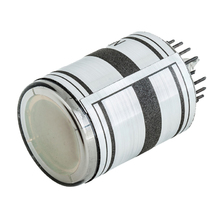
A radiation-hard photomultiplier tube (PMT-187) designed for scintillation counting in high-energy physics systems that must operate under simultaneous exposure to strong magnetic fields, radioactive fields, and elementary particles.
Key figurescomparable across the catalogue
- Design life
- 4 years
- Lead time
- 3 months
Normalised to common units so this product can be compared with others in its category. The supplier's own wording is below.
As published by the supplier
- Purpose
- Scintillation counting in high-energy physics. Systems working under simultaneous exposure of strong magnetic and radioactive fields and elementary particles.
- Year of release
- 1998
- Design life
- 4 years
- Lead time
- 3 months
- Flight qualification of the product
- No
- Possibility to adapt the product to customer requirements
- Yes
- Photocathode diameter
- 17.5 mm
- Device diameter
- 25.8 mm
- Length
- 55 mm
- Spectral response
- 220 ÷ 650 nm
- Photocathode luminous sensitivity
- 60 μA/lm
- Dark current
- 1·10-8 nA
- Supply voltage at anode luminous sensitivity of 30 a/lm
- 1800 V
- Pulse rise time
- 1.4 ns
- Photocathode
- SbKCs
- Gain under magnetic field of h=0,5t
- 2·105
About
The Radiation Hard Photomultiplier of High Immunity to Magnetic Fields 1 (PMT-187) is used for scintillation counting in high-energy physics applications, specifically in systems that work under simultaneous exposure to strong magnetic and radioactive fields and elementary particles. First released in 1998, the device has a guaranteed service life of 4 years and an estimated production/delivery time of 3 months. It is not flight qualified, but the product can be adapted to customer requirements. PMT-187 features a bialkali (SbKCs) photocathode and a 15-cascade secondary-electronic amplifier with mesh dynodes. The input window is made of boron-silicate UV glass, and the first dynode is of the ‘proximity’ type. Key technical parameters include a photocathode diameter of 17.5 mm, an overall device diameter of 25.8 mm, and a length of 55 mm. Its spectral response spans 220 to 650 nm, with a photocathode luminous sensitivity of 60 μA/lm and a very low dark current of 1·10-8 nA. At a supply voltage giving an anode luminous sensitivity of 30 A/lm, the anode voltage is 1800 V, with a pulse rise time of 1.4 ns. Under a magnetic field of H=0.5T, the gain is 2·10^5, reflecting the device’s high immunity to magnetic field interference while maintaining performance in radiation-rich environments.
Documentation
No public datasheet yet — request the datasheet / ICD from the supplier.